Editor’s Note
**Editor’s Note:** Watches of Switzerland is exploring a move to go private, with CEO Brian Duffy reportedly engaging in talks after concluding the stock market undervalues the company. While no formal offer has been made, the discussions signal growing frustration with public market valuation.
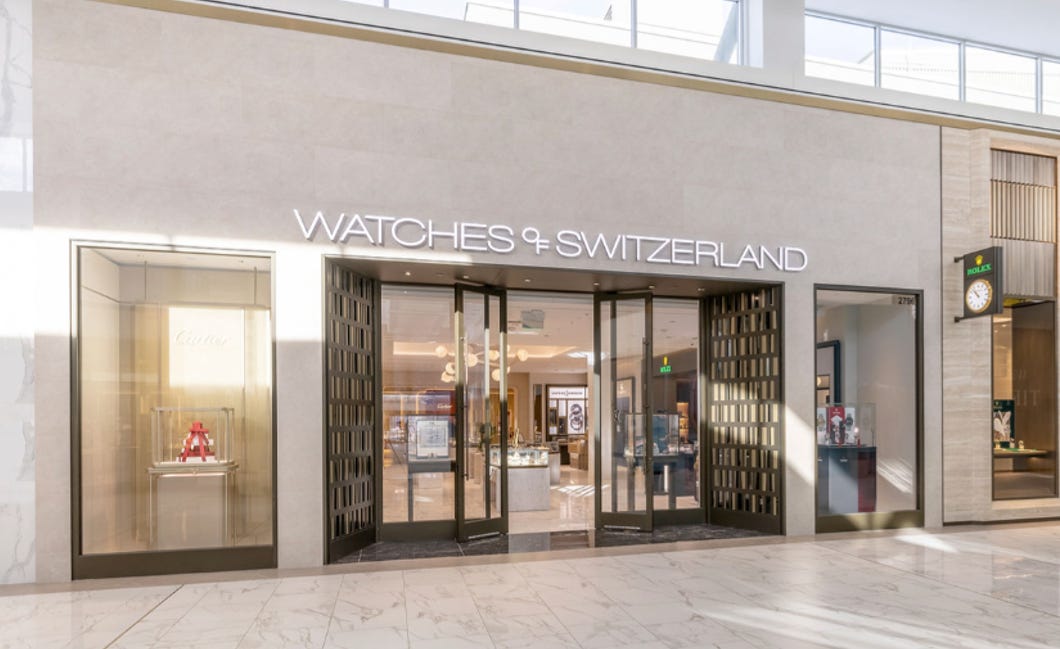
Watches of Switzerland has held talks to take the retailer private, reported Reuters, citing “three sources close to the matter.”
It added that “no formal offer has been made.” But the report made the company’s shares soar on the London Stock Exchange. Duffy declined to comment on the report on the earnings call held earlier today.
The report comes as the retailer announced solid financial results for fiscal 2026, with group revenue increasing 13% on a constant currency basis, with U.S. revenue increasing 24% and U.K. revenue rising 5%. Watches of Switzerland Group owns the Mayors brand in the United States, the North American operations of jewelry brand Roberto Coin, jewelry publication Hodinkee, pre-owned specialist dealer Analog: Shift, and retail brands Mappin & Webb and Goldsmiths.
Kristina Buckley Kayal, the managing director and chief marketing officer for the Natural Diamond Council’s North American division and leading public face for the group, has left the NDC after seven years, The Jewelry Wire has learned. No replacement has been announced.
The World Federation of Diamond Bourses has chosen Mehul Shah, vice president of the Bharat Diamond Bourse, as its new president, following a rare contested election. Shah beat back bids from Ahmed bin Sulayem, president of the Dubai Diamond Exchange, and Lin Qiang, president of the Shanghai Diamond Exchange. Shah takes over from Yoram Dvash, who served two three-year terms as the group’s leader. The WFDB also chose two new vice presidents: Philippe Barasmian, vice president of the Diamantclub van Antwerp, and Luigi Cosma, president of the Italian Diamond Exchange. Molefi Letsiki, chairman of Diamond Dealers Club of South Africa, was selected treasurer.
Lucara Diamond Corp. has discovered a 1,305.4 ct. diamond from its 100%-owned Karowe Diamond Mine in Botswana. The stone is the tenth diamond topping 1,000 carats Lucara has recovered since it took over the mine in 2012. The recently recovered stone is categorized as white and is unbroken. The stone measures 79.9mm x 34.1mm x 51.9mm in size.
Today’s jewelry links cover Pandora, Rolex, Nordstrom, De Beers, Citizen Watch, Debswana, PNJ, the London Bullion Market Association, DMCC, Ohio Silver Company, Brooke Bobb, Stephanie Gottlieb, Jean Arnault, Zendaya, and Princess Kate.
Company news: Does PNJ face legal implications from arrest of lab director? (VietnamNet)
Diamond news: Dubai diamond trade hits record $41.7 billion after 14 years (Gulf News); Was there a political dimension to Venetia closure? (Currency); Venetia shutdown could cost 4,000 jobs (EWN); Q&A with Stephanie Gottlieb on her selling lab-grown (JCK); Debswana plans to export its mining expertise (Business Weekly)
Fashion and design news: Pandora’s “slightly odd” charms will bring smile to your face (The Cut; subscription)
Gold news: Allegations of killing and torture at African gold mine sparks lawsuit against London Bullion Market Association (Leigh Day)
People news: Nordstrom names fashion journalist Brooke Bobb vice president and fashion director (WWD); Jean Arnault firing executives of LVMH watches (Miss Tweed)
Retail news: Dayton-area retailer Ohio Silver Company closing after 52-year run (WDTN)
Watch news: Why have Rolex prices doubled? (WatchPro); Citizen smashes sales and profits records in the UK (WatchPro)
Miscellaneous: Princess Kate is building a Diana-style gemstone legacy (Marie Claire); Zendaya and the earrings with a 3,000-year history (Lost in Jewels)