Editor’s Note
**Editor’s Note:** This article explores the Krayon Anywhere Parhelion, a new gem-set timepiece that elevates the brand’s signature complication into a celebration of light, inspired by the Arctic parhelion phenomenon.
The New Krayon Anywhere Parhelion, A Gem-Set Celebration of Light
Inspired by the Arctic phenomenon of the parhelion, Krayon transforms its Anywhere complication into a highly elaborate artistic creation.
calendar
Created with Sketch.
11 hours ago
|
ic_dehaze_black_24px
Created with Sketch.
By Denis Peshkov
|
ic_query_builder_black_24px
Created with Sketch.
3 min read
|
The Krayon Anywhere was introduced in 2020 and, since then, stands apart from virtually every other astronomical watch. A more straightforward version of the Everywhere, it can be configured for any location on Earth, displaying the exact times of sunrise and sunset for its owner, and it remains one of the most original complications in contemporary independent watchmaking. The brand has explored the idea through a series of increasingly artistic editions, such as the colourful Métiers d’Art interpretations, the Anywhere Arborea, and the instantly recognisable Anywhere Métiers d’Art Azur, not to forget the quite unexpected Pac-Man-inspired piece. Now the Geneva-based independent presents the new, gem-set Anywhere Parhelion, inspired by a trip to Greenland, where Krayon founder Rémi Maillat and photographer Fei Hou witnessed the rare atmospheric phenomenon that provides this version its name.
When sunlight passes through hexagonal ice crystals in high cold clouds, it produces luminous reflections that appear alongside the sun. The parhelion effect, together with Greenland’s shifting landscape of snow, ice and deep blue water, inspired the colours of this latest edition.
Ad – Scroll to continue with article
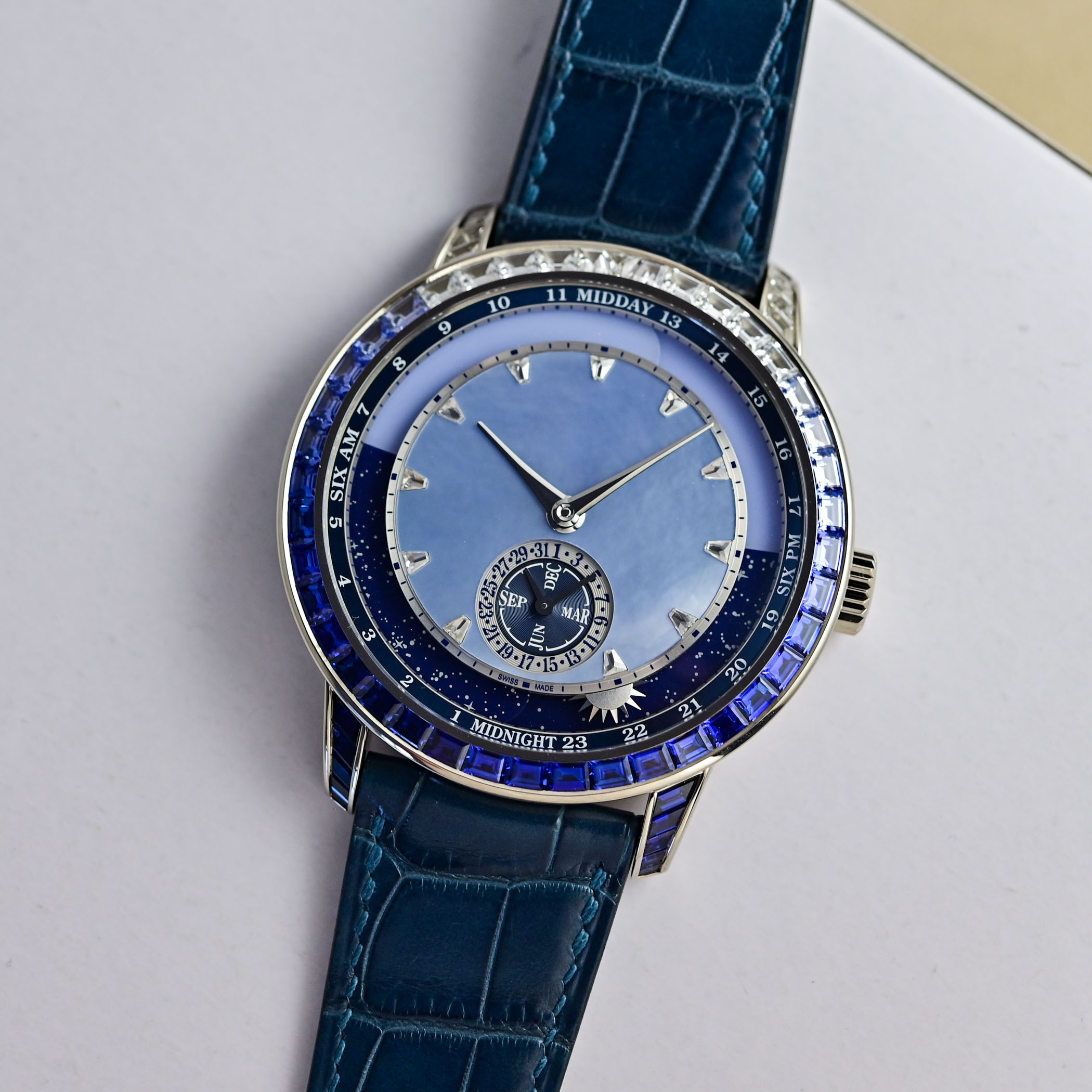
Mechanically identical to previous Anywhere models, Parhelion introduces a new visual language centred around gemstones. The familiar 42mm case is now crafted from white 18k gold containing a high proportion of palladium, cutting out the need for rhodium plating while offering a bright, permanent white finish. Measuring 9.5mm thick, the elegantly proportioned case remains restrained, with sapphire crystals on the front and back and a 30m water-resistance rating.
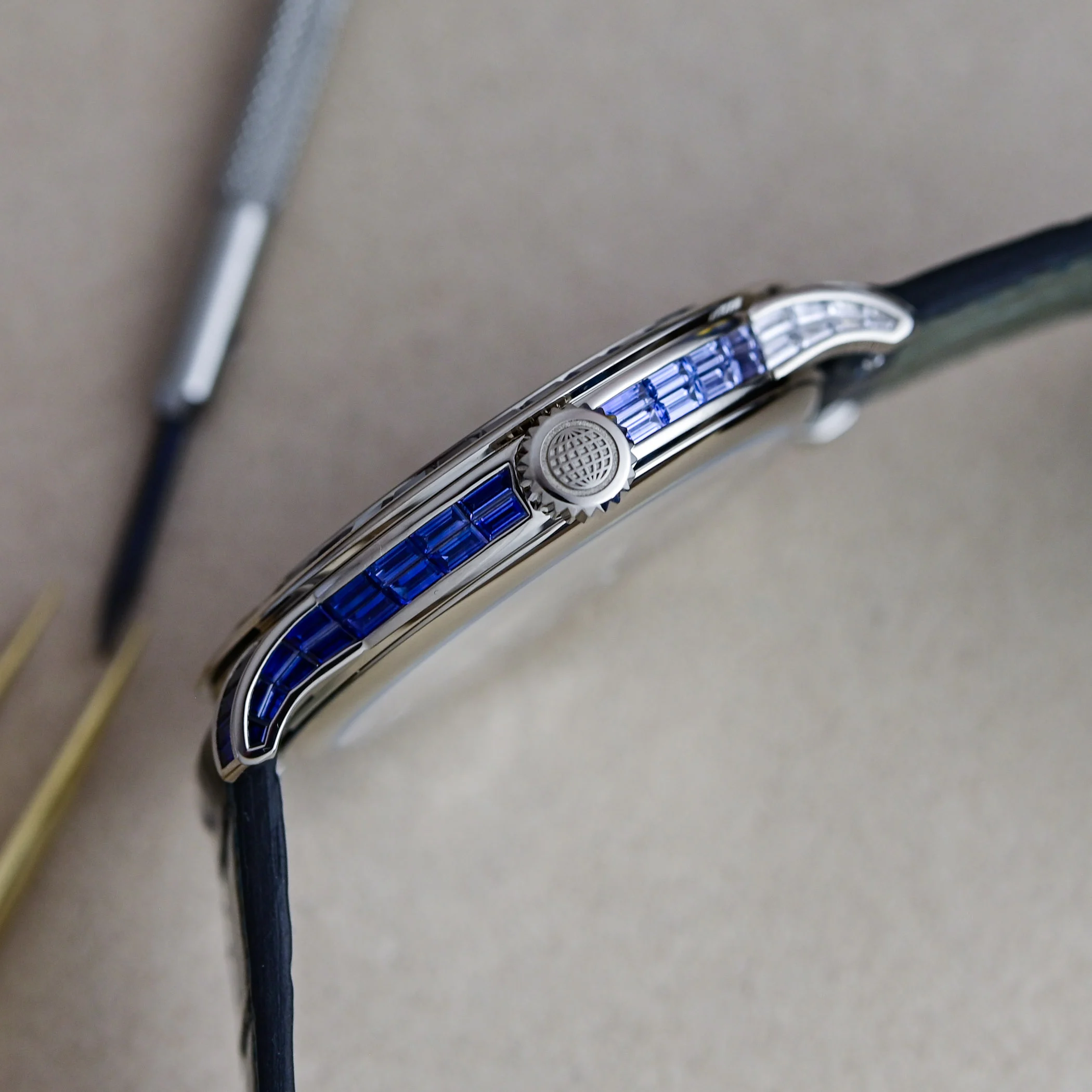
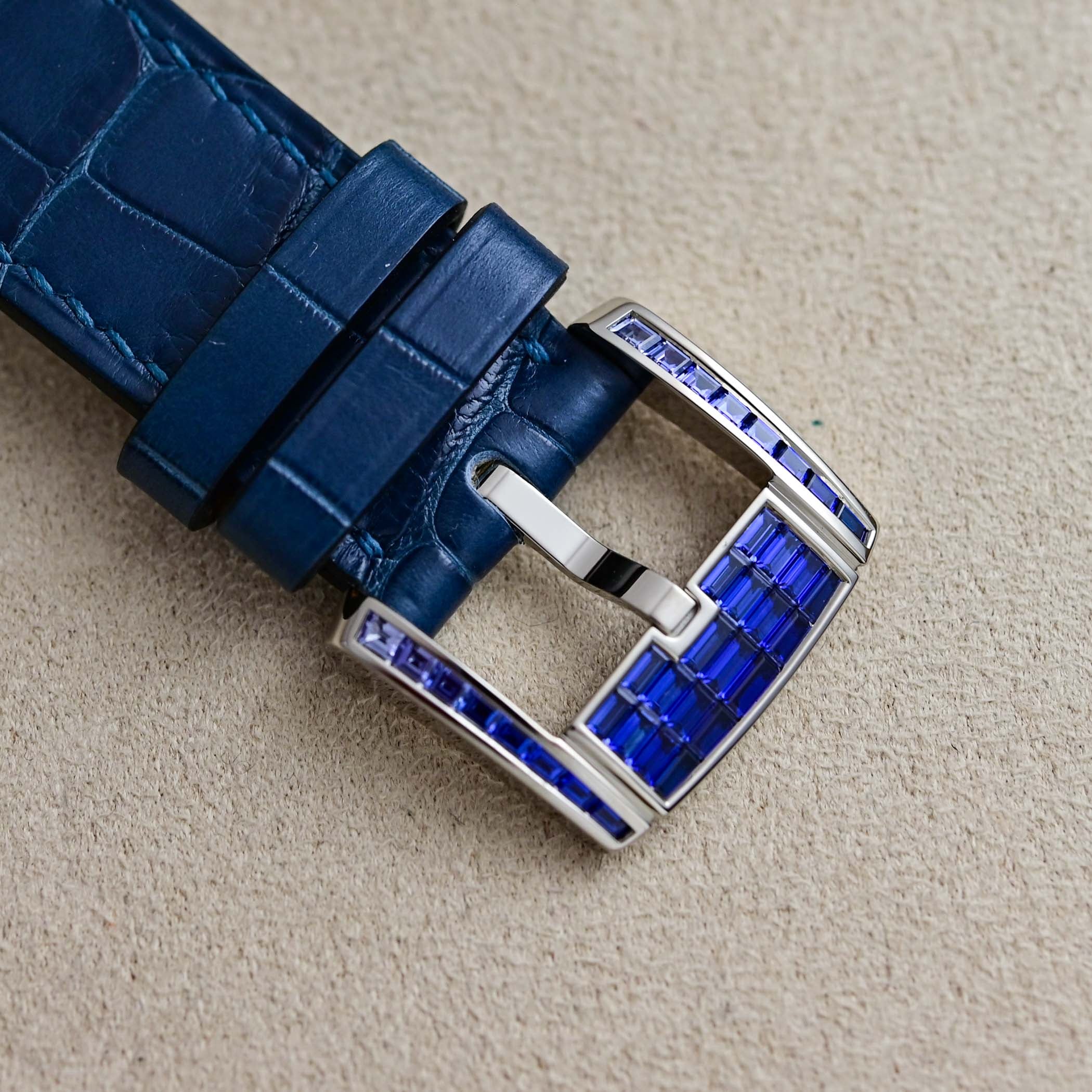
The transformation comes through the extensive gem-setting. A total of 171 gemstones decorate the watch, including 124 baguette-cut sapphires flowing across the bezel, case middle, lugs and crown side, with 35 matching sapphires on the white gold pin buckle. Krayon chose to create a carefully selected gradient that progresses from white through multiple shades of pale blue to deep midnight blue. According to the brand, sourcing stones capable of producing this seamless transition required almost a full year.
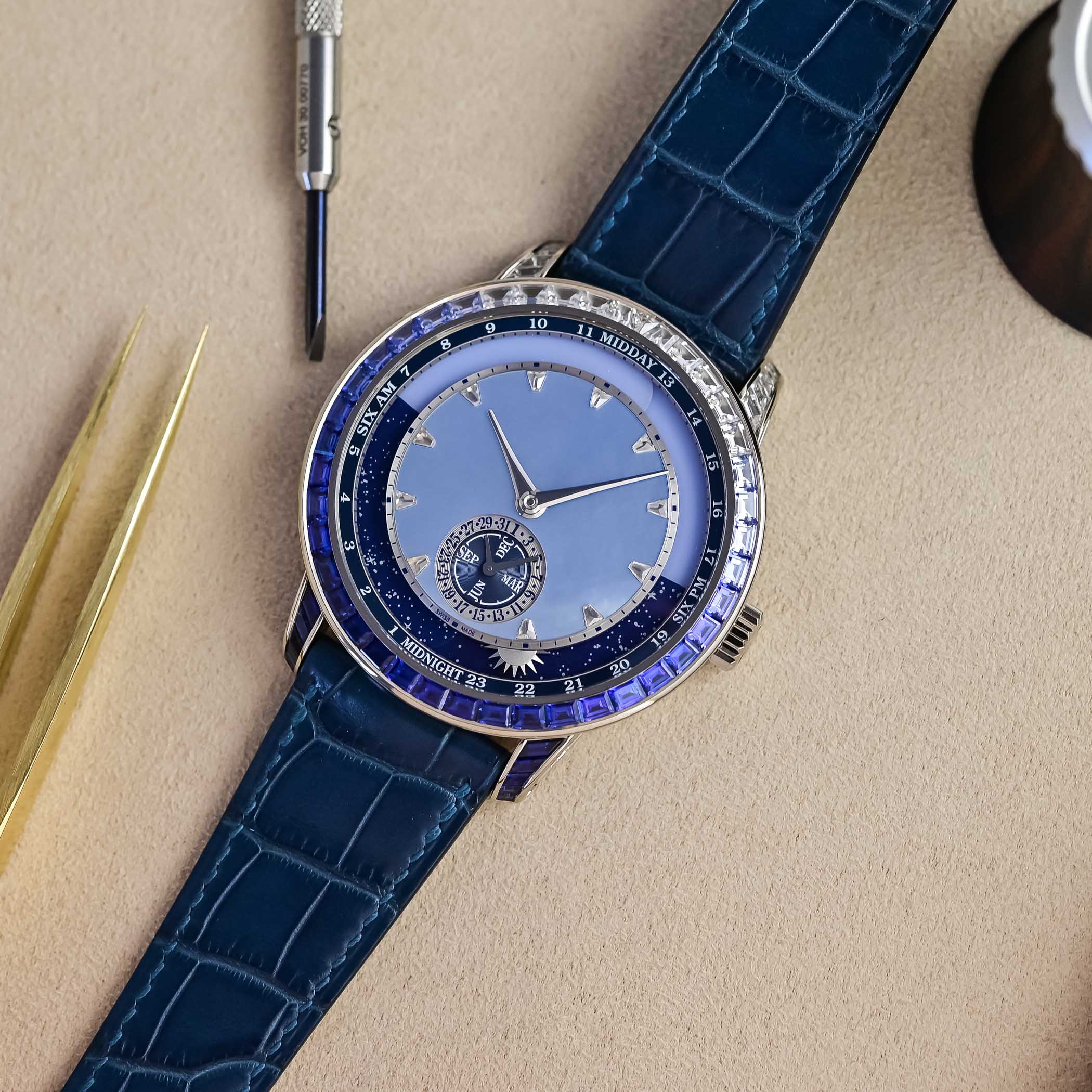
Parhelion also debuts a new signature gemstone shape developed specifically for Krayon. Known as the Krayon Cut, its Y-shaped geometry echoes the brand’s logo. A single white sapphire at 12 o’clock on the bezel introduces this distinctive cut, symbolising the brightest point of the parhelion.
The dial’s centre is crafted from mother-of-pearl, chosen for its constantly changing reflections that evoke Greenland’s icy waters. Eleven white diamond hour markers employ the new Krayon Cut and are mounted using an invisible setting that creates the illusion they are floating above the dial. Around the periphery we see the sunrise and sunset displays, together with the rotating 24-hour scale and date indication at 6 o’clock. The inscriptions “MIDDAY”, “MIDNIGHT”, “SIX AM” and “SIX PM” retain Krayon’s distinctive typography.
The in-house calibre C030, as seen on the Aurora edition
The new Krayon Anywhere Parhelion is worn on a dark blue alligator leather strap secured by a white gold pin buckle adorned with the same graduating sapphire setting as the case. The watch is not limited and is priced at CHF 430,000. For more information, visit krayon.ch.
Case: 42mm diameter x 9.5mm thickness – naturally white 18k gold alloy with high palladium content – 124 baguette-cut gradient blue sapphires plus one Krayon Cut white sapphire – sapphire crystals front and back – 30m water resistance
Dial: mother-of-pearl centre – sunrise and sunset displays – 24-hour indication – 11 invisible-set Krayon Cut diamond hour markers – date and month
Movement: calibre C030 – in-house hand-wound – 35.4mm x 5mm – 432 components – 55 jewels – 21,600vph – 72-hour power reserve – hours, minutes, sunrise, sunset, 24-hour display, date and month
Strap: dark blue alligator leather – white gold pin buckle set with 35 baguette-cut blue sapphires
Availability: Not limited
Price: CHF 430,000