
Editor’s Note
**Editor’s Note:** The U.S. Attorney’s office has charged the co-owners of Surya International, a California jewelry importer, with falsely declaring the origin of gold jewelry to evade customs duties. Raj Kohli and Veena Kohli face charges in Chicago federal court.
The U.S. Attorney’s office has charged the co-owners of a California jewelry company for falsely declaring the origin of their items so they could evade customs duties:
Raj Kohli and Veena Kohli, who operate Surya International, a gold jewelry importer and wholesaler in South San Francisco, were charged in U.S. District Court in Chicago with falsely declaring that the gold jewelry they imported into the United States had originated in Singapore and not its true country of origin—India and United Arab Emirates.
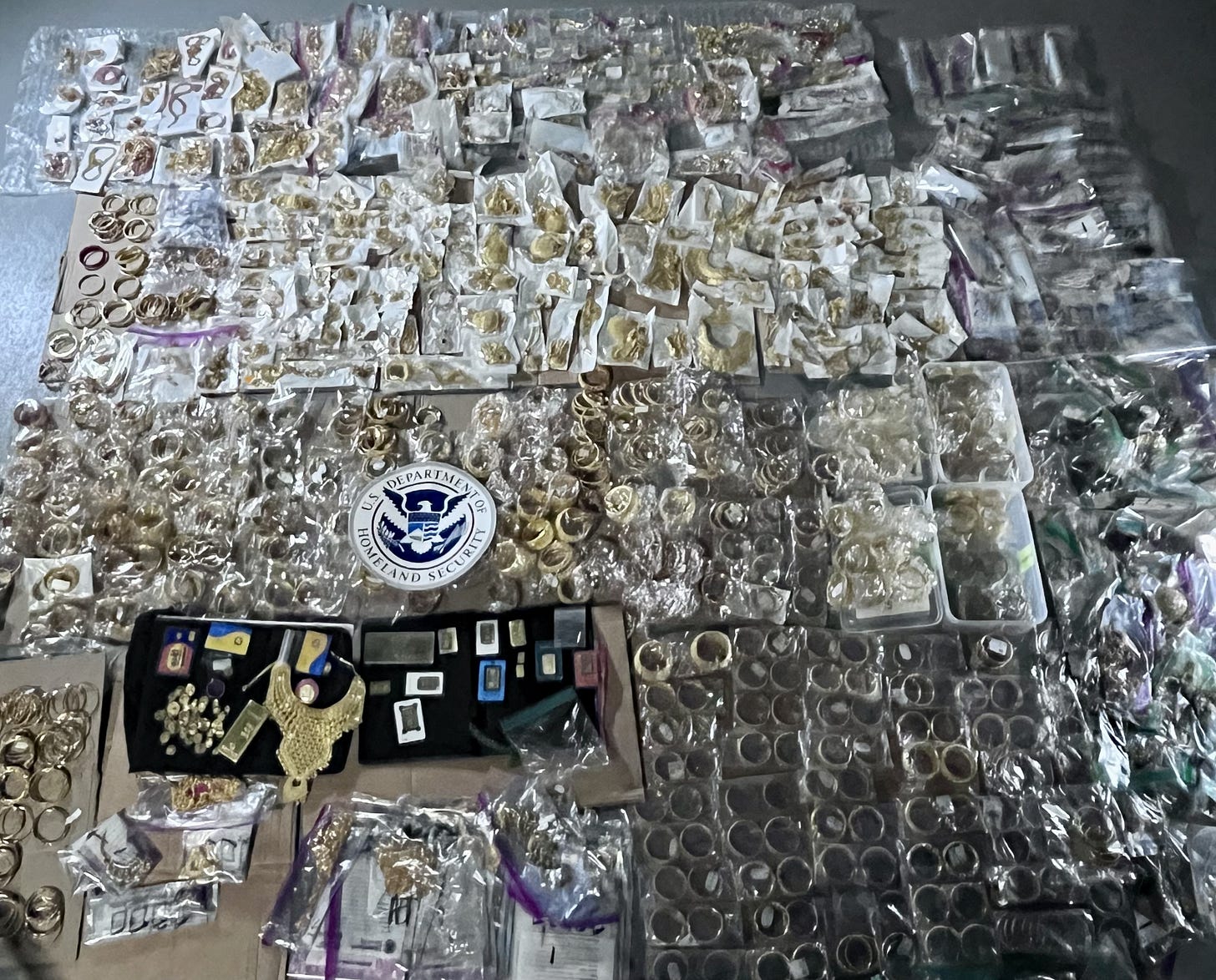
The charges allege that from approximately August 2020 through May 2024, the company, together with foreign manufacturers and other United States entities, imported and brought into the United States approximately 563 separate entries of gold jewelry that were falsely declared as having been manufactured in Singapore and in doing so avoided paying customs duties of between 5.5% and 5.8% of the declared value of the imported gold jewelry. The gold jewelry had an estimated total value of more than approximately $693 million, thus causing the avoidance of more than approximately $38 million in United States customs duties.
And that’s not the only recent case of this type:
Narain Gulabani, who owned and operated Barkha Wholesale, Inc., a gold jewelry importer and wholesaler in Naperville, Illinois, was charged in U.S. District Court in Chicago with falsely declaring the country of origin for imported gold jewelry.
The charges allege that, from approximately May 2016 and October 2021, Gulabani, together with foreign manufacturers and other United States entities, imported or caused to be imported into the United States approximately 242 separate entries of gold jewelry that were falsely declared as having been manufactured in Oman or Singapore and in doing so avoided paying customs duties of between 5.5% and 5.8% of the declared value of the imported gold jewelry. The gold jewelry had an estimated total value of more than approximately $240 million, thus causing the avoidance of more than approximately $13.6 million in United States customs duties.
Jewelry seized by law enforcement. Courtesy: U.S. government
Last year, UBS Gold was charged with evading tariffs and duties. Trade lawyer and former Justice Department official Joshua Kurland told me at the time we should expect to see more cases like this:
Richemont’s jewelry division was once again the conglomerate’s best-performing division in its latest quarter, with sales rising 24% year-over-year at constant exchange rates (21% at actual rates), with sales to the Americas rising 25%—its best-performing market.
Sales at specialist watchmakers rose 8%.
Richemont’s four jewelry brands are Buccellati, Cartier, Van Cleef & Arpels, and Vhernier.
The U.S. Bankruptcy Court for the Southern District of Texas has approved the pre-arranged plan QVC and its lenders worked out before it went Chapter 11 in April.
Says the home shopping channel’s statement:
Gary Roskin cautions jewelers that fracture-filling is not just a problem for emeralds:
The Jewelry Wire initially misspelled Kristina Buckley Kayel’s name in a story about her departure as managing director and chief marketing officer for the Natural Diamond Council’s North American division. Kayel adds:

She can be reached at [email protected].