Editor’s Note
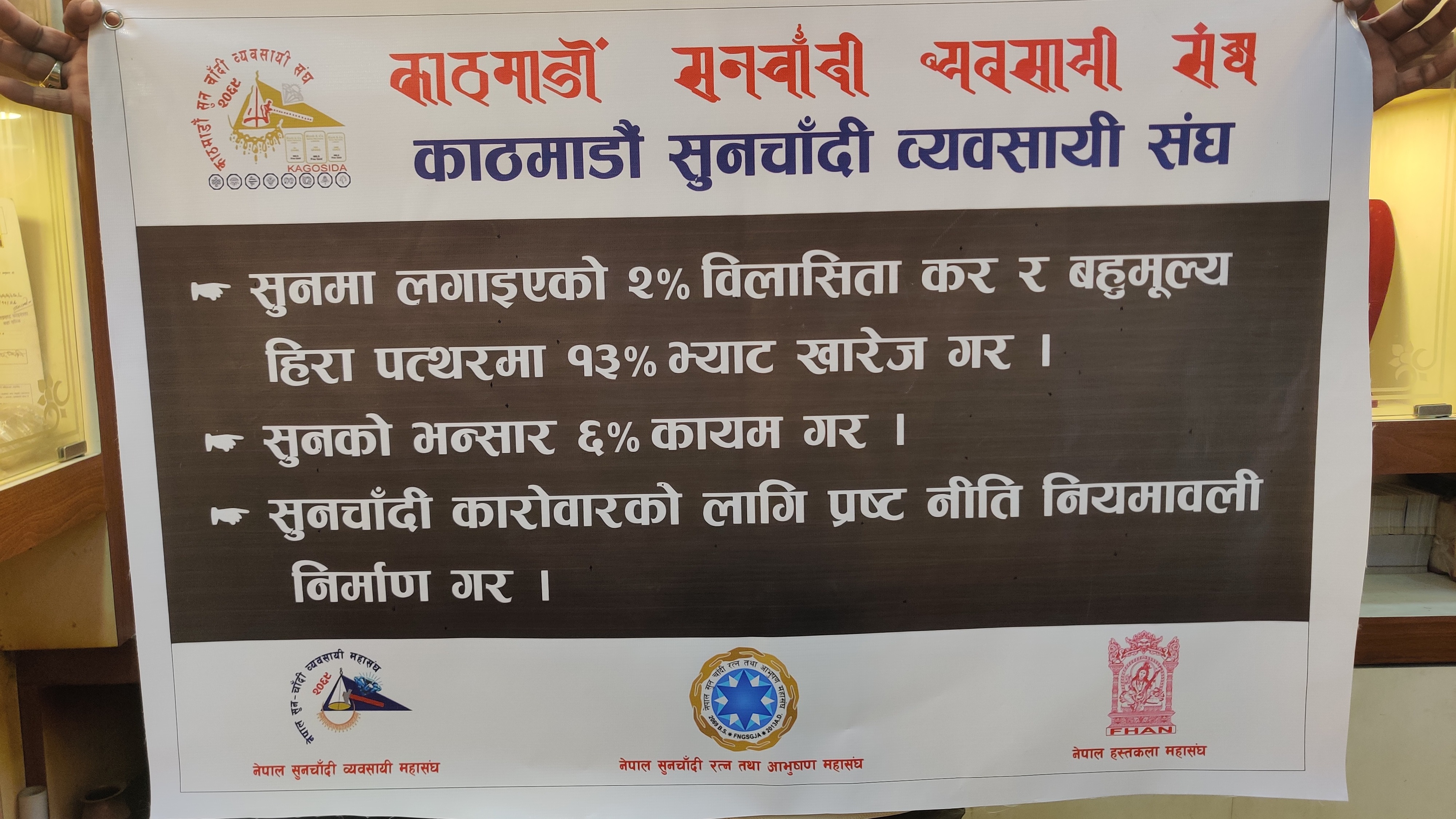
**Editor’s Note:** This article examines the impact of the new 2% luxury tax and 13% VAT on stone-set gold and silver jewelry, introduced in the 2082/083 budget. With small businesses and artisans already strained by high gold prices and existing customs duties, the policy has sparked widespread concern across the sector.
This concern addresses the recently implemented government policy in the 2082/083 budget, which imposes an additional 2% luxury tax on all consumers and 13% VAT on gold and silver jewelry set with stones. This decision has caused significant distress among small business owners, artisans, workers, and traders—many of whom are already struggling with rising gold market prices.
Currently, there is already a 10% customs duty on imported gold. Last year, under the 2081/082 budget, the government raised this duty to 15–16%, which was widely protested by business owners and relevant authorities. The rate was later reduced to 10% due to public pressure. However, this is still higher than India’s 6% customs duty, creating an imbalance and encouraging smuggling.
Now, in addition to the existing customs duty, the government has decided to implement a 2% luxury tax on all gold and silver ornaments, and 13% VAT on jewelry embedded with stones. This has further burdened an already fragile industry.

In protest, business owners and stakeholders across Nepal held a week-long general strike from Jestha 29 to Asar 4. Despite promises from PM Oli during this period, the government has refused to withdraw the policy and is moving forward with implementation.
As a result, businesses are now preparing for an indefinite shutdown starting Asar 13, with a protest rally beginning at 11 AM from New Road Gate.
Such taxation not only threatens the survival of traditional, often family-run, jewelry businesses—it also unfairly impacts ordinary consumers. The luxury tax is an indirect tax, meaning the burden falls on consumers, not just business owners. With gold prices already extremely high, this policy may shut down many businesses permanently due to a significant drop in demand.
While the government’s intention may be to control illegal gold imports, this is not the right solution. There are other, more effective ways to regulate the market. One key solution is to reduce the customs duty to between 2% and 6%, which would bring it in line with India’s tax structure and discourage illegal imports.
Additionally, new rules prohibit the reuse of old gold jewelry to make new pieces. Consumers must now sell old gold to businesses, incurring a 6–8% loss in value due to taxation. This is deeply unfair to the general public and further discourages legitimate transactions.
I strongly urge the concerned authorities to reconsider this policy, engage in meaningful consultation with stakeholders in the jewelry industry, and explore fairer alternatives that do not harm small entrepreneurs, workers, or the economy at large.