Editor’s Note
Sri Lanka’s gem and jewellery sector faces continued pressure from high gold import taxes tied to IMF regulations, with no immediate relief in sight. However, authorities are pursuing a local gold refinery to address raw material shortages, as NGJA Chairman Prof. S. P. Chaminda highlights the challenge of balancing gold’s dual role as industrial input and financial reserve.
Sri Lanka’s gem and jewellery sector is unlikely to see immediate relief from high gold import taxes due to ongoing International Monetary Fund (IMF) regulations, but authorities are actively exploring the establishment of a local gold refinery to ease raw material shortages for the industry.
Addressing concerns raised during the official media launch of the FACETS Sri Lanka 2027 exhibition, National Gem and Jewellery Authority (NGJA) Chairman Prof. S. P. Chaminda explained that treating gold purely as an industrial raw material is complicated by its status as a financial reserve asset.
The heavy taxation on gold imports stems from the country’s recent severe foreign exchange crisis. Historically, Sri Lanka allowed relatively free gold imports, but as currency pressures mounted, the government imposed steep import duties to curb dollar outflows and prevent arbitrage. Current import and other taxes on gold sit in excess of 45 percent, a policy that effectively halted legal bullion imports and inadvertently fuelled an underground smuggling network. While these taxes helped stabilise the currency and met international regulatory requirements, they have severely disadvantaged local jewellers who struggle to compete with international hubs like Hong Kong, where raw materials flow freely without duty. Sri Lanka Gem and Jewellery Association (SLGJA) leadership acknowledged the industry’s frustration over the uncompetitive tax environment but admitted that comprehensive tax reform for gold will take time.
Beyond gold taxes, the SLGJA is pushing for broader deregulation to simplify export procedures and enhance Sri Lanka’s competitiveness as a global gem trading hub. Industry leaders at the event highlighted that continuous negotiations with the government have already yielded positive results, such as the implementation of a Value Added Tax (VAT) refund system for tourists at the airport last year. The industry remains hopeful that as macroeconomic environment stabilises, further regulatory bottlenecks, including corporate tax burdens on exporters, will be systematically dismantled to propel the sector’s growth back toward the US$1 billion export mark.
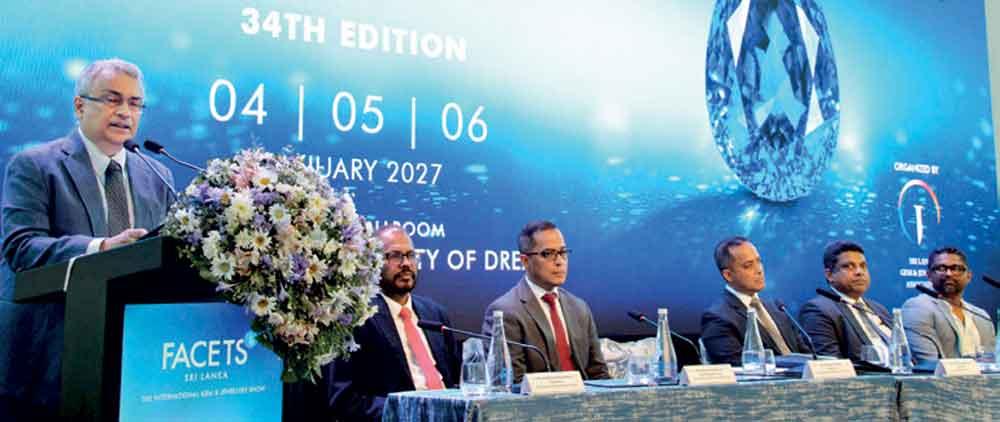
SLGJA President Akram Cassim addressing the gathering. Pic by Kithsiri de Mel. By Nishel Fernando. He noted that the government’s fiscal flexibility is currently heavily constrained by the macroeconomic parameters set under the ongoing IMF programme.
To circumvent the heavy taxation that has crippled legal gold imports, the government is evaluating a proposal to set up a local refinery. Operating as a Board of Investment (BOI) project, the facility would import secondary or mixed metals to be refined locally, providing a creative solution to current import barriers. Speaking further on the sidelines of the event, Prof. Chaminda revealed the technicalities of the proposed operation.
This facility would cater to domestic manufacturers, supply the Central Bank, and add value for re-export.