Editor’s Note
**Editor’s Note:** This piece explores how FoundRae builds jewelry around personal mythology rather than seasonal trends, creating pieces meant to be layered, symbolic, and worn into the fabric of daily life.
FoundRae has held firm to that conviction while shaping a jewelry world built less around seasonal novelty than personal mythology. Her medallions, chains and rings are gathered slowly, layered with symbols and worn until they become inseparable from the lives of their owners.
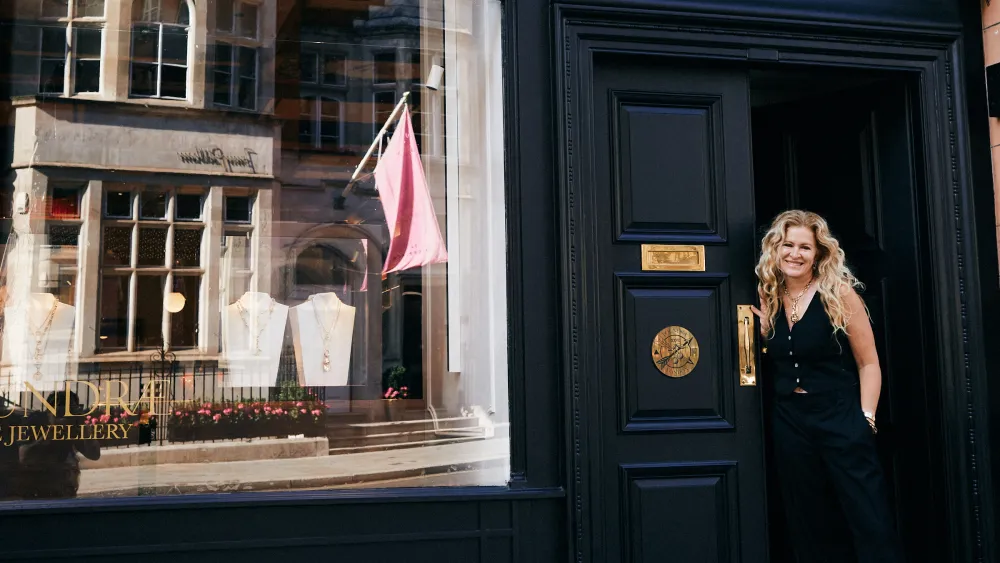
Now that richly coded universe has jumped the pond, with the company opening its first international flagship on Mount Street in London’s Mayfair district. The move brings the New York-based brand’s increasingly expansive retail expression to one of the city’s leading luxury thoroughfares, while marking a significant inflection point for its global business.
As with its U.S. boutiques, the space was designed to fit in its surroundings. The interior resembles a personal library, with shelves housing the brand’s chains, Foundation collection and 10 tenets alongside rows of books. Oversized hand-painted cards introduce the symbols embedded throughout the FoundRae lexicon, making its more cerebral codes visible from the street before a visitor discovers the jewelry itself.
Past the main salon, a garden hallway leads to the Vertu room, housing FoundRae’s home collection as well as an on-site bench jeweler and hand engraver. A separate United in Love room is devoted to commitment jewelry.

The flagship represents a crescendo of FoundRae’s existing relationship with London. It offers a clearer view of how the company is approaching retail: not as a race to accumulate doors, but as a response to sustained demand, established client relationships and a cultural affinity with the brand’s philosophy.
For Hutchens, the choice of London was as emotional as it was commercial.
That combination provides a fitting backdrop for a brand whose pieces are positioned as modern heirlooms, connecting inherited visual languages with the private narratives of their wearers. Mount Street’s architecture and quieter cadence also offer a counterpoint to London’s larger shopping corridors like Bond or Sloane streets, allowing the boutique to feel less like a conventional luxury outpost than a world entered through one of Hutchens’ considered doorways.

The boutique’s signature seal is the Double Cherry, rendered throughout the space in a bright red. Two cherries joined at the stem represent the bond of a committed love or close friendship. The motif also gathers several British references: wild cherries are native to the U.K., while the image appears in Shakespeare’s “A Midsummer Night’s Dream.”
The symbol has been translated into an 18-karat gold medallion set with cabochon garnets and pavé diamonds, available exclusively at the Mount Street store.
London is the first market where FoundRae found both the commercial demand and cultural alignment necessary for a permanent international home. Whether another city eventually meets those criteria remains open, but Hutchens is clear that any future expansion will remain deliberate.