Editor’s Note
**Editor’s Note:** Boucheron’s new high jewelry collection, “HUMAN BEING,” redefines luxury by celebrating the irreplaceable value of human connection and individuality in an increasingly artificial world.
BOUCHERON has unveiled its new high jewelry collection, “HUMAN BEING.” This collection shines a spotlight on the preciousness of humanity, exploring human connections, individuality, and differences. It embodies the Maison’s spirit of pushing beyond traditional high jewelry conventions and definitions, giving birth to an innovative collection that opens up new frontiers.
Boucheron presents two different high jewelry collections each year, in January and July. The July collection is named “Carte Blanche,” as Creative Director Claire Choisne is freed from all constraints to freely choose the theme. For Claire, “Carte Blanche” is an opportunity to redefine what is precious. In 2024, “OR BLEU” sounded an alarm about the crisis of depleting water resources. In 2025, “IMPERMANENCE” conveyed a societal message about protecting endangered nature. This year, 2026’s “HUMAN BEING” asserts that in our modern world overflowing with artificiality, what is truly precious is “humanity.”

With the newly announced “HUMAN BEING” high jewelry collection, Claire Choisne and the creative studio highlight the commonalities that connect people, as well as the individuality and differences that make each person unique. To express the answer to the question, “What do we humans have in common?”, Claire first focused on a classic form in high jewelry necklaces: a cohesive cluster necklace with gemstones set in a continuous arrangement. The collection features five jewelry sets, each consisting of a necklace and a ring. While the five pieces share a fundamental common form, each is crafted using different materials and exceptional craftsmanship. Subtle differences in volume, gemstones, and the delicate balance of light embody nuances that reflect the countless individualities of humanity.
“RAIN” evokes a fantastical scene of raindrops falling onto the skin. Its greatest appeal lies in its unparalleled transparency and the visual effect of diamonds seemingly floating in space. The material used is rock crystal, which the Maison has employed in high jewelry before. The crystal is first hollowed into a teardrop shape, then multiple layers of plant-based resin are poured inside—an extremely meticulous technique. Between these layers, over 4,800 diamonds are individually and three-dimensionally placed by hand. To prevent contamination by fine particles or air bubbles, this entire process is carried out under vacuum. To recreate the supple movement of falling rain, artisans conducted extensive research for this setting. Each part is connected by a movable white gold base, giving the entire necklace a flowing beauty. The base is also set with diamonds to visually conceal the structure, enhancing the pure brilliance of the piece.
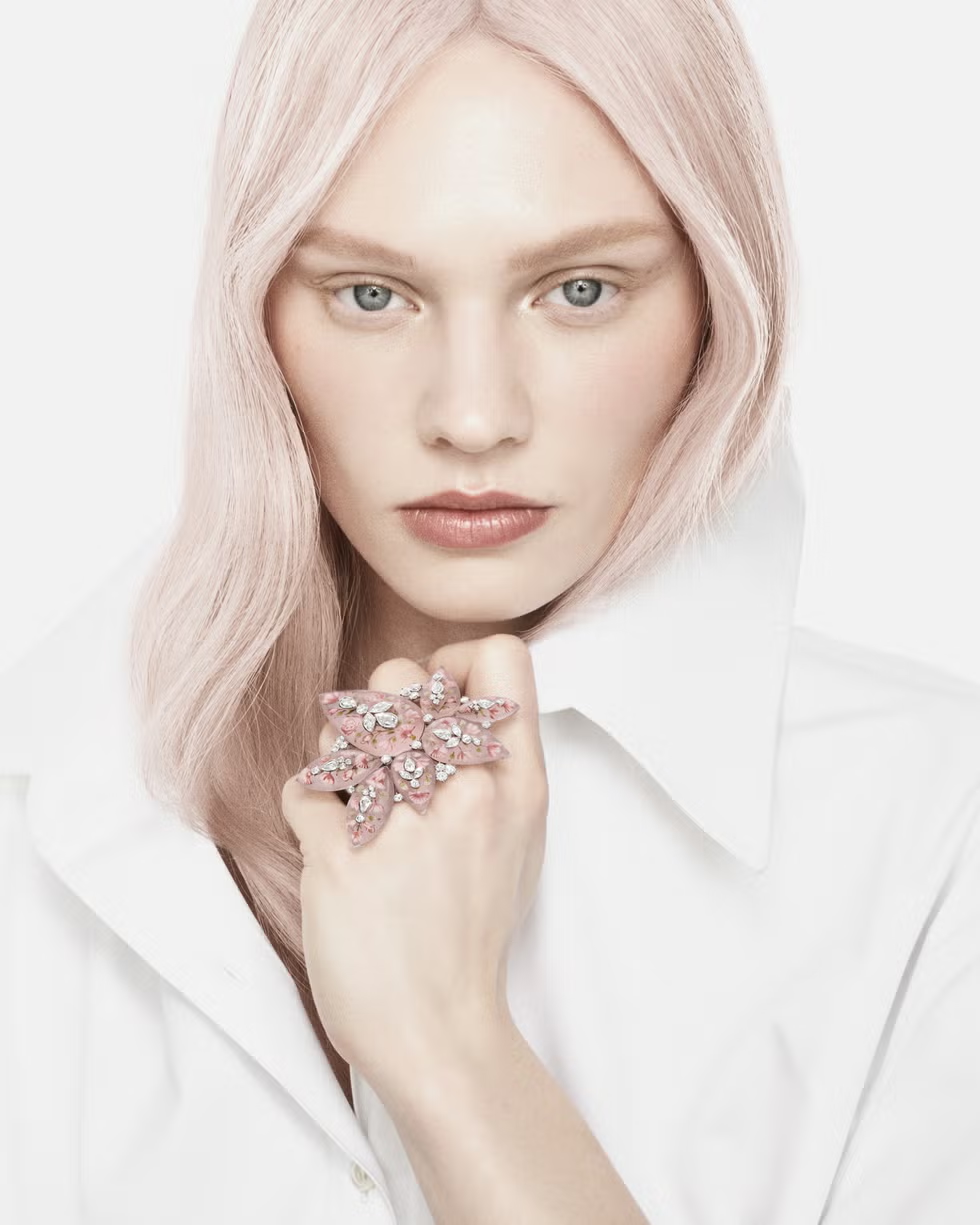
“FLOWER” portrays the stages from bud to full bloom in a symmetrical composition across the entire jewelry piece. The highlight is that small pink quartz stones were used as canvases, with miniature painters directly painting flowers onto them. Using magnifying lenses and delicate brushstrokes that skillfully manipulate light and shadow, astonishing three-dimensionality and depth were achieved within these tiny stones. It took an average of about 10 hours per stone, and over 1,200 hours for the entire necklace and ring set, to project the vivid freshness of living flowers. A varnish finish, requiring advanced craftsmanship to create a perfectly smooth surface without a single air bubble, protects this meticulous art. From the selection of ideal stones, to a structure that hides all prongs and clasps, to ceramic coating on the metal parts to match the pink quartz’s hue, the entire piece’s tone is thoroughly unified. The fantastical appearance, as if flowers are blooming directly from the stone, radiates a unique beauty born from the fusion of traditional jewelry techniques and miniature painting art.

“LIGHT” skillfully arranges morganites of various sizes and cuts, allowing light to pass freely between the stones. This piece uses over 1,500 carats of strictly selected morganite. Given the natural variations in gemstones, gathering such a large quantity with perfectly uniform color was an extremely challenging process. The main challenge in creation was the delicate nature of morganite, which is sensitive to vibration; traditional hammering methods risked damaging its internal structure. Therefore, the Maison’s artisans adopted an innovative technique: placing prongs around the stones and securing them with screws. This draws out the stone’s beauty without applying direct pressure. Furthermore, to realize Claire’s original design of placing diamonds directly on top of the morganite, the stones themselves were precisely carved, and diamonds were set into a gold frame using prong and bezel settings.
“TATTOO” is inspired by the artistic beauty of Victorian-era tattoos. It features motifs of flora and fauna long beloved by the Maison, such as poppies, roses, birds, and snakes, with some designs taken from the archives. By directly engraving the motifs onto the back of smoky quartz, the jewelry creates an elegant illusion of floating on the skin like a real tattoo. Using the ancient glyptic technique, which creates three-dimensionality through depth of carving and textural variation without color, the piece achieves a graphical finish that captures light and changes expression from moment to moment. Because quartz is extremely hard, artisans custom-ordered over 200 tools, repeatedly remaking and evolving the tools as they wore down from carving the stone. The process was particularly difficult because it was irreversible; carving a perfectly symmetrical design into a small gemstone was extremely challenging. Taking over 1,100 hours, this piece is a symbol of the Maison’s traditional savoir-faire, brought to life by the skill of master gem engravers.

“CHECKERS” fuses the houndstooth pattern, a textile design Claire particularly loves, with the texture of gemstones. As a tribute to the Maison’s roots in haute couture, the onyx is directly carved to achieve a texture resembling couture fabric. This process employs a “femtosecond laser” used in watchmaking. This extremely precise technology carves the pattern onto the onyx surface without heating it, and determining the appropriate carving depth without compromising the stone’s durability was a major challenge. In terms of design, 163 drop-shaped onyx stones were meticulously planned using CAD modeling to ensure the pattern flows smoothly and seamlessly from stone to stone. To accommodate stones of different sizes and shapes, 163 custom tools were ordered, and the curved surfaces of the drops were also intricately carved by hand. The six onyx stones at the center were hollowed out for weight reduction, with comfort in wear also factored into the design.
Boucheron’s new high jewelry collection, “HUMAN BEING,” looks at human connections and, going a step further, explores our differences. Please pay close attention to these mysterious creations, which embody the various elements that shape human existence through the numerous techniques of skilled artisans.