Editor’s Note
**Editor’s Note:** Milamore’s selection as a 2026 CFDA/Vogue Fashion Fund finalist marks a pivotal moment for the New York–based fine jewelry brand. In the following interview, founder George Inaki shares the behind-the-scenes story of the announcement, his preparation for the Vogue jury presentation, and his vision for leveraging this opportunity to shape the brand’s future.
New York–based fine jewelry brand Milamore was named one of the ten finalists for the 2026 CFDA/Vogue Fashion Fund on June 2. The Fund is American fashion’s flagship incubator program, providing financial support, mentorship, and business development resources to the next generation of US-based designers and brands.
Less than ten days after the announcement — and just one day after his first jury presentation at Vogue’s US headquarters — founder George Inaki sat down with OSF at The Ritz-Carlton New York, NoMad.
In the conversation that follows, Inaki reflects on the moment he learned the news, how he prepared for the presentation, and how he intends to turn this opportunity into Milamore’s future.
―― Congratulations again on your selection as a finalist. For a brand with Japanese roots, establishing yourself in the American market is no small feat. Can you tell us about the moment you learned the news?
The Monday before the announcement, I received a phone call directly from Steven Kolb, the CEO of the CFDA, telling me that Milamore had been named a finalist. It came so out of the blue that, for a moment, I couldn’t find any words.
―― It must have come out of nowhere.

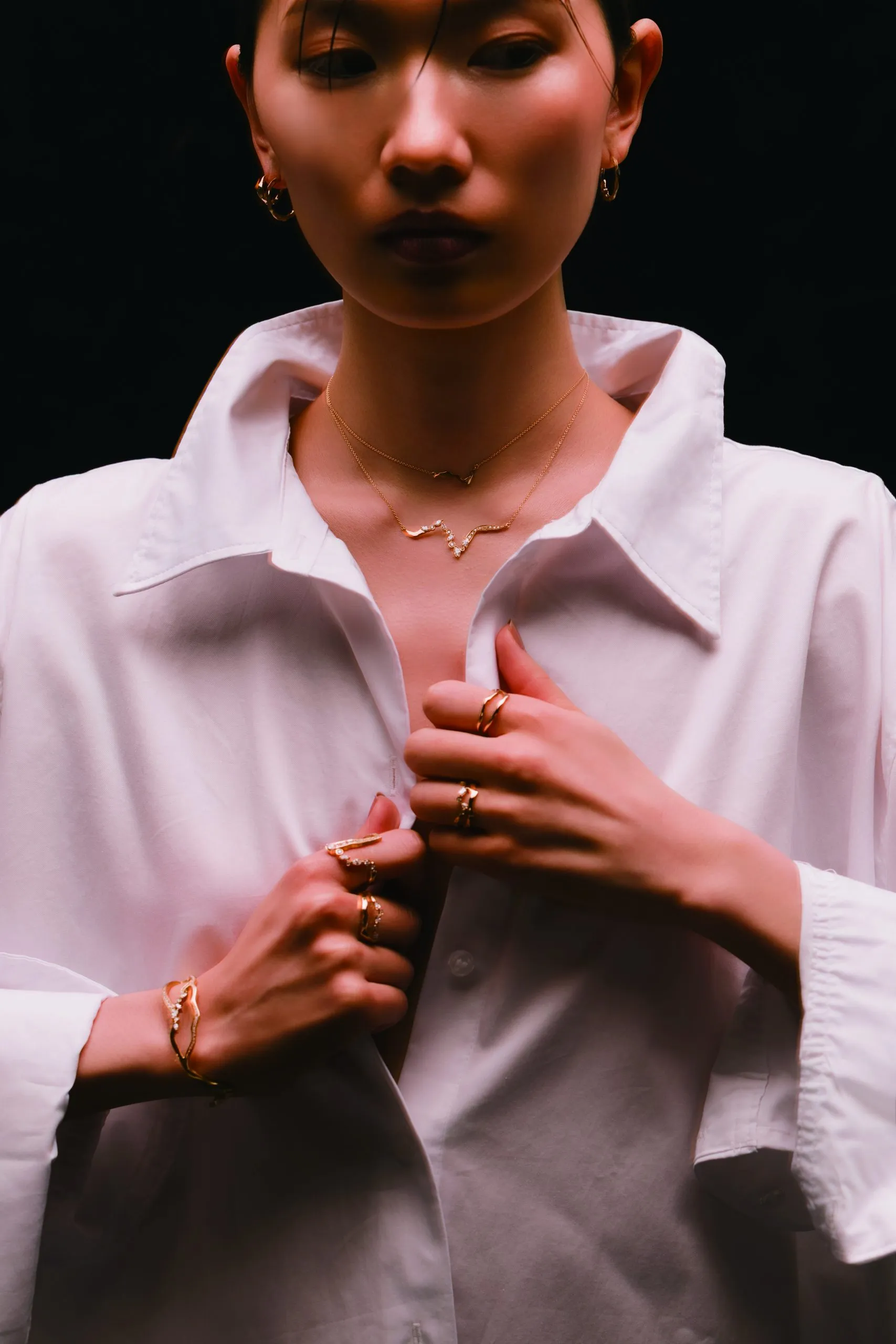
Guided by the motto “Designed in New York, Handcrafted in Japan,” Milamore creates fine jewelry that unites Japanese craftsmanship with contemporary design. Through collections inspired by kintsugi — the traditional Japanese art of repairing ceramics with gold — the brand has championed a philosophy it calls “Mended, Not Broken.”
I have loved Thom Browne for years — for some fifteen years, I had been going to see his New York Fashion Week shows. And suddenly, there he was, right in front of me. I will admit I was nervous. What’s more, this fund brings every category together: not only ready-to-wear but accessories, shoes, bridal, and fine jewelry, all judged on the same stage.
Talking with the other finalists, it dawned on me for the first time: I have become one of the designers representing America. Until now, I was “George, the Japanese designer in New York.” Now, simply, “an American fine jewelry designer.” That is an entirely different thing. Twelve years after arriving in the US, I finally feel able to give myself some credit.
―― On the jewelry side, there is also the award presented by Tiffany and the CFDA. Why did you choose the Vogue Fashion Fund?
That is a wonderful program as well, but before I am a designer, I am an entrepreneur — and the brand itself. This fund, which supports a brand’s growth in a holistic way, felt better suited to where Milamore stands today. I had known about the Vogue Fashion Fund for a long time, and in fact I applied last year. I reached Phase 2 but fell short of the finals. So this year, I tried again.
Jewelry has no seasons, so you cannot show new work every year. My portfolio included last year’s pieces; what I changed was the imagery — the way it was presented visually. Rereading my answers from last year’s application, I was struck by how much a person can grow in a single year. It became a valuable moment of reflection.

―― A selection from fine jewelry carries real significance for the industry.
In America, fine jewelry is defined as solid gold of 14 karats or above — plating does not qualify. And there has always been a gap between fine jewelry and fashion. The fashion industry revolves around ready-to-wear; fine jewelry sits outside it, in a very small world of its own. American fine jewelry, moreover, is stone-driven — the great diamond as the emblem of wealth. That is one aesthetic, of course, but what I want to pursue is design. That is why I work with kintsugi, and why this selection means so much to me.
―― So the vision reaches beyond jewelry alone.
I have no intention of being a jewelry brand. Take Chrome Hearts: cut it anywhere and it is unmistakably Chrome Hearts. There are sunglasses, there is clothing, and yet it is known for jewelry. That is the ideal. Some artists paint; others sculpt. The medium differs, but what is being expressed is one thing — that is how I think about it. Right now, jewelry is the medium through which I convey kintsugi and Japanese craftsmanship, but I want to extend the kintsugi concept into fragrance, candles, and sunglasses. I would like to write from the kintsugi perspective as well. I want to express the philosophy of kintsugi in every possible form.
I cannot share the details yet, but there is a project about a year away that I am very much looking forward to. Beyond the category of jewelry, I want to bring the philosophy of kintsugi and the world of Milamore to people in a far broader form.
for the first time with a presentation — an opportunity to bring the philosophy of kintsugi, Japanese craftsmanship, and the lifestyle world the brand envisions to a wider audience, with fine jewelry as its point of origin.

Guided by those words, Milamore now moves beyond the frame of a jewelry brand — into its next chapter, carrying the philosophy of kintsugi to the world.