Editor’s Note
**Editor’s Note:** This article provides a concise overview of LVMH, the French luxury conglomerate, detailing its founding in 1987 by Bernard Arnault, Alain Chevalier, and Henry Racamier.
LVMH is a French multinational corporation and conglomerate with a focus on luxury goods. The company, officially known as LVMH Moët Hennessy Louis Vuitton, was founded in 1987 by Bernard Arnault, Alain Chevalier, and Henry Racamier. Arnault, a French investor, had the idea to create a luxury brand group from the outset. To realize this vision, he collaborated with the CEO of Moët Hennessy Alain Chevalier and the president of Louis Vuitton Henry Racamier.
LVMH is a French multinational holding corporation and conglomerate with a core focus on luxury items.
Parfums Christian Dior is the perfumery, makeup, and skincare line of French fashion house Christian Dior SE which was founded in 1946 and is now chaired by Bernard Arnault.
Dom Pérignon is a vintage champagne brand named after the Benedictine monk and cellar master who was a pioneer of blending grapes to improve wine quality.

Chaumet is a luxury jeweler and watchmaker founded in 1780 by Marie-Étienne Nitot. With over 240 years of craftsmanship experience and an impressive list of clientele, the company has seen expansion into Asia with a particular focus on…
Royal Van Lent is a Dutch manufacturer of luxury yachts founded as an association of families to revive the industry after World War II.
Joseph Phelps is a family-owned and operated winery in the famed Napa Valley wine region of California.
Fresh is a beauty and cosmetics company founded in 1991 by Russian immigrants Lev Glazman and Alina Roytberg.

Fred is a French jewelry and watches brand. Later, Samuel opened a store in his own name in the eighth arrondissement of Paris and was one of the first importers of Japanese cultured pearls. His creativity and innovation initially upset the Parisian elite, but his jewelry became popular over time. Fred was purchased by LVMH in 1996 and was the conglomerate’s first jewelry acquisition. It expands LVMH’s presence in luxury jewelry and complements its watch brands.
– LVMH owns more than 70 different brands, spanning various luxury sectors including fashion, cosmetics, wine, spirits, jewelry, and yachts.
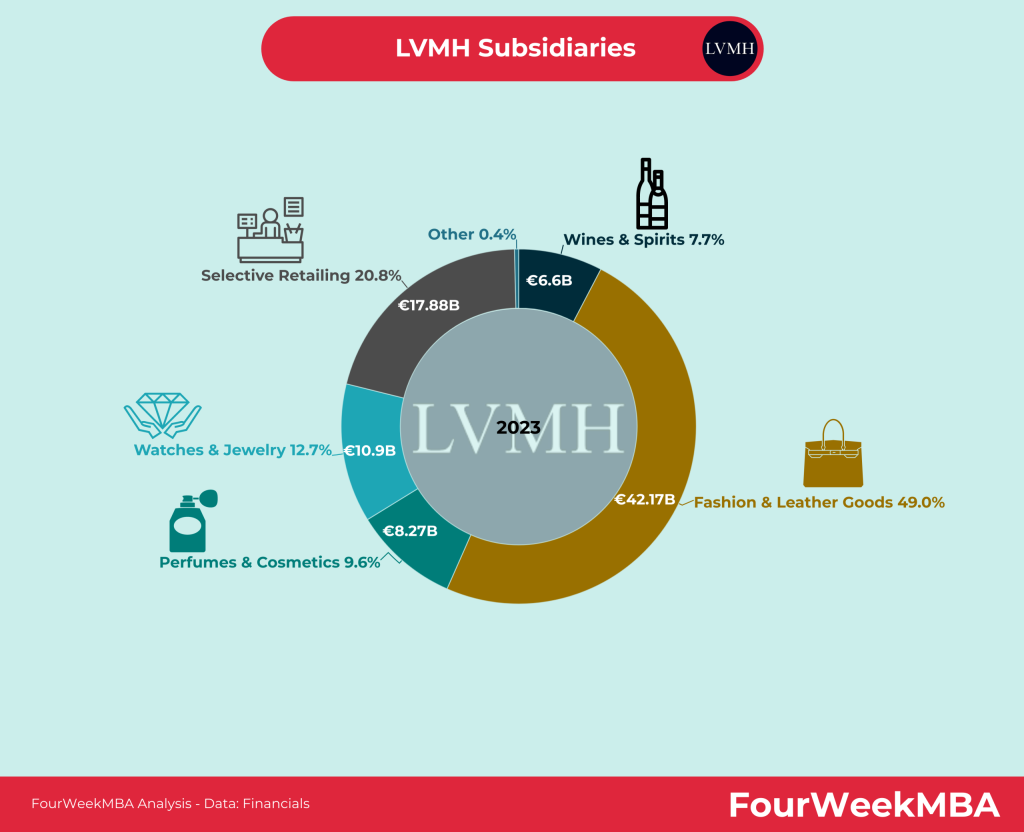
– LVMH is a global luxury empire with over €79 billion ($83 billion) in revenues for 2022, spanning several industries: wines and spirits, fashion and leather goods, perfumes and cosmetics, watches and jewelry, and selective retailing.
– LVMH owns 75+ luxury brands including Louis Vuitton, Christian Dior, Moët & Chandon, Hennessy, Tiffany & Co., Bulgari, TAG Heuer, Sephora, and Berluti across fashion, spirits, cosmetics, jewelry, and retail sectors.
– Bernard Arnault controls over 75 luxury brands and subsidiaries through LVMH, making it the world’s largest luxury conglomerate.
– Some lesser-known LVMH subsidiaries include luxury watch and jewelry maker Chaumet, premium duty-free product and service provider DFS, and Dutch yacht manufacturer Royal Van Lent.

– LVMH has acquired luxury brands across five segments: Fashion & Leather Goods (Louis Vuitton, Dior), Wines & Spirits (Moët, Hennessy), Perfumes & Cosmetics (Sephora), Watches & Jewelry (Tiffany, Bulgari), and Selective Retailing.