Editor’s Note
**Editor’s Note:** This article explores the Val d’Ossola exhibition, where goldsmithing, costume, and portraiture merge to reveal Alpine culture. Running from July 19 to October 25, 2026, the showcase treats the territory as a living archive, using faces, jewelry, and textiles as interpretive keys.
The identity of the Val d’Ossola is defined through a tight visual and material dialogue between local communities and Alpine culture. The exhibition investigates the territory as a living archive where traditional goldsmithing, the history of costume, and painted portraiture converge into a single hermeneutic lens.
Faces, jewelry, and textiles serve as keys to understanding an Alpine civilization. From July 19 to October 25, 2026, Ornamenta. Tesori d’eleganza e d’identità in Ossola tells the story of Ossola taste between the 19th and 20th centuries across three exhibition venues: the Musei Civici Gian Giacomo Galletti in Palazzo San Francesco and Casa De Rodis in Domodossola, and the Centro Culturale Vecchio Municipio in Santa Maria Maggiore. The inauguration is Saturday, July 18 at 4:00 PM at the Cappella Mellerio in Domodossola.
The exhibition is curated by Federico Troletti, curator of the Civic Museums of Domodossola, and is promoted by the Municipality of Domodossola in partnership with the Fondazione Angela Paola Ruminelli, with the collaboration of the Municipality of Santa Maria Maggiore, the Collezione Poscio, and the Pro Loco di Domodossola.
The project is not a painting exhibition in the traditional sense. Objects, paintings, and garments designed or made in Ossola intertwine in a narrative that traverses women’s fashion in all its forms: from festive attire to everyday work clothes, down to intimate garments and accessories that signaled age, marital status, and community belonging.
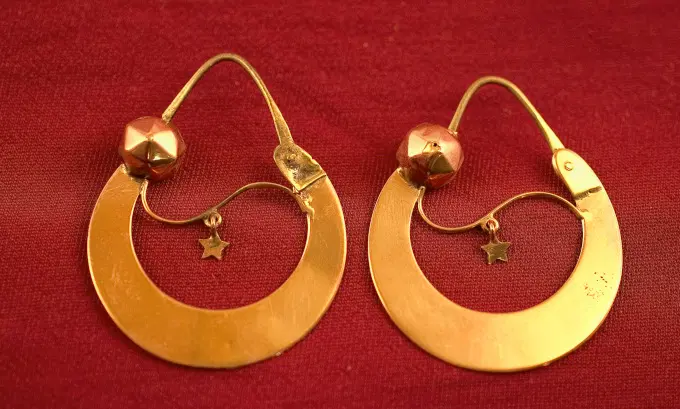
The section hosted at Palazzo San Francesco focuses on the territory’s goldsmithing tradition and its cosmopolitan vocation. On display are works and tools belonging to famous Ossola jewelers who emigrated across the Alps: the renowned Mellerio dits Meller of Paris, the firm Ponti Gennari of Geneva, and the Fabbrica Nicolaj of Masera. The public can admire iconic accessories of local identity: garnet necklaces, the so-called dorini, the croce à la Jeannette, Ossola earrings, the mulèta, and the Spilla Margherita. Alongside the jewelry, late 19th-century garments, hats, textiles, buckles, and mannequins complete the picture of Ossola elegance.
As the curator explains:
At Casa De Rodis, the Collezione Poscio hosts the section dedicated to workwear and ordinary life. The register changes: no longer the light of festive jewelry, but the more humble fabric of peasant daily life, told through painting and photography.
The protagonists are the masters of the Vigezzina painting season. Carlo Fornara captures the dignity of peasant labor in light and gesture; Enrico Cavalli captures female figures in an almost devotional stillness; Lorenzo Peretti and Gheduzzi complete the narrative with portraits and scenes of mountain life. These canvases are accompanied by reproductions of period images from the Fondazione Scuola di Belle Arti Rossetti Valentini in Santa Maria Maggiore.
The Santa Maria Maggiore venue explores the dynamic between what is seen and what remains hidden in dress. Headdresses, scarves, hairstyles, shoes, and pedule (traditional footwear) were not mere accessories: they indicated age, marital status, and position in the social hierarchy. Clothing, with its legible signs, was only the surface of a more complex system of meanings.
Part of the works come from a collection of textiles and embroideries exhibited at the Turin Exhibition of 1911, produced by the embroidery school Ossulae Domestica Ars and preserved to this day. It is a sample book of Ossola decorations and local processing techniques.
The exhibition is accompanied by a catalog published by Sagep Editori. Alongside Federico Troletti, specialists from various disciplines have contributed: Silvia Malaguzzi, an art historian specializing in jewelry, analyzes the connections between Ossola ornaments and the French area; Cinzia Oliva and Gian Luca Bovenzi investigate textiles and lace; historians Enrico Rizzi and Gian Vittorio Moro bring to light archival documents on artistic exchanges in Ossola. Olivier Mellerio, of the historic Parisian jewelry house, also contributed to the volume, paying homage to his family’s Vigezzina origins.
Ornamenta is open from July 19 to October 25, 2026, at the three venues in Domodossola and Santa Maria Maggiore.