Editor’s Note
**Editor’s Note:** The Energy and Mines Ministry has clarified that exported raw materials are surplus not used by local artisans, emphasizing that new markets complement rather than compete with Dominican crafts.
The entity guaranteed that the material destined for export does not correspond to that used by Dominican artisans and assured that the production of miners in Barahona generates a sufficient surplus to supply both the local and international markets.
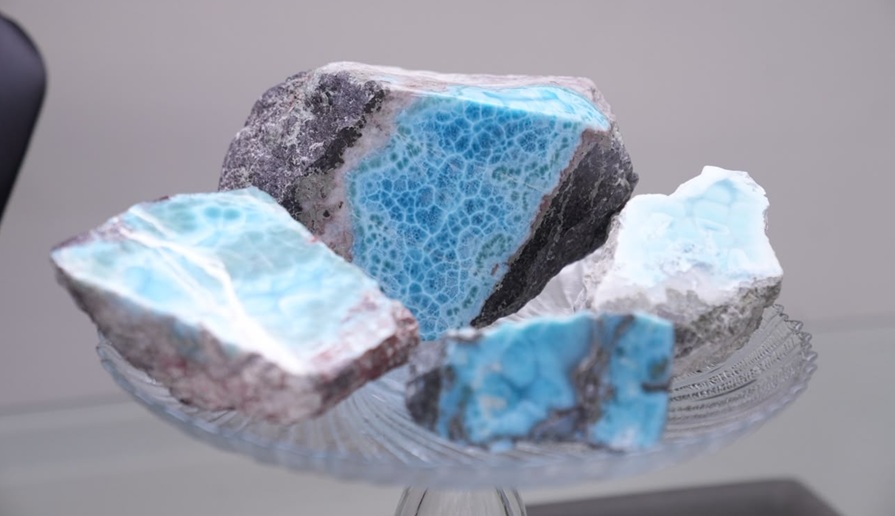
Santo Domingo. – The Ministry of Energy and Mines assured this Sunday that exports of larimar as raw material do not compromise the supply of the national market, explaining that 60% of production remains in the Dominican Republic to meet the demand of local artisans and workshops, while the remaining 40% is destined for export.
In this context, it announced that on August 21, 2026, the Larimar 2026 Miners-Artisans Direct Sale Fair will be held at the Larimar Workshop School Museum, located in Bahoruco, Barahona province, as part of initiatives aimed at strengthening the value chain of the national stone and promoting direct commercialization between producers and artisans.
Energy and Mines made these clarifications in response to concerns expressed by some artisans about a possible shortage of the national stone and assured that exports are carried out under technical criteria that guarantee the availability of the mineral for the local industry.
It explained that a significant part of the official export figures is often misinterpreted, because the tariff heading used groups larimar in all its presentations: raw stone, semi-processed, and processed. Consequently, a significant proportion of the exported value corresponds to already worked pieces with higher added value, and not exclusively to rock extracted from the mines.
Likewise, it reiterated that first and second category larimar, recognized for its intense blue color and higher commercial demand, is reserved primarily to supply Dominican workshops and artisans, guaranteeing the continuity of local jewelry and handicraft production.
It pointed out that mine production far exceeds the purchasing capacity of the domestic market, so preventing the commercialization of the surplus would directly affect the economic sustainability of mining cooperatives and put hundreds of jobs in the southern region at risk.
It highlighted that the strengthening of the sector has allowed significant advances in formalization and occupational safety, and that currently miners organized in cooperatives operate with better working conditions, using formal electrical energy, adequate ventilation systems, and infrastructure that significantly reduce the risks of mining activity.
It added that the safe and sustainable extraction of larimar today requires considerably greater investments than in the past, so maintaining commercial channels is essential to finance these improvements and avoid a return to informal practices that endangered workers’ lives.
According to statistics from the Mining Promotion Directorate, during the first half of 2026, national production reached 188,696 pounds of larimar.