Editor’s Note
**Editor’s Note:** This article explores the intricate craftsmanship behind gold chain weaves, breaking down the three primary families that define their structure and movement.
Each gold chain has a special weave, the result of precision engineering where metal is transformed into threads and links to create movement and drape on the skin.
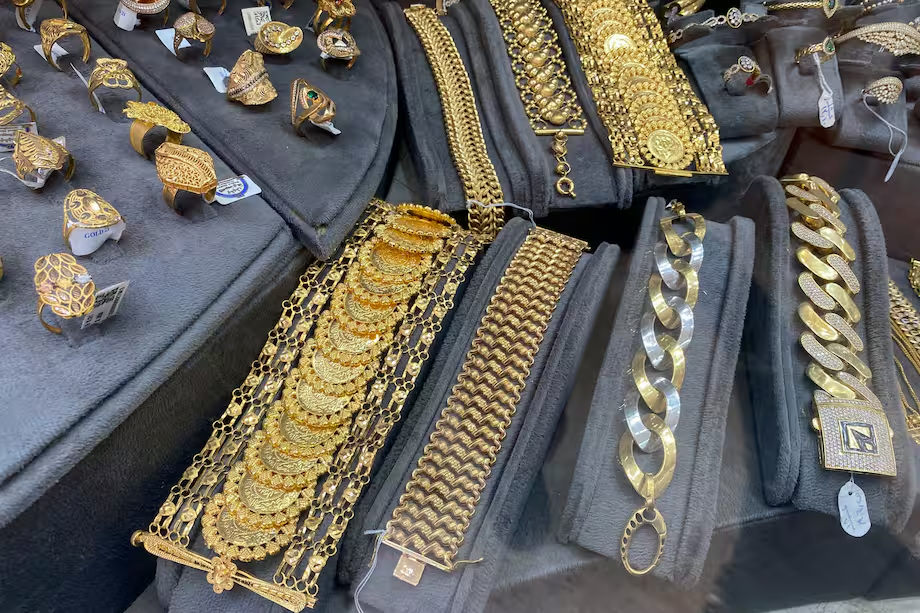
It is an evolution of the traditional cable link chain. It consists of round or oval links that have been uniformly twisted and flattened using different tools. The links are interwoven so compactly that the chain looks almost like a solid, flat surface. When placed on a table, it stays completely straight without twisting. It is a heavy, robust weave with a very characteristic mirror-like shine on its flat faces; it can also be found with stone inlays on its surface. It is the king of volume in contemporary urban fashion.
Inspired by the nautical world (specifically the chains that hold ship anchors) and popularized in high jewelry by the Italian fashion house. Each link is an oval or flattened oval with a vertical bar right in the center.
In the Hispanic and Latin American market, a very showy and elaborate variation that often combines double links, textured finishes, or intricate diamond-cut finishes is commonly known as the “Chinese weave.” Unlike European minimalism, this weave stands out for its high ornamentation.
Technically composed of small cubic or square links assembled so compactly that the space between them almost disappears. Visually, it is perceived as a continuous, fluid thread of gold.
It is the classic chain of links interconnected perpendicularly. Technically, we know it as the forced link or cable link.
According to the expert, a flat weave seeks static sophistication, while a round or braided link plays with light with every movement.
Gold and precious stones require proper maintenance to preserve their original finish over time. Keep in mind that among the enemies of jewelry are cosmetics, perfumes, hairsprays, and sweat, as
Storage: Gold can easily scratch if it comes into friction with other pieces or harder stones like diamonds. Ideally, store them individually in soft cloth bags or padded compartments. Chains should also be closed before storing to prevent links from tangling or undergoing stress that could deform the weave.
Professional Maintenance: Once a year, it is advisable to take them to a trusted workshop for a general ultrasonic and polishing service, which reactivates the original shine of the metal without wearing down the piece.
How to Clean Jewelry at Home:
1. The maintenance bath: Place the gold pieces in a container with warm water and a few drops of mild liquid soap (neutral pH). Let them soak for 10 to 15 minutes to loosen skin oils or creams.
2. Brushing: Use a toothbrush with *extra soft* bristles. Gently scrub, paying special attention to the joints of the links and under the settings if the piece has gemstones.