Editor’s Note
**Editor’s Note:** This piece captures a moment of quiet triumph for the founders of Yaogong Jewelry, as they reflect on a serendipitous alignment between their workspace, their art, and their vision. It is a story of decisive action and the unexpected harmony that follows.
“Coming here, we finally felt that this scroll of calligraphy was hung in the right place.”
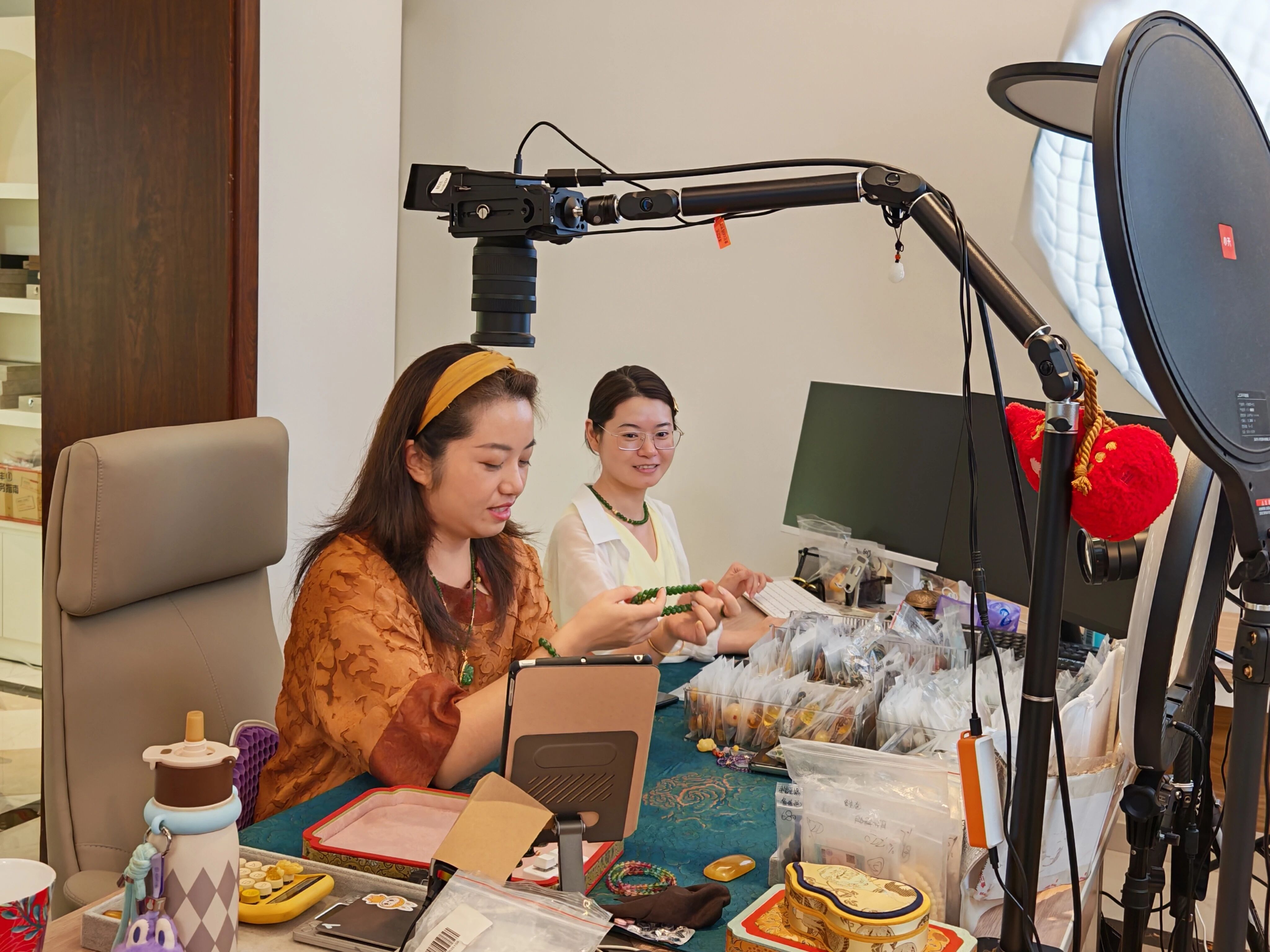
In the office of the Yaogong Jewelry e-commerce base, located in the Xiaojing Bay community of Xiaoyong Street, Daya Bay, brand founders Li Jieyu and Gong Yao pointed to the calligraphy on the wall reading “Splendid Treasures, Vibrant Life” and sighed. These eight characters perfectly mirrored the scenery outside the window and their current state of mind.
More than three months ago, they used two 11-meter-long flatbed trucks to move the e-commerce department of their jewelry company, which had been deeply rooted in Shanghai for nearly 20 years, from the banks of the Huangpu River to Xiaojing Bay, Xiaoyong, Daya Bay on the South China Sea coast—a journey of over 1,400 kilometers. From the initial idea to the completion of the move, it took only 30 days. This seemingly “impulsive” relocation has now become the most determined step in their lives.
Yaogong Jewelry was founded by Gong Yao and Li Jieyu in 2008. Based on offline stores in Shanghai, it has recently focused on live-streaming e-commerce, becoming a well-known brand in the industry. The turning point began with an accidental “convenient stop.”
Gong Yao recalled that on the fifteenth day of the first lunar month this year, while vacationing in Guilin, Guangxi, they decided to first visit factories in Guangdong and then take a convenient route along the coast. After seeing several scenic spots, they arrived at Xiaojing Bay, Xiaoyong, Daya Bay. “Wow, this place is so beautiful!” The moment she saw the picturesque coastal scenery, she immediately had the idea to “move.”

On moving day, two oversized trucks loaded all the e-commerce department’s belongings—including that scroll of calligraphy, the piano she had played since childhood, and her favorite potted plants. Then, they spent nearly a month organizing inventory and setting up the new base, successfully starting their broadcasts. By the end of June, Yaogong (Shanghai) Supply Chain Management Co., Ltd. Huizhou Daya Bay Branch was officially registered and established.
“In recent years, the company has expanded its online business, which is the confidence behind our ability to ‘leave at a moment’s notice,'” Li Jieyu said frankly. Jewelry e-commerce is not constrained by geography, and Xiaojing Bay is even more of a “paradise for jewelry e-commerce professionals.”
This area is located in the center of the Guangdong coastal jewelry industry belt—including Jieyang Ketang, Zhaoqing Sihui, Foshan Pingzhou, Guangzhou Hualin, Shenzhen Shuibei and Songgang—all spread along the coastline and close to Hong Kong, making it more convenient for exhibitions and resource connections. Additionally, Guangdong’s strong new media and cross-border e-commerce atmosphere, abundant talent pool, and Huizhou’s strong industrial development potential and good layout further solidified their confidence in settling here.
Beyond the business blueprint, Xiaojing Bay has given them more in terms of physical and mental healing.
“Here, I feel ‘nourished’ by nature,” Gong Yao said. Born in Jiayuguan, Gansu, she has a natural yearning for the sea and greenery. Xiaojing Bay is already a famous scenic spot; with windows opening to the sea, and downstairs is the Wushantou Greenway, nestled between mountains and sea. “The first thing we did after arriving was each buy a bicycle. Now, we almost go cycling on the greenway every day.”
What confirmed her choice was also the feedback from her body. Gong Yao said that before, she often felt oxygen-deprived during indoor live streams, but now she no longer has that feeling. Leaving home at 8 a.m., the community is full of elderly and children exercising in the morning, brimming with vitality. Employees live in the neighboring community, just a few minutes from home to office. After work, they feed stray cats together, go to Xiaoyong for seafood, and drink sugar water—life is simple and comfortable.
Gong Yao said she had always wanted to go camping; the RV and equipment were ready long ago, but she never managed to do it in five years. Not long after arriving in Xiaojing Bay, she fulfilled her dream with neighbors at the “Qianlimu” mountain-sea rice field garden in Xiaxiang Shangjiao Village. “Here, with mountains, sea, and farmland, playing while working—it’s so fulfilling,” she said. Her father recently visited her in Xiaojing Bay and remarked that she was much happier than before, even saying he wanted to move here after retirement.

The nurturing environment has also reflected positively on their business.
“Before, a trip to the factory required planning days in advance, from planning to execution taking about 20 days, with very low fault tolerance,” Li Jieyu said. Now, if they feel like going to the market or factory in the morning, they can just go. Material selection, design, processing, and sales are seamlessly connected, greatly improving efficiency.
Rooted in this land “nourished by nature,” they are planning an even bigger blueprint. “We plan to make this our core operations center, focusing on cross-border e-commerce and supply chain this year,” Li Jieyu said. “We are confident that we will thrive here.”
From Shanghai to Xiaojing Bay, what changed was the geographic coordinates; what remained unchanged was their passion for jewelry. As Gong Yao said: “The reason we can stay rooted for so long is because of true passion. Here, many life goals have already been realized.”
In this landscape of mountains and sea, they have not only found a “strategic fortress” for their jewelry business but also rediscovered the true essence of life.
(Reporter: Lu Wei, Correspondent: Hui Wanxin)
Editor: Lu Wei