Editor’s Note
**Editor’s Note:** Madonna delivered a show-stopping halftime performance at the 2026 FIFA World Cup final in New York, blending pop spectacle with football legend as Ronaldinho and Ronaldo Nazário joined her on stage.
Madonna captivated the audience with a dazzling halftime show at the FIFA World Cup 2026 final in New York. The Queen of Pop showcased her charisma in a vibrant performance, featuring a striking aesthetic by Saint Laurent and Swarovski. She was joined by two iconic former Brazilian national team players, Ronaldinho and Ronaldo Nazário.
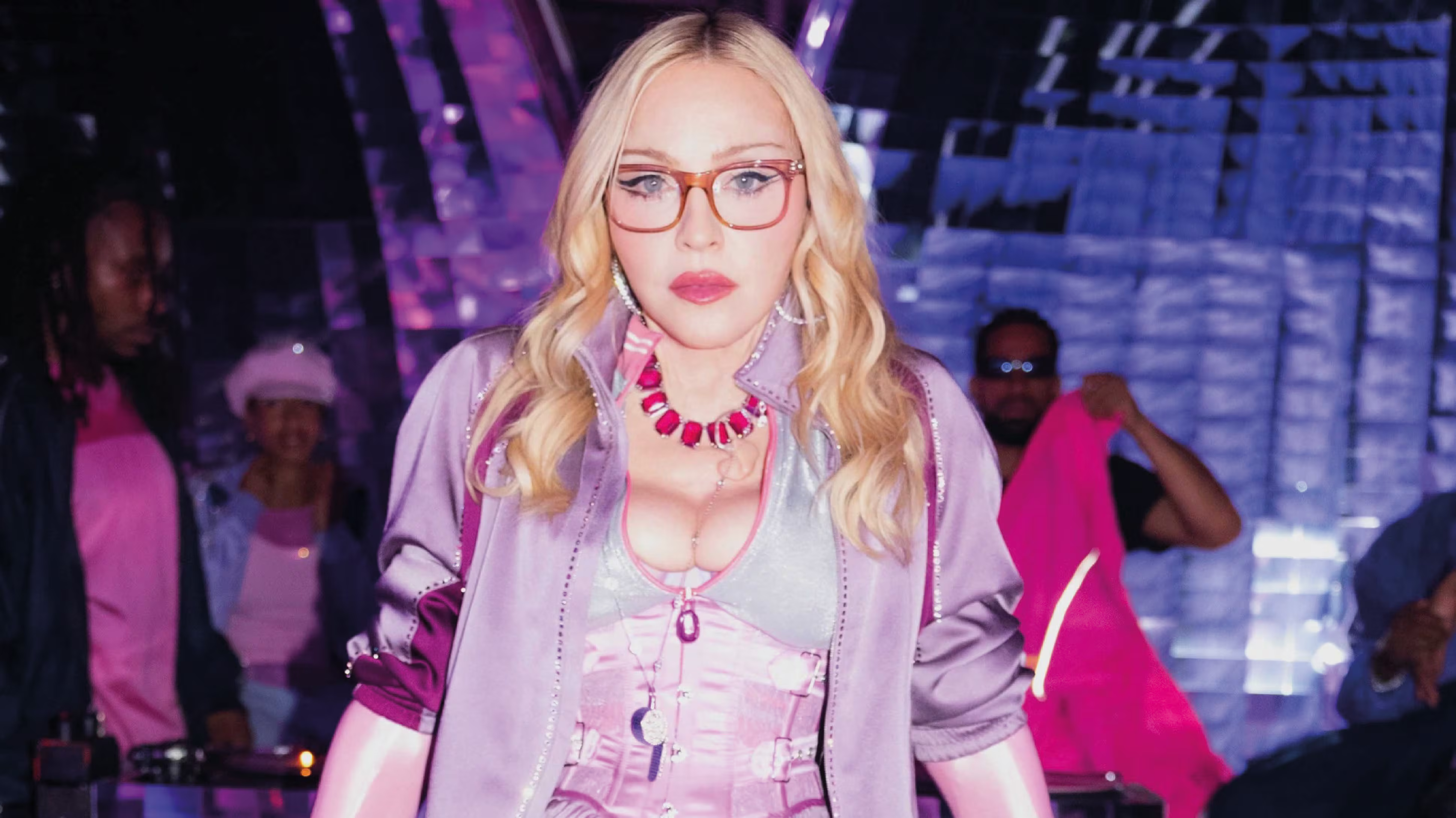
Madonna chose a high-impact look created by her stylist, Rita Melssen.
She wore a pink satin corset with lace and adjustable buckles, featuring a top that mimicked a gray satin T-shirt with a plunging neckline and pink front closure. She completed the outfit with a satin sports jacket in violet and lilac tones, adorned with crystal appliqués, and a matching pleated skort, all by Saint Laurent. Long pink gloves and fuchsia fishnet mitts covered in Swarovski crystals added the characteristic pop touch. Madonna finished the look with laced high-top boots in shiny violet leather, paired with translucent lilac high socks with lace, and gradient-tinted sunglasses. Each garment and accessory embellished with crystals was handled by Giovanna Engelbert, creative director of Swarovski.
For the beauty look, she featured impeccable, fresh, and luminous skin: pastel lilac and pink eyeshadows, accompanied by fine black and white eyeliner. She added a distinctive, avant-garde touch with bright crystals strategically applied to the tear ducts, and wore glossy pink satin lips. True to the Queen of Pop, she kept her iconic platinum blonde hair with well-defined waves and a middle part.
The meticulous details of the costume showcased fine haute couture craftsmanship and personalized Swarovski jewelry. On the back of the lilac sports jacket, the name “MADONNA” was inscribed alongside the number 10, both made of violet embroidered appliqués bordered by a dense row of crystals. The exclusive jewelry from the Austrian brand drew all eyes: she wore a choker with large violet gemstones. She paired it with a fine chain featuring a silver whistle-shaped pendant fully encrusted with purple crystals and a distinctive initial “M.” Finally, the look included fuchsia mitts covered in crystals, metallic manicure in violet tones with appliqués at the base, and pink knee pads with a central star fully covered in crystals.
Shakira also headlined the World Cup final halftime show. The Colombian singer took the stage alongside Burna Boy to perform the tournament’s official song, showcasing an energetic outfit with her signature style. For the occasion, she wore a short, body-hugging dress with a plunging neckline and side cutouts at the waist, designed by Roberto Cavalli. The piece featured over 200,000 embroidered crystals in bubblegum pink, orange, and yellow. The skirt stood out with layers of fringed, frayed strands, adding dynamism to every step. True to her on-stage style, the Colombian performed barefoot, wearing her blonde hair loose with natural waves and volume. The show’s costumes maintained a cohesive aesthetic: Shakira, Burna Boy, and the dance troupe coordinated their outfits in a warm color palette centered on yellow and orange. The dancers and children on stage wore tie-dye T-shirts and skirts or pants decorated with yellow fringe, while Burna Boy provided contrast with a basic white T-shirt, dark pants, and a black hat. The show featured a special appearance by Ghetto Kids, the renowned children’s dance group from Kampala, Uganda.
