Editor’s Note
This article explores the geological mystery behind pink diamonds’ rarity, revealing the unique conditions that concentrated nearly all of them in a single, now-closed Australian mine.
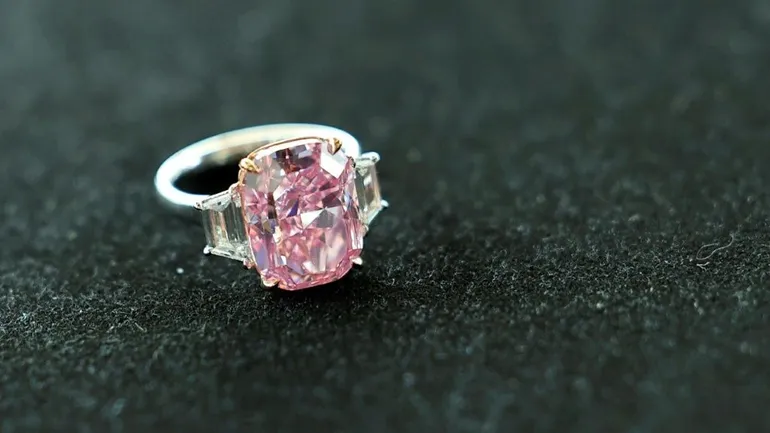
Researchers have uncovered the secret behind the rarity of pink diamonds, which are found almost exclusively in Australia, explaining their astronomical price.
More than 90% of all existing pink diamonds originate from the recently closed Argyle mine in northwestern Australia. But no one really knew why they were found at this location, situated at the edge of the Australian continent, while most diamond mines are located in continental interiors, such as in South Africa or Russia.
The two “ingredients” necessary for creating a pink diamond were already known, explained the study’s lead author, Hugo Olierook, from Curtin University in Perth, Australia.
First ingredient: carbon located at great depth. At depths less than 150 km, this carbon is common graphite, the kind used in pencil leads, and “doesn’t look very nice on a wedding ring,” the researcher jokes.
Second “ingredient”: colossal pressure, significant enough to change the color of a transparent diamond but without being too forceful.

The discovery by the Australian team helps explain what brought the pink diamonds from the Earth’s crust up near the surface. It was initially thought that the Argyle mine formed 1.2 billion years ago, but without explaining how the diamonds could have risen in the absence of an associated geological phenomenon.
The researchers then refined the dating of the deposit by measuring the age of elements from tiny crystals in a rock from the mine. They arrived at an age of 1.3 billion years. An age corresponding to the fracture experienced by the first supercontinent, called either Nuna or Columbia.
Previously “all land masses were clumped together.”
The pressure that colored the diamonds occurred with the collisions of the Western and Northern Australian land masses 1.8 billion years ago. This mass fractured 500 million years later, and at that location, magma rose, bringing the pink diamonds to the surface “like a champagne cork,” according to Hugo Olierook.