Editor’s Note
The recent record-breaking auction of the Fabergé Winter Egg underscores its enduring status as a pinnacle of craftsmanship and imperial history. This article details its journey from a royal gift to a landmark sale.
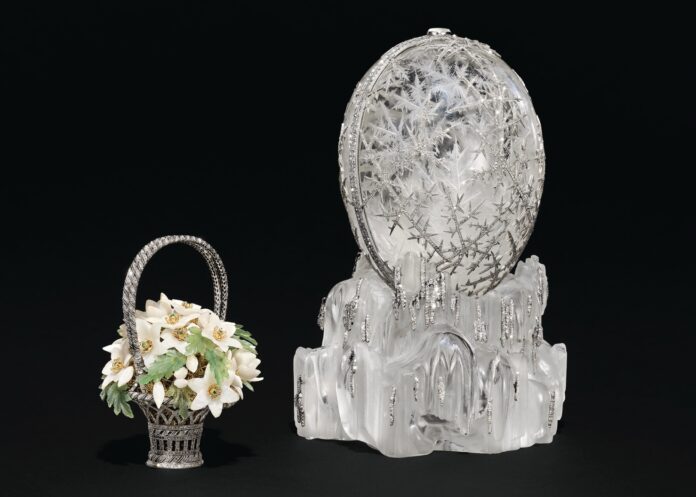
The legendary Fabergé Winter Egg has made history once again. The piece, one of the most sophisticated and valuable created by the House of Fabergé for the Russian tsars, was auctioned at Christie’s for a record-breaking sum of £22 million, becoming the most expensive Fabergé work ever sold at a public auction. The buyer has chosen to remain anonymous.
The egg was created in 1913 by order of Tsar Nicholas II as an Easter gift for his mother, the Dowager Empress Maria Feodorovna. It belongs to the series of Imperial Eggs, considered the pinnacle of jewelry craftsmanship at the turn of the century, and is one of the few that remain outside of museums or institutional collections.
The Winter Egg stands out for its artistic complexity and the use of extremely elaborate materials. It is carved from translucent rock crystal, hand-engraved to simulate frost and ice crystals. The mount is made of platinum, and the exterior is decorated with over 4,500 diamonds and semi-precious stones that recreate icy branches, snowflakes, and the brilliance of the Russian winter.
The piece rests on a base of rock crystal carved into icicles, reinforcing the sensation of an artistic block of ice, completely transparent and chiseled with millimeter precision.
Inside, the egg hides the traditional Fabergé surprise: a meticulous platinum basket inlaid with diamonds and a bouquet of wood anemones made from white quartz, green nephrite, and small garnets. The work symbolizes the transition from winter to spring and is one of the surprises most highly valued by art historians.
The design was the work of Alma Pihl, one of the very few female jewelers in the Fabergé workshop. Her work on this piece is considered by experts to be one of the highlights of the entire house’s production, both in terms of technique and aesthetic coherence. The egg was manufactured in the workshop led by Albert Holmström.
After the Russian Revolution, the egg was confiscated, sold by the Soviet government, and passed into the hands of European collectors. For decades it was lost, reappeared at auctions in the nineties and 2000s, and has finally returned to the market reaching an unprecedented figure.
Its rarity, its state of preservation, and the mythology surrounding the Imperial Eggs explain why this piece has become one of the most coveted jewels on the international market.
Fabergé eggs were created between 1885 and 1917 for the Russian imperial family. Approximately 50 Imperial Eggs were produced, of which 44 survive. Each piece incorporates precious metals, translucent enamels, rare stones, and an interior surprise, and they are considered the pinnacle of European jewelry art.
For many experts, the Winter Egg is the crowning achievement of that tradition: a perfect balance between technique, symbolism, and excessive luxury, capable of reflecting the opulence of the last period of the Romanovs before the empire’s collapse.