Editor’s Note
The enduring symbol of luxury is facing a valuation crisis. While diamonds retain their cultural cachet, a confluence of market forces has sent prices tumbling. This analysis explores the perfect storm—from lab-grown alternatives to shifting consumer tastes—reshaping the bedrock of the traditional diamond industry.
Few things symbolize luxury better than a fine diamond. They shine in the windows of the most exclusive shopping streets in Paris, Milan, or New York, on the hands of Hollywood actresses, and on the watches of the world’s most expensive footballers. However, these are not good times for precious stones, at least not when it comes to their valuation. A perfect storm mixing factors both intrinsic and external to the sector has weighed down their price, leaving it, according to some analysts, at lows not seen so far this century.
The big question is… What can we expect now?
No matter which source you consult, these are not good times for diamonds. The ultimate expression of luxury, the great symbol of opulence, has been seeing its value slide down a slope away from the peaks it reached between 2021 and 2022, when the sector experienced an “exceptional demand” in the US market thanks to couples who had postponed their engagements or weddings due to Covid-19.
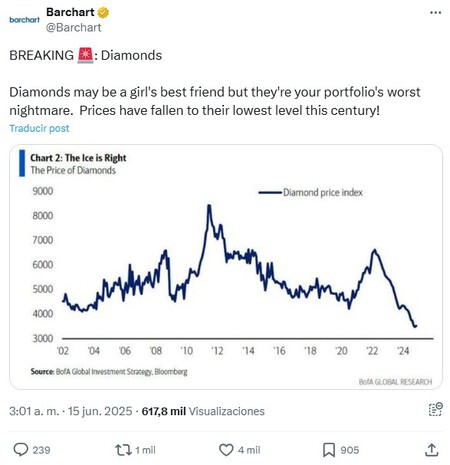
A few days ago, Barchart, a financial data platform, shared a chart reflecting the downward curve that precious stones have drawn since 2022, reaching what the firm considers “their lowest level of the century.” The Paul Zimnisky price index for rough diamonds also shows a “burst” since the pandemic, though not yet reaching record lows. The picture is similar in the charts from DiamondSE or PriceScope, which reflect the lowest values for natural gems since at least 2008.
If we talk about valuations, the diamond industry has seen better years. In February, Bloomberg estimated that in just two years, prices had fallen by almost 50% for rough diamonds and 35% for polished stones. Around the same time, The Guardian revealed that in stores, natural diamonds cost 26% less than two years prior—a considerable drop but one that pales in comparison to the cumulative decline since 2020 for lab-created diamonds.
Citing Tenoris, a firm that tracks diamond prices in over 2,000 US stores, the British newspaper pointed out that at the end of last year, the average price for a one-carat natural diamond was $4,997. In May 2022, it exceeded $6,800. For “artificial” diamonds, the price had gone from $3,410 in January 2020 to $892 by the end of 2024. Their charts on PriceScope and DiamondSE also show declines.
The big question at this point is… Why? What is driving this price drop? The reality is there isn’t a single answer, but a cocktail of them, a mix of factors that have impacted the market. Analysts point to a change in demand after the health crisis, when prices rose thanks to post-pandemic sales increases. Others point to the “burst” in weddings, especially in the US, meaning fewer wedding bands and engagement rings; or even the effects of the war in Ukraine on the sector.
Another factor explaining the plunge is the behavior of the Chinese market, crucial for the industry. In February, Bloomberg estimated that its demand had shrunk by 50% since the pandemic. And not only that. Citing industry experts, the agency specified that, on average, retailers in the Asian giant were returning between $30 and $40 million worth of surplus polished diamonds to the wholesale market in India each month. All this in an economically challenging context for Beijing.
If something has truly influenced the global diamond industry, beyond whether we marry more or less, the Covid hangover, or the drop in demand in China, it is the appearance of a new product on the market: “synthetic” diamonds, grown in laboratories, which have marked a before and after in the sector. Instead of requiring millions of years of formation, as with mined natural gems, a “synthetic” stone can take shape in a laboratory in record time: a few weeks or even hours.
“Synthetic” diamonds are not exactly new. Their origins can be traced back to the 1950s. However, they have recently burst onto the market forcefully for several reasons. One is that their origins are easier to trace than those of mined gems, which has earned them a reputation for being “more ethical,” especially in the eyes of millennials. Their appearance and price also play a role, which can be up to 70% lower than that of natural stones.
Their appeal has even caught the attention of luxury jewelry and watch brands, in some cases with market receptions exceeding expectations. Of course, not everyone shares the same opinion.