Editor’s Note
This article highlights Richemont’s mixed first-quarter results, where strong jewelry sales and European performance were tempered by a decline in Japan and a disappointing watchmaking segment.

The Swiss group’s performance for its first quarter, ending in late June, was slightly above expectations. Richemont revealed robust activity in jewelry and in Europe but took a hit in Japan due to an unfavorable base effect. The watchmaking division disappointed.
For the quarter from April to the end of June, the owner of brands Cartier and Van Cleef & Arpels reported revenue growth of 6% at constant exchange rates and 3% in reported figures, reaching 5.4 billion euros.
Richemont was primarily driven by its main division, jewelry (72% of revenue), where growth reached 11% at constant exchange rates. The Swiss group exceeded expectations, both in its overall growth and in jewelry. According to a consensus cited by Bank of Canada, analysts had expected revenue growth of 5% at constant exchange rates and 9% for the jewelry division alone.
Conversely, watchmaking (15% of revenue) saw its revenue decline by 7% at constant exchange rates, which is worse than the consensus feared (-5%).
By geographic region, the situation remains mixed, even though all regions exceeded expectations in terms of organic growth (in comparable data), notes Bernstein.
In the Asia-Pacific region, sales remained stable (against an expected 4% decline by consensus). The 7% decline in activity in China, Hong Kong, and Macao was entirely offset by robust growth in almost all other Asian markets, explained Richemont, specifying that sales in Australia and South Korea experienced double-digit growth.
In Japan, activity fell by 15% when the consensus expected a 7% sales increase in the country. Richemont cited a high comparison base after a strong 59% sales growth in the same period the previous year. The strengthening of the Japanese yen curbed tourist spending, particularly that of Chinese clientele, while local demand remained positive.
Outside this region, Richemont recorded significant growth across all its regions. In Europe, revenues grew by 11% excluding currency effects (against 10% expected by consensus), thanks to spending by tourist clientele and local demand described as robust by the company. Activity grew by 17% in the “Americas” region, against expectations of 12% for that region.
Recall that the group operates in the “hard luxury” niche (watchmaking, jewelry, as opposed to soft luxury which includes leather goods and clothing), a segment that better weathered the luxury storm last year. This is because “hard luxury” has less exposure to so-called “aspirational” clientele, oriented towards less expensive products and more sensitive to the economic climate.
This positioning allows Richemont to post one of the best stock market performances among major luxury players this year.
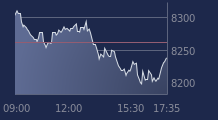
On the Zurich Stock Exchange, its stock reacted, albeit quite little, to this relatively mixed publication, with a rise of only 0.2% around 12:00. But for the whole of 2025, Richemont is up 8%.
A performance that is much better than those of LVMH (-25.3%), Kering (-18.1%), Salvatore Ferragamo (-25%), Prada (-21.50%), or Brunello Cucinelli (+1.5%). Even Hermès, the quintessential luxury safe-haven asset, often considered the sector’s top performer, is beaten (+5%). Only Burberry’s stock is performing significantly better (+26.8%). But the British brand’s rebound is partly explained by the fact that its stock price had plunged into the stock market abyss in 2023 and 2024.