Editor’s Note
This article provides a concise overview of diamond saw blades, defining them as essential consumable tools for cutting hard materials across construction, manufacturing, and stone processing industries. It highlights their selection criteria and widespread application in ensuring stable, high-quality cutting operations.
Diamond saw blades are consumable tools used for cutting hard materials in fields such as construction, civil engineering, stone processing, and manufacturing. They are selected on-site based on the material and thickness of the cutting target, such as concrete, asphalt, stone, and ceramics, and are widely adopted in cutting operations for building construction, demolition, and product processing. Job sites demand stable cutting quality and maintenance of work efficiency, making durability and wear characteristics under continuous use key evaluation factors. A feature is the selection of dry or wet operation depending on the application, with use tailored to the work environment and safety management conditions. The uniformity of cutting precision, suppression of vibration, and responsiveness to work load are positioned as elements supporting the reproducibility of on-site work.
QYResearch’s survey report classifies the diamond saw blade market into the following key segments and provides a detailed analysis of market trends and growth potential in each area:
– By Product: Sintering, High-Frequency Welding, Laser Welding
– By Application: Stone, Building Construction, Ceramic, Others
– By Region:
– North America: USA, Canada
– Europe: Germany, France, UK, Italy, Netherlands, Rest of Europe
– Asia Pacific: China, Japan, South Korea, Southeast Asia, India, Australia, Rest of Asia Pacific
– Latin America: Mexico, Brazil, Rest of Latin America
– Middle East and Africa: Turkey, Saudi Arabia, UAE, Rest of Middle East & Africa
Major companies in the global diamond saw blade market include LEUCO, Stanley Black and Decker (Lenox), Shinhan, EHWA, Moreschi Srl, Makita, Bosch, Diamond Products, Saint-Gobain (NORTON), Diamond Vantage, MK Diamond Products, Jiangsu Huachang Tool Manufacturing, XMF Tools, Cortag, Husqvarna Group, Tyrolit Group, Wan Bang Laser Tools, AT&M, Fengtai Tools, Bosun, Huanghe Whirlwind, Monte-Bianco.
This survey provides a detailed competitive analysis of these companies, including company overviews, latest activities, and specific information on each company’s key market strategies and market trends.
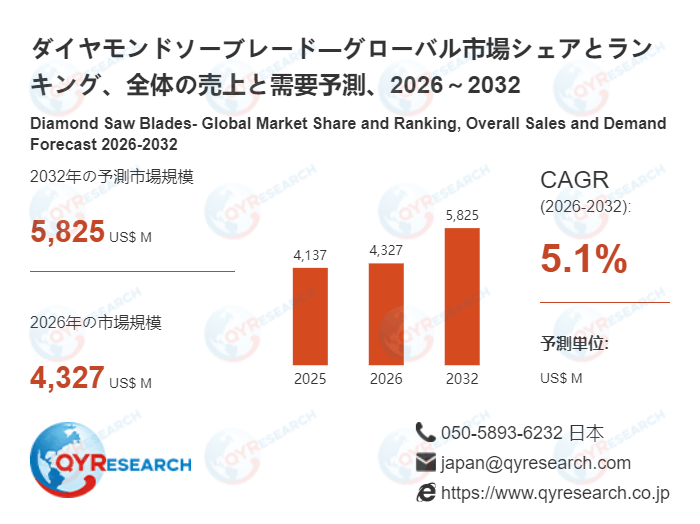
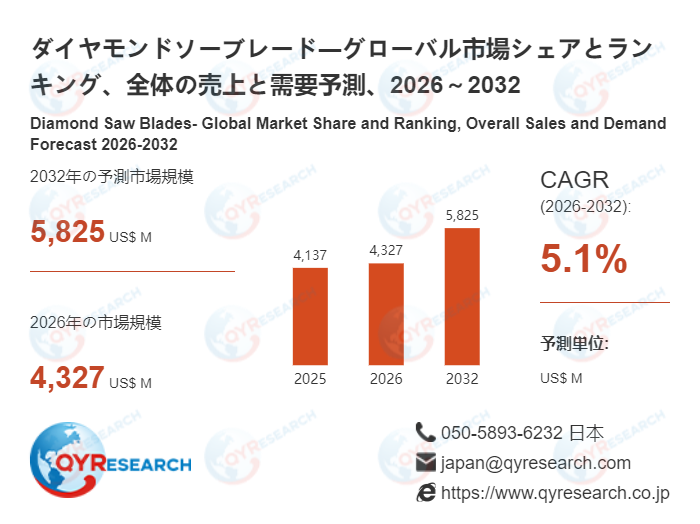
According to the new market research report “Diamond Saw Blades – Global Market Share and Ranking, Overall Sales and Demand Forecast, 2026-2032” published by QYResearch, the global diamond saw blade market size is expected to expand steadily from approximately USD 4,137 million in 2025 to USD 4,327 million in 2026. It is projected to grow at a compound annual growth rate (CAGR) of 5.1% during the forecast period, reaching USD 5,825 million by 2032.
1. Infrastructure Renewal Demand Supports Construction Applications
In Japan, driven by the promotion of the “National Resilience” policy and the aging of social infrastructure, repair and renewal work on public infrastructure such as roads, bridges, and ports is continuously carried out. Diamond saw blades are used for cutting high-strength materials like reinforced concrete and asphalt and are repeatedly used in demolition, repair, and re-construction processes. Such long-term construction demand, centered on public works, forms a stable demand base for diamond saw blades in the Japanese market.
2. Advancement of Manufacturing Processes Promotes High-Precision Processing
Japan has a high concentration of manufacturing in fields such as semiconductors, automobiles, and high-performance components, and the demand for precision and reproducibility in processing is increasing year by year. In the semiconductor field, with the miniaturization of device structures, demand for thin, high-precision diamond saw blades for wafer dicing applications is expanding. In automotive-related manufacturing, the increased use of high-strength alloys and composite materials is driving the adoption of high-performance blades with high compatibility with automated equipment and CNC devices.
3. Accumulated Technology Supports Product Performance Enhancement
The manufacturing technology accumulated by Japanese tool manufacturers continuously contributes to improving the performance of diamond saw blades. In addition to adopting processes such as vacuum brazing and laser welding, design improvements considering heat dissipation and chip removal have led to gradual improvements in cutting efficiency, durability, and safety. Such improvements based on technological accumulation are gently promoting product renewal in the market.
1. Expansion of Tool Value through Smartization
In Japanese manufacturing sites, as overall equipment digitalization progresses, processing tools are also required to improve operational efficiency. By introducing mechanisms to visualize the usage status of diamond saw blades and manage wear conditions and cutting parameters, it becomes possible to optimize processing efficiency and avoid unexpected stoppages. Such smartization efforts are expanding the scope for high-value-added products.
2. Demand Expansion in Ultra-Precision Processing Fields
In ultra-precision processing areas where Japan has competitiveness, such as optical components, medical devices, and aerospace-related fields, requirements for processing accuracy are becoming even stricter. Diamond saw blades capable of processing hard and brittle materials and complex shapes are positioned as high-value-added applications in these fields. Application-specific product development provides entry opportunities into differentiated markets.
3. New Material Compatibility Creates New Applications
With the lightweighting of automobiles and the development of energy-related fields, the use of carbon fiber composite materials and advanced ceramics is also expanding within Japan. Diamond saw blades with dedicated designs can provide stable cutting quality for these difficult-to-machine materials, holding potential for opening up new applications.
1. Impact of Raw Material Price Fluctuations
Diamond saw blades are highly dependent on industrial diamonds, and their supply is susceptible to mining trends, synthetic technology, and international situations. Fluctuations in raw material prices directly affect manufacturing costs and may impact pricing and profit stability in the Japanese market.
2. R&D Burden Accompanying Technological Progress
To keep pace with the technological evolution of downstream industries, including semiconductors, continuous performance improvement is required for diamond saw blades. Consequently, R&D investment for product development is on an increasing trend, which can become a burden for maintaining competitiveness, especially for small and medium-sized manufacturers.
3. Skilled Labor Shortage Affects High-Value-Added Applications
In some high-difficulty processing and special construction work, the judgment and operation of skilled technicians remain crucial. Due to aging and changes in the labor structure in Japan, skill succession has become a challenge, which may affect the adoption of diamond saw blades in high-value-added applications.
