Editor’s Note
LVMH’s 2025 results reflect the broader pressures facing the luxury sector, from geopolitical strains to volatile currencies. As the market leader stumbles, its performance offers a critical barometer for the industry’s near-term challenges.

Amid global geopolitical tensions, currency fluctuations, and policy adjustments impacting some markets, global luxury goods giant LVMH Moët Hennessy Louis Vuitton (LVMH) experienced a difficult 2025, with both revenue and profit declining, putting overall performance under pressure. As the industry leader, what signals does LVMH’s financial report send?
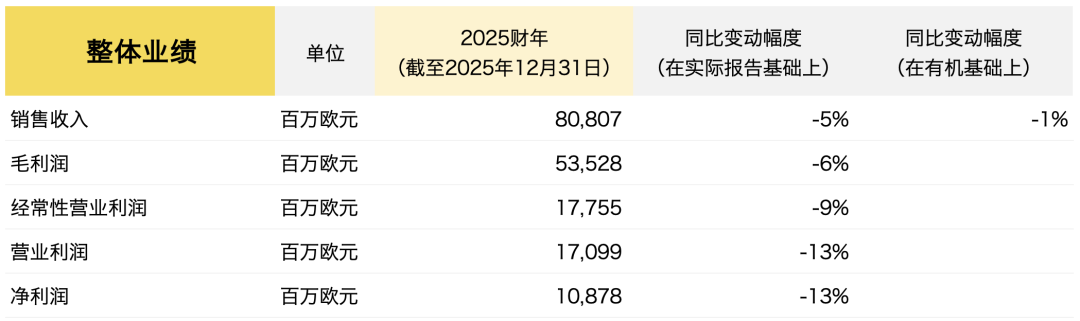
On January 27, LVMH released its 2025 financial report. The group still has not returned to a growth trajectory, achieving total annual revenue of 80.8 billion euros, a decrease of 3.876 billion euros (approximately 32.263 billion yuan) or 5% year-on-year. Recurring operating profit and net profit both saw declines, down 9% and 13% year-on-year to 17.755 billion euros and 10.878 billion euros respectively. The revenue recovery pace of its core businesses has not met expectations.
Within the low data points, its Selective Retail business became a bright spot for growth, providing a strong boost to revenue. Meanwhile, the Asian market, centered on China, drove the group’s business recovery in the second half of the year. The financial report shows that group sales in the fourth quarter reached 22.7 billion euros, with organic revenue growth of 1% year-on-year. Trends across all business divisions improved, with consumer demand in Asia-Pacific and US markets showing signs of recovery.
LVMH Group Chief Executive Officer Bernard Arnault commented at the earnings release conference:
He also stated:
Fortunately, the group’s free operating cash flow grew by 8%, exceeding 11 billion euros. LVMH remains “resilient” and well-positioned, retaining the determination for its long-term strategy, awaiting spring.
Financial data indicates that for LVMH to welcome spring, it still needs to further pursue high-end positioning, break away from the model of relying on fashion and leather goods, and rely on Selective Retail, beauty, and other segments to “compensate.”
As the group’s largest business segment, LVMH’s Fashion & Leather Goods department lost ground in 2025, with full-year revenue down 8% year-on-year to 37.77 billion euros, and organic sales declining 5%, further widening the gap compared to last year. Recurring operating profit was 13.209 billion euros, down 13% year-on-year. However, the performance of this department improved in the second half of the year, with its operating profit margin at 35%, still maintaining a high industry position.
LVMH owns renowned brands such as Louis Vuitton, Dior, and Celine, among which Dior’s new creative momentum is promising, with Louis Vuitton serving as the cornerstone business pressure stone.
Arnault commented on recent industry dynamics, noting that this Dior haute couture series was designed by Giannina Andrade, marking the latter’s first foray into the high-end custom field. This show ultimately received positive market evaluations. He added:
The financial report also specifically affirmed the performance of the Italian top cashmere brand Loro Piana, pointing out that the brand’s valuation has increased about fivefold since the acquisition. Simultaneously, LVMH announced an increase in its stake in the brand at a price of 1 billion euros, raising its shareholding ratio from 85% to 94%.
The Watches & Jewelry department was hit the hardest. Affected by currency fluctuations and tariff increases, coupled with the department’s products already being priced high, unable to transfer cost pressures through price hikes, performance significantly declined. Full-year revenue was 5.358 billion euros, with organic revenue down 5% year-on-year. Recurring operating profit fell even more sharply by 25% to 1.016 billion euros, becoming the main factor dragging down segment performance.
Perfumes & Cosmetics and the “hard” Watches & Jewelry business prevented this annual report data from looking too bleak, holding the bottom line of profitability. Total revenue for high-frequency repurchase luxury goods like Perfumes & Cosmetics remained flat on an organic basis, with operating profit margin increasing to 8.9%. Core classic products such as Miss Dior and Sauvage men’s fragrance continued to lead the market. Brands like Guerlain and Givenchy consolidated their market share through product line expansion.
The “hard” Watches & Jewelry business withstood the pressure, achieving 3% organic growth for the full year, with revenue of 10.486 billion euros. The Polychroma high-end jewelry series set a record for single-piece sales of several hundred million euros.
It is not difficult to see that the development trajectories of major luxury brands are beginning to diverge under the trend of consumption downgrading. Brands highly dependent on the Fashion & Leather Goods business are under performance pressure, while brands in high-end luxury channels like jewelry show relatively brighter performance.
For example, recently, Cartier’s parent company, Richemont Group, released its third-quarter financial report for the 2026 fiscal year, delivering results exceeding expectations. Total retail sales increased by 1% year-on-year, with the jewelry department led by Cartier growing 14% year-on-year. The “long-term structural appeal” of high-unit-price jewelry categories demonstrates stronger resilience.
Zhou Ying, Dean of the Yaok Research Institute, told 21st Century Business Herald, stating that there are too many new competitors in the luxury industry now, especially as Chinese luxury brands have also joined the luxury track, leading to the entire market having already recovered and is expanding, but the relative competitive advantage of traditional international luxury brands is declining, and their pressure will become greater.
Another lifeline in LVMH’s 2025 financial report is the Selective Retail business. This business achieved 4% organic growth, with revenue of 18.348 billion euros. Recurring operating profit increased significantly by 28% year-on-year to 1.78 billion euros, and the operating profit margin increased by 2 percentage points to 9.7%. Sephora continued to expand its global market share, with sustained growth in revenue and profit.
In 2025, Sephora continued to invest in its omni-channel strategy and expanded its retail network, opening approximately 100 new stores for the full year. Growth was particularly strong in European, Middle Eastern, and Latin American markets, with North American business continuing to grow. New brands like Rhode set record debut performances, and Sephora consolidated its position as a global beauty retail leader.
Against the backdrop of the Chinese market still facing challenges, Sephora’s strategic focus is to further differentiate its products and services (especially in the color cosmetics category), deepen the “Sephora Collection” products and brand collaborations, while enhancing customer loyalty and optimizing the in-store experience.
Sephora’s success reflects a clear trend of consumption polarization. Facing more customers and larger markets, luxury brands have been striving for mass-market appeal in recent years.
Zhou Ying also pointed out that some luxury mass-market products are in an awkward position of being neither high nor low, with rapidly declining competitiveness, potentially losing ground.