Editor’s Note
As the Diamond and Gemstone Exchange in Idar-Oberstein marks its 50th anniversary, its towering presence continues to spark debate. Is it a landmark celebrating the city’s heritage or a divisive eyesore? This article explores the building’s shifting role in a community once defined by global trade.

Landmark or eyesore? The Diamond and Gemstone Exchange in Idar-Oberstein is celebrating its 50th anniversary. The city of Idar-Oberstein is known for jewelry and gemstones. The exchange building in the center was once a place for traders from all over the world. But that has changed today.
The exchange skyscraper, 21 stories and about 75 meters high, has long been a topic of discussion in Idar-Oberstein. For many, the building is a relic of its time; for others, it remains a historic landmark.
Looking back to 1974: The exchange in Idar-Oberstein was officially opened on March 29. It was intended to fill a market gap with the world’s largest gemstone offering. Around 100 traders from Germany and abroad had rented space in the building.
Company owner and diamond cutter Dieter Hahn was one of the initiators of the Diamond and Gemstone Exchange. Among them were also many Idar-Oberstein residents like Dieter Hahn. He was one of the co-initiators of the exchange association, which would have its headquarters in the skyscraper in the coming decades.
He recounts that the idea of opening Germany’s first diamond exchange initially arose in Frankfurt.
The exchange in Frankfurt was history just a few years later. In contrast, the exchange association in Idar-Oberstein was admitted to the World Federation of Diamond Bourses in 1975. Members like Dieter Hahn thereby gained access to specialist traders in diamond exchanges in Antwerp, Tel Aviv, and New York. To this day, the association represents the interests of its members in the gemstone and diamond industry. Back then, the exchange also made the trading place in Idar-Oberstein more international.

The gemstone and jewelry industry has a centuries-old tradition in Idar-Oberstein. Its origin goes back to a natural occurrence of agate, jasper, and amethyst. On the banks of the Nahe River, these local raw stones were ground using water-powered grinding wheels. Professions like agate grinders and drillers emerged. As early as the 17th century, many goldsmiths settled in the region.
After the regional agate deposits were exhausted, the trade and import of gemstones became more important. Gemstones processed in Idar-Oberstein have since come from all over the world. Furthermore, grinding techniques were continuously developed, a first diamond cutting workshop was founded, and since the 18th century, more and more jewelry has been manufactured.
1973 saw the founding of the Diamond and Gemstone Exchange, an association-run international trading platform for diamonds and gemstones – and the only German diamond exchange in the world federation.
Today, according to the German Federal Association of the Gemstone and Diamond Industry, Idar-Oberstein is considered the only gemstone center in the world where all known gemstones are cut and distributed.
Gemstone and jewelry traders from India, Pakistan, Sri Lanka, and Ghana came to Idar-Oberstein in the 1970s and 1980s.
Over time, the exchange skyscraper lost its significance as a trading place. More and more office spaces stood empty. International competition had grown. Trade and jewelry production shifted abroad. In the 1990s, the building was placed under compulsory administration. Due to ongoing financial problems, it had to be auctioned off in 2006.
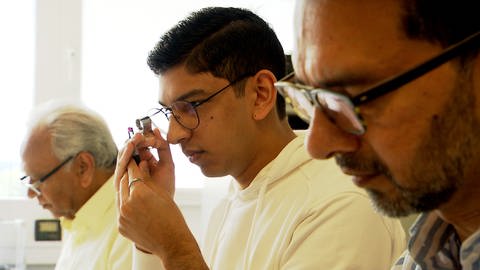
Today, the skyscraper houses, among other things, a hotel and some apartments, but only a few gemstone traders remain. Among them is the Mohammed family. Grandfather Nazeer came to Idar-Oberstein 50 years ago at the invitation of the exchange association. Today, he runs the business with his son and grandson.
Although things were much busier in the past, even today the exchange skyscraper is an important location for the Mohammed family, says grandson Fayez Ansari Mohammed:
This is good for the Indian traders. This way, they still come into contact with new customers. This is also why, as Fayez Ansari Mohammed tells it, they remain loyal as one of the last gemstone traders in the exchange even after 50 years.