Editor’s Note
This article highlights a significant shift in the luxury watch market, where sustainability and craftsmanship are becoming key drivers of consumer choice. As preferences evolve, brands are increasingly integrating eco-friendly practices to meet this demand.
Luxury Watch Statistics reveal that consumer preferences are evolving, with a growing emphasis on sustainability and craftsmanship. In 2023, approximately 30% of luxury watch buyers indicated a preference for brands that emphasize sustainable practices, such as using recycled materials or reducing their carbon footprint. This trend is expected to continue in 2024, with more brands focusing on eco-friendly initiatives to attract environmentally conscious consumers.
The luxury watch industry has witnessed significant development in recent years. For the most part, this industry focuses on incorporating the luxurious properties of Swiss watches and is regarded as a prominent export-driven sector. It is essential to go through the Luxury Watch Statistics to get a comprehensive idea of this lucrative industry.
The Luxury Watch statistics reveal that the luxury watch industry’s market revenue is expected to be USD 85 billion by the end of 2028.
The revenue from second-hand luxury watches increased from USD 2.65 million in 2022 to USD 436.87 million in 2014.
The import value of luxury watches peaked in 2022 at USD 56.9 billion.
Hong Kong is the top importer of luxury watches, with USD 7.6 billion.
Louis Vuitton is the top-rated luxury brand watch with USD 129.9 billion as of 2023.
(Reference: Statista.com)
The luxury watch statistics show that the revenue of the luxury watch industry is growing consistently.
In 2018, the luxury watch industry generated revenue of $62,566.26 million.
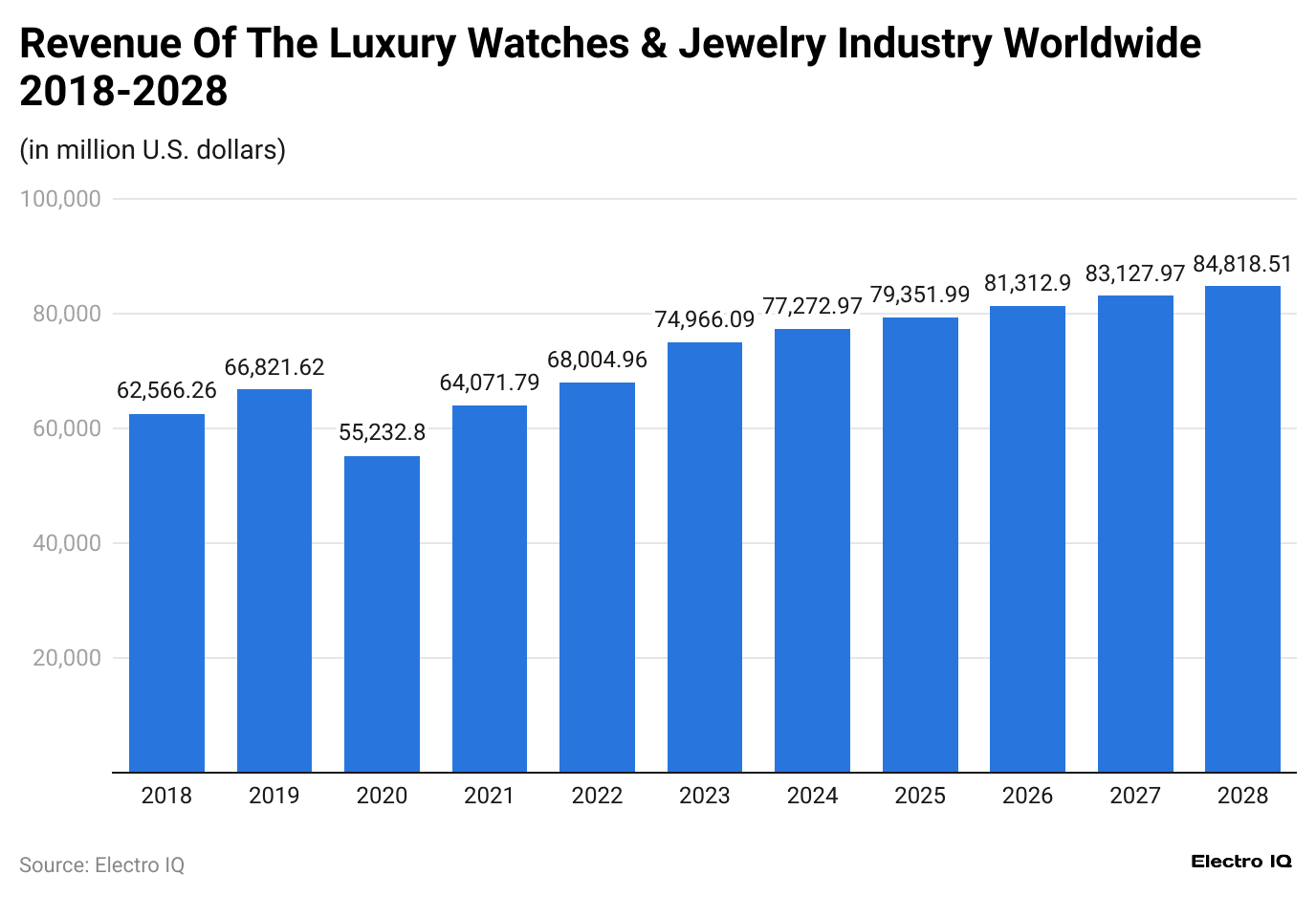
By the end of 2023, the luxury watch industry generated revenue of around $75,000.
Revenue from the luxury watch industry is predicted to reach approximately $85k by the end of 2028.
(Reference: Statista.com)
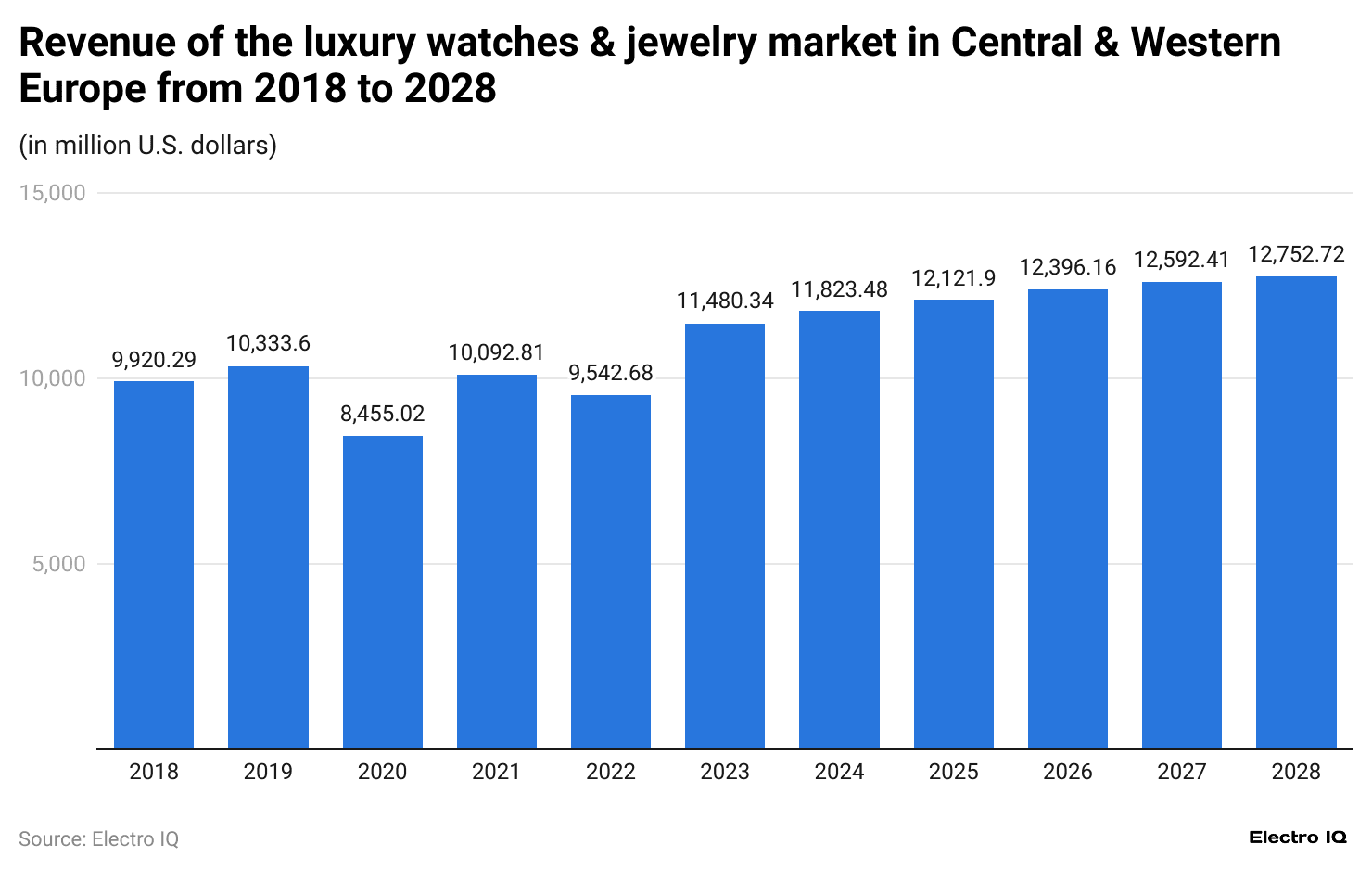
Luxury watch statistics showcase that they have generated substantial revenue in recent years.
In 2018, the luxury watch industry generated revenue of $9,920.29 billion.
By the end of 2023, there was $11,480.34 billion in revenue.
The luxury watch industry’s revenue is predicted to be $12,752.72 billion by the end of 2028.
(Reference: Statista.com)
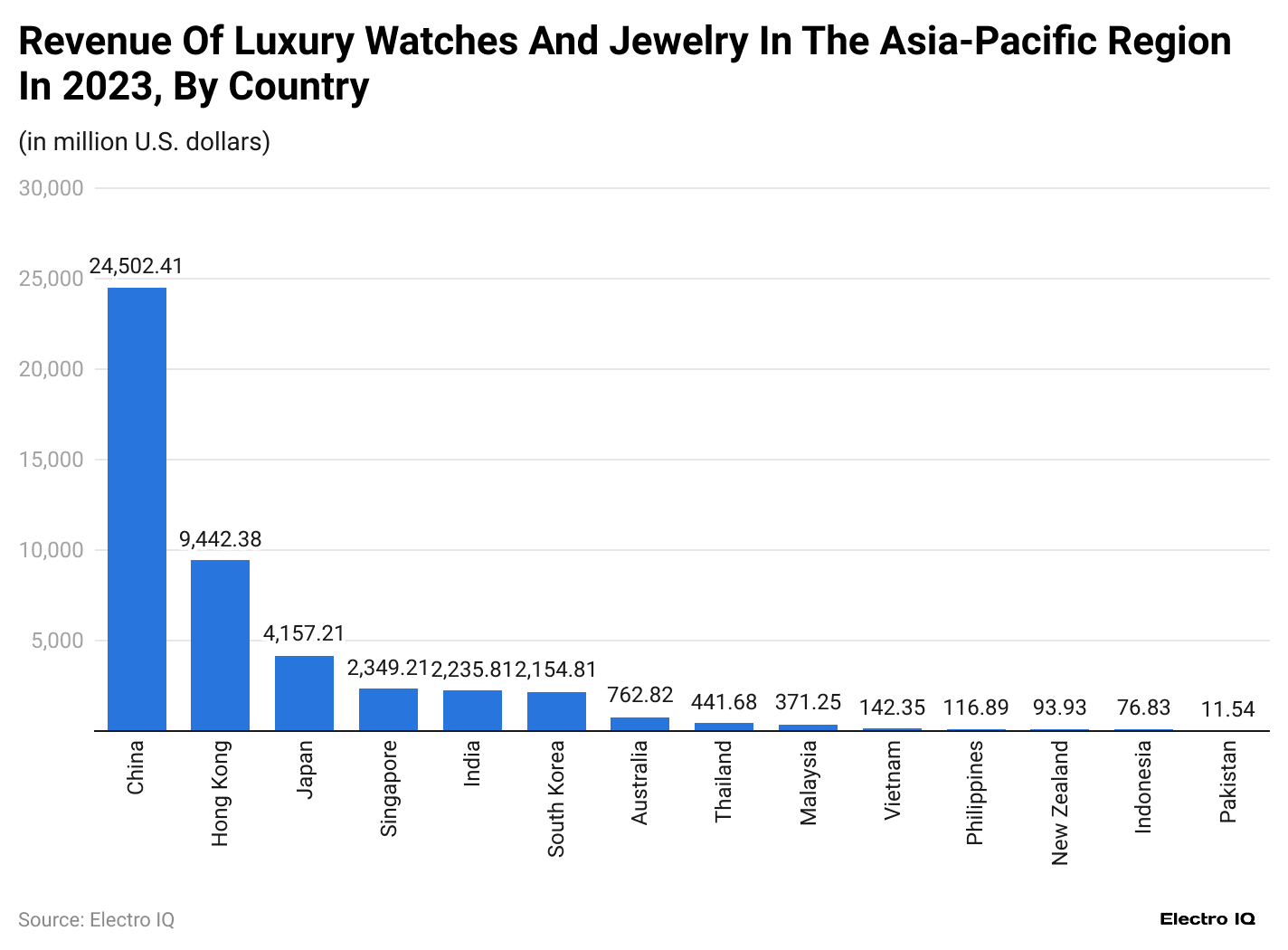
The luxury watch industry showcases that China is the highest revenue region, with revenue of $24,502.41 million in 2023.
It is followed by Hong Kong with $9,442.38 million, Japan with $4,157.21 million, Singapore with $2,349.22 million, India with $2,235.82 million, South Korea with $2,154.81 million, Australia with $762.82 million, Thailand with $441.68 million, Malaysia with $371.25 million, Vietnam with $142.35 million, Philippines with $116.89 million, New Zealand with $93.93 million, Indonesia with $76.83 million, Pakistan with $11.54 million.
(Reference: Statista.com)
The luxury watch statistics even showcase that the revenue of second-hand luxury watches is increasing consistently.
In 2014, the revenue of second-hand luxury watches was $436.87 million.
By the end of 2023, the revenue of second-hand luxury watches was $2,651.81 billion.
It is predicted that by the end of 2028, the revenue of the luxury watch industry will be $3,668.29 million.
(Reference: Statista.com)
The luxury watch industry has witnessed variable growth in recent years.
The luxury watch statistics show that in 2021, the US had a 49% growth rate. Europe has a 25% growth rate, and China’s a 40% growth rate.
It is predicted that by the end of 2024, the luxury watch industry will grow by around 4% in Europe, 3% in the US, and 5% in China.
(Reference: Statista.com)
Luxury watch statistics showcase that merger and acquisition deals were highest during 2021 at $1,096 million.