Editor’s Note
This personal reflection marks a turning point for the iconic Basel Fair, tracing its evolution from a simple trade event to a global horological showcase, and hinting at the profound changes that would follow its 2019 closure.
I never missed the annual watch and jewelry fair held every spring in Basel, Switzerland, commonly known as the “Basel Fair,” until 2019. My first visit was exactly 30 years ago, in April 1994. The trade fair was simply named “Basel 94.” It was from the following year’s “Basel 95” that the official name gained the subtitle “World Watch, Clock & Jewellery Show,” emphasizing its global scale. However, it wasn’t until 2003, after two major venue renovations, that it was rebranded as “Baselworld” to scale up.
Now, to the main topic. At Basel 94, the booth situated on the left side at the very front, just past the entrance of the main hall, was none other than IWC. Moreover, it was an impressive two-story structure primarily in the brand’s signature white color. There’s no doubt that IWC, occupying this prime spot, was the “face” of the Basel Fair at that time. Incidentally, as watch enthusiasts know, the brand name IWC is an acronym for International Watch Company. A direct translation would be International Watch Company. Both the brand name and the booth’s location made it seem like the poster child for this global watch exhibition. Regarding how the brand was referred to, in Japan, among enthusiasts and industry insiders, the easy abbreviation “Inter” was more common than “I-Double-U-C” or “International Watch Company.” As for the locals at the Basel Fair, quite a few used the German pronunciation “Ee-Veh-Tseh.” Indeed, it’s easy to say in three syllables and fits the image of this solid, robust brand. To this day, I remain a secret “Ee-Veh-Tseh” advocate.
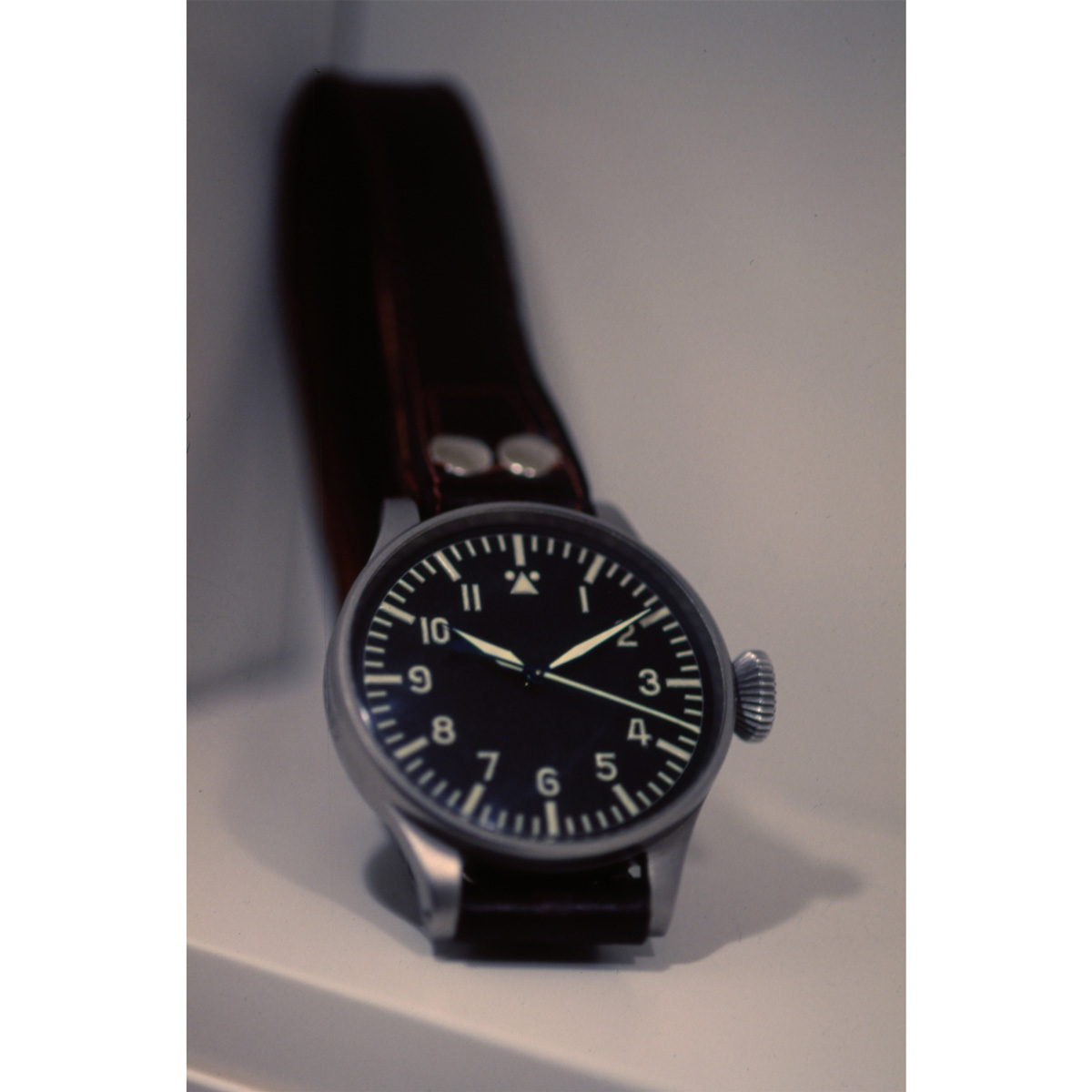
In the early 1990s, IWC was focused on reviving the pilot’s watch and building a collection around it. One source of inspiration was the large “B-Uhr” watch manufactured in 1940. By the late 90s, it was reissued under the name “Big Pilot’s Watch.”
At Basel 94, I visited IWC on the first day of coverage. In the early 90s, starting with the groundbreaking split-seconds chronograph “Doppelchronograph” launched in 1992, the brand was pouring energy into reviving its iconic pilot’s watches. Under the then Vice President Hannes A. Pantli, they were in the midst of systematically developing them into series. The historical pilot’s watches displayed in the booth’s window were a symbol of this effort. The highlights of the new releases were the steel model of the “Mechanical Flieger Chronograph” (its name at the time), a rare-for-its-exterior ceramic model, and steel bracelet versions of the “Mark XII” and the “Doppelchronograph.” All of these were mechanical. However, there was also a kind of hybrid version called the “Flieger Chronograph,” which had a quartz base with a mechanical chronograph module. Other interesting models included a dress watch application of the perpetual calendar mechanism from the “Da Vinci” in a hand-wound version. Having just celebrated its 125th anniversary the previous year, the ambitious drive of Günter Blümlein, who was steering the brand, was evident across the entire product range.
The next day, it was off to IWC’s main factory. From our hotel in the suburbs of Zurich, we drove about 50 km north by rental car, heading straight for Schaffhausen on the banks of the Rhine. For factory visits in the 90s, we often drove ourselves. I left the driving to the photographer while I navigated the unfamiliar route from the passenger seat, checking maps and road signs. It was a drive where I didn’t know left from right, but we managed to arrive safely.
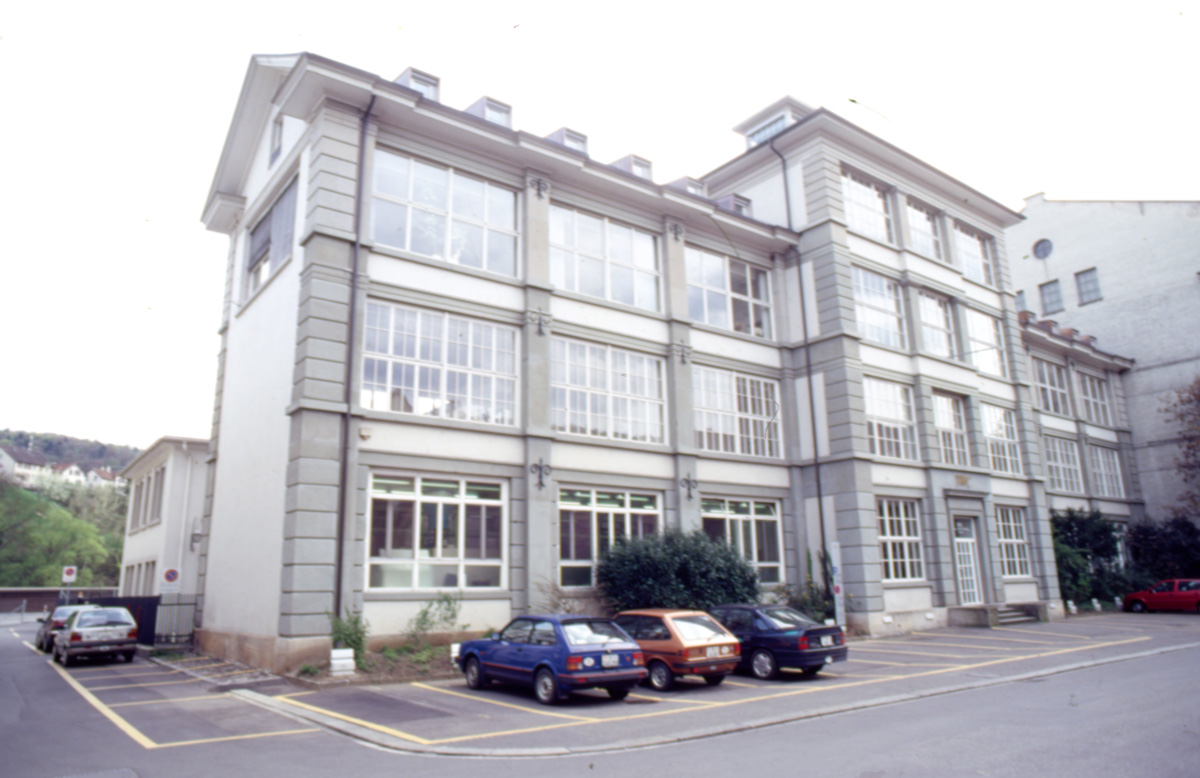
Schaffhausen is in Switzerland, yet the view of the town, which retains the appearance of a medieval fortified city, gives an unmistakably German impression. It’s also famous for being mistakenly identified as German territory during World War II due to its location north of the Rhine, leading to significant damage from American air raids. IWC’s building, facing the north side of that Rhine, is said to have been built in 1875. Through its long history of expansion and renovation, the building before us, unlike the town’s scenery, felt quite functional and modern in atmosphere. In the small park opposite the building stood a statue of Heinrich Moser, who contributed to Schaffhausen’s industrialization. Yes, he is the legendary figure who founded the present-day watch brand H. Moser.
At 9:30 AM, we met with representatives from the then Japanese import agent, Cosa Liebermann, and promptly began the tour, or rather, the visit. Our guide was none other than Kurt Klaus. In introductions, he was described as the watchmaker famous for designing the “Da Vinci” and developing grand complications. He mentioned he was currently handling guests from home and abroad, with particularly many visitors during the Basel Fair period. We toured the main production lines of the factory, visited the special complications atelier with a view of the Rhine outside its windows, and were then invited by Mr. Klaus to his private museum—a space he called his “special place,” set up in what felt like an attic room at the top of a steep staircase.
At that time in Switzerland, only a handful of watch manufacturers had established museums within their premises. In this penthouse-like space, IWC’s historical watches were displayed chronologically with explanations, and the beautiful presentation style was also impressive. It has since been relocated to the right side of the entrance.
The display cases in the exhibition rooms, divided into white and black rooms, contained everything from late 19th-century pocket watches to various 20th-century wristwatches—namely, prototypes of the “Portugieser,” successive pilot’s watches, the “Ingenieur,” and the first quartz “Da Vinci,” all arranged in chronological order. About 80% of the watches, primarily antiques, were said to be the personal property of then Vice President Hannes A. Pantli, constituting a rather substantial collection.
In the museum, what Kurt Klaus emphasized as truly innovative technology was his own design: the 1985 perpetual calendar chronograph “Da Vinci,” specifically its ceramic (zirconium oxide) model. Mr. Klaus passionately spoke about the fusion of traditional complications and modern high-tech materials. IWC is always future-oriented, he said. Come to think of it, the ceramic “Mechanical Flieger Chronograph” I had just seen the previous day was certainly an example of that.
During the visit, I was wearing a simple “Portofino.” Its automatic movement was the Cal.37521, based on the ETA 2892-A2. It was the IWC-customized version of that movement, known for being fully gilded and decorated to emphasize its visual appeal. I already had several close work colleagues who were IWC enthusiasts. From what I recall, there was the “Ingenieur” with a Genta design and a Jaeger-LeCoultre movement, and then the stylish “Sportivo” and the titanium diver “Ocean 2000” from the Porsche Design By IWC series. Alongside its technical prowess, sporty and cool designs like these were also popular in Japan. Enthusiasts were here in Schaffhausen too. Glancing at the wrists of staff working, I spotted quite a few Porsche Designs. Its popularity seemed just as high among IWC’s factory staff.
This visit was limited to the morning, so it ended as a somewhat rushed tour, which was a bit regrettable. I expressed a desire for a proper interview opportunity in the future and took my leave. After saying goodbye to IWC, the photographer and I climbed up to the Munot fortress in Schaffhausen to enjoy the view of the town below, then extended our trip to nearby Neuhausen am Rheinfall. I thought, since we were here, we should see the Rhine Falls. The renowned Rhine Falls are not a waterfall where water plunges dramatically as you might see in Japanese mountains, but rather a cascade where a massive volume of water tumbles violently down a rocky step in the river. However, considering that Heinrich Moser utilized the power of this Rhine to build a power plant in Schaffhausen, and that Florentine Ariosto Jones, who visited here, founded IWC with his support, I felt the Rhine was telling me that the factory and the Moser statue I had seen just this morning held real significance.