Editor’s Note
This article reports on a White House meeting between President Trump and major oil executives to discuss investment in Venezuela’s struggling oil industry. The administration’s push for private capital to revive the sector raises significant questions about policy, sanctions, and the future of Venezuela’s economy.
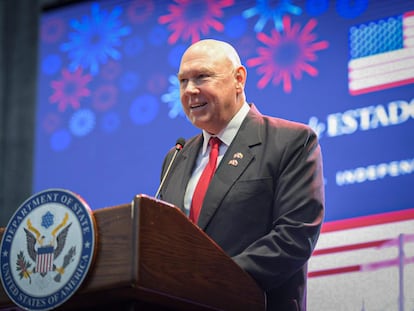
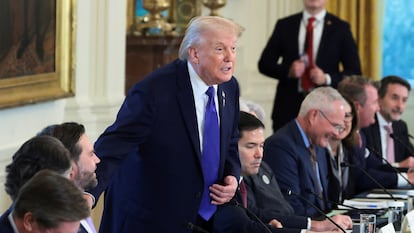
Two dozen executives from the world’s largest oil companies met this Friday at the White House with US President Donald Trump to try to clear up doubts about the investments needed for Venezuela’s oil industry to flourish again.
the Republican leader stated during the meeting with the oil companies.
he explained.
The companies have been evasive when it comes to committing to investing that amount of money. Although the executives have spoken words of appeasement towards the president, they have avoided committing to large investments.
The meeting was held behind closed doors in the East Room of the White House, a room usually reserved for receptions, but which had to be set up due to the large number of attendees, which increased at the last minute. Some of the companies had expressed their desire for the meeting to be discreet. President Trump has urged them to participate in the reconstruction of Venezuela’s oil industry for national interest.
Bloomberg reports he conveyed to the executives.
Some executives of the major oil companies have expressed their doubts about the risk of committing huge investments in Venezuela when there is still high political uncertainty. They have not forgotten the enormous losses recorded when Hugo Chávez decided to nationalize the sector almost two decades ago. Therefore, they have demanded legal and financial guarantees for billion-dollar investments, which take years to become profitable. The president has guaranteed them “the protection and security of the Government,” without specifying whether he refers to legal or physical security.
explained Mark Nelson, the president of Chevron, the only major US oil company that maintains activity in the Caribbean country, who did not commit to increasing its investments, but rather to updating the ones it already has.
Exxon, another of the major US oil companies, has stated that it is not possible to invest in Venezuela unless there are major changes.
declared Darren Woods, CEO of Exxon Mobil.
he said during the meeting.
the US president wrote a few minutes before the meeting began. And he added:
The meeting was attended by the CEOs of Chevron, the only US oil company that maintains activity in the Latin American country, Exxon, ConocoPhillips, Continental, Halliburton, HKN, Valero, the British Shell, the Spanish Repsol, the Italian Eni, Trafigura, Marathon Petroleum, Vitol Americas, Aspect Holdings, Tallgrass Energy, Raisa Energy, and Hilcorp Energy. The Republican leader anticipated that he had summoned “the biggest in the world of oil,” although there are also other smaller companies, which are more agile in carrying out the first operations.
the White House occupant slipped in a joking tone.
The CEO of Repsol, Josu Jon Imaz, participated in the meeting. The Spanish oil company is one of the few foreign companies that maintains activity in the Caribbean country. It exploits, together with the Italian Eni, one of the world’s main natural gas fields, La Perla, located in the Gulf of Venezuela, a business that represents 15% of Repsol’s total production and 85% of its business in Venezuela, which is destined for the domestic market.
Imaz stated.
