Editor’s Note
This article explores the rapid evolution of synthetic diamond production, highlighting how innovations in additive manufacturing and other technologies are enabling faster, larger-scale output and greater customization. These advancements are fueling growing demand across diverse sectors, from industrial machining to cutting-edge biomedical applications.
From the announcement of the first composite diamond made via additive manufacturing to improvements in existing technologies, the synthetic diamond industry continues to advance towards faster, more massive production, and the ability to give diamonds specific shapes and characteristics.
Demand for synthetic diamonds is constantly growing for machining tools, biomedical applications such as dentistry, optics and lasers, material strength (in the form of nanodiamonds), and of course, jewelry. The prices of synthetic diamonds are 10 to 50% lower than natural diamonds. The challenge today is to manufacture them quickly and in large quantities, and above all, to be able to give them the desired shape and characteristics. Currently, a synthetic diamond still needs to “grow,” which takes several weeks to produce a small batch. However, technologies are advancing, and new processes are emerging.
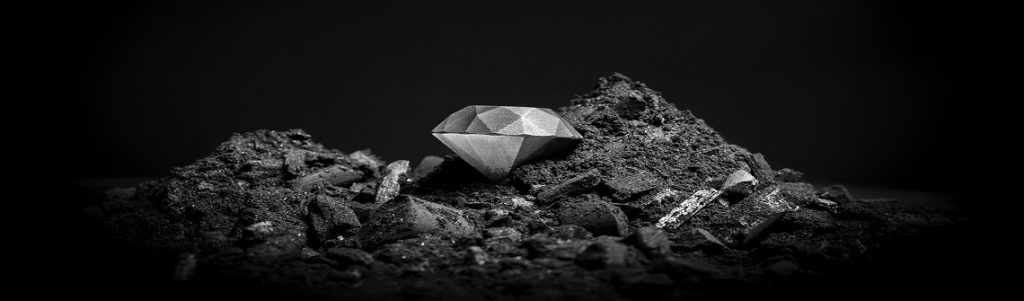
Last spring, the Swedish company Sandvik Additive Manufacturing announced it could 3D print the first composite diamonds. Even though it is still just a composite, it is already a small revolution.
Sandvik manufactures this type of diamond using a UV stereolithography process on a matrix formed from diamond powder and a polymer. The diamond, created layer by layer, can therefore take almost any shape, including complex ones. Subsequently, a patented process developed by the Swedish company allows the diamond to be given a number of sought-after properties: hardness, conductivity, low density, resistance to heat and corrosion, etc. Furthermore, the process is economical in terms of raw materials, as unused diamond powder, still mixed with polymer, can be recovered for another production. Beyond classic applications, the ability to give complex shapes to these composite diamonds should pave the way for applications yet to be invented!
Today, two main methods are used to manufacture synthetic diamonds, whether for industry or jewelry.
The first is the HPHT (High Pressure, High Temperature) process, where the gem grows in industrial presses under high pressure (up to 50,000 times atmospheric pressure) and high temperature (around 1500°C).
The second synthesis method is a CVD (Chemical Vapor Deposition) process, where growth occurs layer by layer from a silica or diamond substrate. In vapor-phase reactors, a mixture of hydrogen and methane at low pressure (0.1 atm) and temperatures around 800°C is ionized by a microwave discharge that creates a plasma in the growth chamber. This creates diamonds that are purer than HPHT diamonds but less resistant. It is on this technique that a CNRS laboratory has worked since the 1990s. The result was the creation in 2016 by one of the researchers, Alix Gicquel, of the first French producer of synthetic diamonds for jewelry (Diam Concept). The startup, which designs its own CVD reactors, is already capable of producing 60 stones per batch, compared to 10 in common commercial reactors. Now that its manufacturing process is stabilized, Diam Concept is set to join the Air Liquide group’s innovation center to be able to multiply reactors, increase batch sizes, and invest in a laser to cut its own diamonds.

Another method for manufacturing nanodiamonds for industry is being developed. It has the advantage of being able to be done at ambient temperature and pressure. It is a process using lasers that was revealed in 2015 with the discovery of Q-carbon (also called quenched carbon). The characteristics of Q-carbon are exceptional: hardness and transparency superior to diamond, loosely bound peripheral electrons, ferromagnetic behavior at room temperature, and at low pressure, a precursor to diamond.
Q-carbon is obtained by rapidly heating and cooling a thin layer of amorphous carbon (a few hundred nanometers) deposited on a substrate (sapphire, polymer, etc.). Heating is done by a laser in a few hundred nanoseconds, allowing the substrate’s surface layer to reach 4000K and enter a supercooled state. Upon cooling, the atoms arrange themselves in a form different from diamond or graphite, uniformly in space. Research has determined that by varying substrates or cooling speeds, crystallization forms are modified, and face-centered cubic crystallization characteristic of diamond can be obtained. Nano or microdiamonds can then be obtained.