Editor’s Note
This article describes an unconventional sales display observed in China’s largest physical gold market, where silver bars were stacked atop gold bars—a reversal of typical merchandising tactics. The observation highlights shifting market dynamics and consumer behavior during a holiday trading period.

During the New Year’s Day holiday when the Shanghai Gold Exchange and Shanghai Futures Exchange were closed, trading at Shuibei in Shenzhen, the largest physical gold and jewelry trading market in China, did not stop.
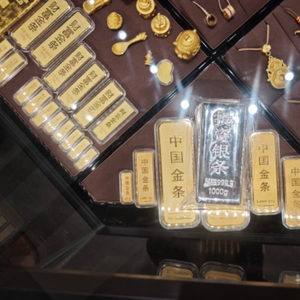
On January 4, a reporter from the 21st Century Business Herald noticed during a visit to the Shuibei market that some merchants were selling silver bars stacked on top of gold bars.
Conventional sales strategy dictates placing the best-selling or most valuable items in prominent positions. However, Shuibei merchants gave a more straightforward reason to the reporter: there was no space for the newly purchased silver bars. Consequently, the more expensive gold bars had to “take a lower position.”
This also indirectly indicates that these silver bars were likely rushed restocks, and the counters hadn’t even had time to “make space” for them.
In the past year of 2025, silver prices surged by about 140%, outperforming gold’s approximately 60% increase, making it the strongest-performing precious metal for the year. Even among major asset classes in the entire market, silver’s performance stood out.
The silver market frenzy even shifted trading from exchanges to over-the-counter markets. In late December, the only mainland market fund primarily investing in silver, Guotou Ruiyin LOF, announced purchase limits and frequent trading halts.
As a result, investors flocked to Shuibei, the largest gold and jewelry wholesale market in China, rushing to purchase physical silver like silver bars and ingots through offline channels. Some were even told that silver bars were completely pre-sold and had to return empty-handed.
For a time, even silver bars sold at a premium were in short supply. During this period, some merchants also joined in, willing to pay high prices to material suppliers for silver plates and bars.
However, the shortage of physical silver in Shuibei has seen a significant shift. On the first day after the New Year’s Day holiday (January 4), the reporter learned during a visit to the Shuibei Wanshan Jewelry Commercial Center that many merchants had numerous silver bars on display at their counters, all “available as spot goods” without the need for pre-orders. This suggests the “silver rush” for physical silver may be returning to rationality.
That day, the large screen in Shuibei quoted silver at 21 yuan, a noticeable drop from last week’s high of 23.2 yuan (this is actually the price for silver jewelry). Based on quotes from multiple Shuibei merchants, the reporter learned that the average price for investment-grade silver bars was around 19.5 yuan per gram.
During the visit, several merchants selling silver bars stacked on gold bars caught the reporter’s attention.
The reporter saw “silver bars stacked on gold bars” at at least five stalls, but over half of the larger merchants still displayed silver bars and ingots separately in dedicated areas.
Meanwhile, gold remained the “center stage” in Shuibei during the New Year period. Although silver’s gains and short-term popularity even surpassed gold last year, a Shuibei merchant revealed to the reporter that during the New Year period, there were still more investors inquiring about gold than about silver.
It is worth noting that Shuibei Wanshan is one of the few among dozens of markets in Shuibei to have a dedicated “silver jewelry zone.” The first floor is mainly for gold and platinum, the second for jadeite, and the third for silver jewelry.

The reporter further observed that the third-floor silver jewelry zone was noticeably quieter overall compared to the first and second floors, divided into retail and wholesale areas. Many retail merchants had signs saying “Live streaming, do not disturb,” focusing on online sales rather than offline transactions. Some wholesale merchants had signs like “No retail” or “Inventory counting,” mostly having their own factories with processing and shipping as their main business.
From this perspective, silver seems to have been overhyped.
Additionally, the reporter visited two brand stores located outside the market. Compared to Shuibei, brand stores had less silver bar inventory, and prices were slightly higher. The two stores had 3 and 4 silver bars left, priced at 19.7 yuan and 20.7 yuan per gram, respectively.
Compared to gold, which has nearly 100% monetary and financial attributes, silver, as the metal with the best electrical and thermal conductivity, possesses both industrial and financial attributes.
Therefore, silver is not purely a financial precious metal; industrial demand from the electronics and new energy sectors provides long-term support for its price. Especially since December, increasingly strong demand for physical silver delivery further pushed prices to a peak.
In response, the Chicago Mercantile Exchange (CME) raised margins for precious metal futures twice in the final week of December, triggering sharp adjustments in the high prices of gold and silver.
Wind data shows that from December 29, 2025, to January 4, 2026, COMEX gold fell 4.63% this week; COMEX silver fell 6.39%, a larger drop than gold, with significantly increased volatility during the period.
In Shuibei, the silver frenzy is also returning to rationality. Merchants rarely purchase at premiums anymore, and investors are turning their attention back to gold.
Regarding the difficulty of sourcing silver in late December, a merchant told the reporter directly:
On the investor side, as mentioned earlier, there were still more inquiries about gold than silver during the New Year period.
Currently, mainland investors mainly have three channels for investing in silver: public funds (now limited), futures trading, and physical silver.
Industry analysis suggests that compared to physical gold, physical silver has higher storage costs; silver is less dense, so the same weight of silver occupies about 1.84 times the volume of gold; silver’s chemical properties are slightly more reactive than gold’s and it can oxidize and tarnish in air.
On the other hand, because the silver market is much smaller than the gold market and has high concentration, the liquidity of physical silver is poor. Also, compared to gold, the spread between the selling price and buyback price for silver is larger.
Taking Shenzhen Jubao Hui’s quotes on January 4 as an example, the discount for gold buyback (974.46 yuan) compared to the selling price (979.46 yuan) was only about 0.5%; while the discount for silver buyback (18.82 yuan) compared to the selling price (19.04 yuan) was as high as 1.15%.
CITIC Securities stated that the driving force behind silver’s surge comes from multiple factors, resulting from the combined effects of financial attribute revaluation, tight physical supply and demand, market sentiment push, and macro-environmental catalysts.
Among them, the regional transfer of silver inventories was the direct trigger for this round of price spikes. Since late 2024, traders moved large amounts of silver from London to New York, causing COMEX inventories to rise sharply while LBMA inventories declined simultaneously. The inventory tightness was dramatically amplified through financial mechanisms, triggering price spikes, and the physical shortage in the London market quickly transformed into a financial squeeze.
The company believes that looking ahead to 2026, the silver market stands at a crossroads full of opportunities and risks, with intertwined bullish and bearish factors, and the game is entering a “critical point.”
Simultaneously, JPMorgan stated that the annual rebalancing of the Bloomberg Commodity Index is approaching, which may suppress recent volatility in precious metals.