Editor’s Note
This article explores a landmark moment in luxury auctions—the 2020 online sale of a historic Cartier Tutti Frutti bracelet by Sotheby’s. It highlights how the pandemic accelerated digital shifts in high-stakes art and jewelry markets, challenging traditional norms of exclusivity and access.
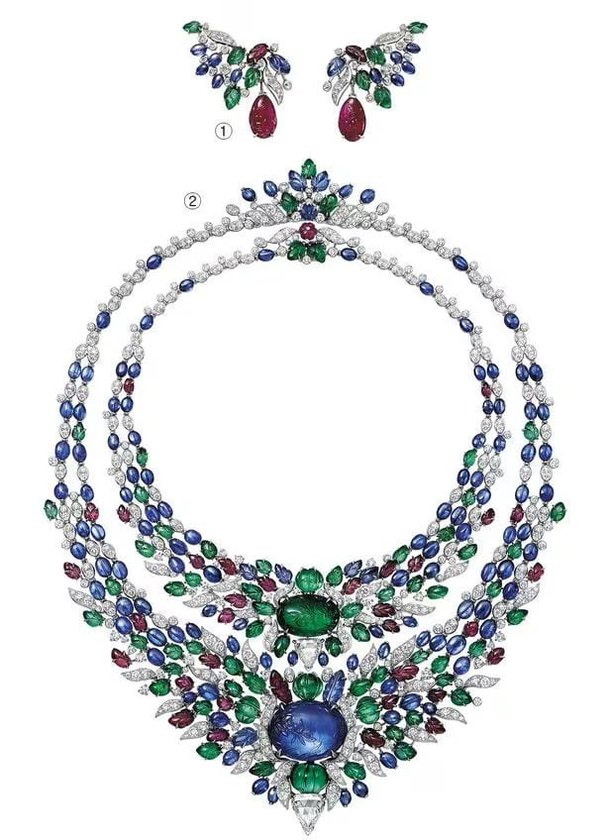
In April 2020, as the COVID-19 pandemic began to shake the world, an unbelievable piece of news arrived. A Cartier Tutti Frutti bracelet, crafted in 1930, was boldly put up for online auction by Sotheby’s New York. Tutti Frutti is not only one of the most expensive pieces of Art Deco jewelry but also a symbol of Cartier itself. The idea that this piece, which one would fly to see whenever it appeared at an auction or museum exhibition, was being sold online! Moreover, this was a ‘virgin’ piece that had never been auctioned before, making the inability to see it in person even more regrettable.
High-value jewelry at auction is a delicate and demanding category, preceded by thorough previews. However, during the ‘period of prohibition’ when all events and gatherings were canceled, it was impossible to inspect the item in person. Ultimately, after fierce bidding among five participants, the bracelet sold for double its estimated price, setting a new record for an online jewelry auction. Sotheby’s proved that the power of iconic jewelry endures even in difficult times, and I felt a sense of generational change witnessing the transfer of ownership of a historic piece with a single touch.
India was, in a word, a blessed land of gemstones. For over 2000 years, it was the world’s only source of diamonds, and with sapphire, ruby, and emerald deposits nearby, a colorful array of gems converged there. Since ancient times, Indians believed that the finest gems and pure gold possessed powerful forces to ward off misfortune and were used in dowries to pray for fertility and happiness. It was natural that the Maharajas (rulers of Indian princely states) of the 20th century, inheriting this tradition and culture, were deeply knowledgeable about gems.
Meanwhile, in the West, after World War I, manufacturing grew rapidly due to war profits, and it was a time when public consumption desires ran wild, known as the ‘Roaring Twenties.’ Art and culture flourished alongside, with jazz dominating music and the Art Deco style standing out in visual arts and jewelry. The characteristics of Art Deco design can be summarized as intense color combinations, black-and-white contrast, geometric designs, and symmetry. But above all, it boldly embraced exotic Eastern motifs, imprinting upon the public what modern sensibility meant.
It was at this time that Cartier made two significant marks on jewelry history. One was jewelry modified in a Western style for Indian clients, and the other was jewelry designed for Western clients, inspired by Indian style. If the former was the collection of the Maharajas, the latter was precisely the Tutti Frutti collection.
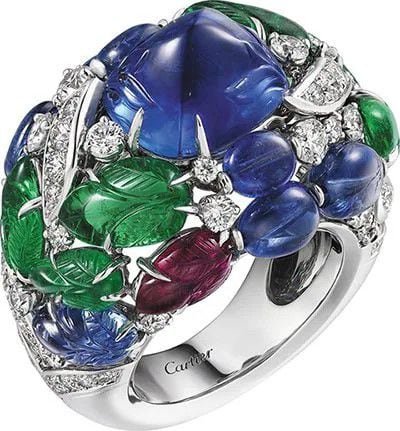
Cartier’s formal connection with India dates back to 1911. At the time, Cartier was run by the founder’s three grandsons, managing branches in Paris, New York, and London. Among them, Jacques Cartier, the head of the London branch, traveled to India on an important mission. It was an occasion for India’s Maharajas to pay homage to Britain’s George V, who had become Emperor of India. For Cartier, it was also a perfect opportunity to establish its position as a global brand. Jacques brought 133 pieces of delicate Belle Époque style jewelry (jewelry with ribbon and flower designs made of diamonds and pearls) with the intention of introducing them to India’s upper-class women.
However, he quickly had to revise his sales strategy. The primary consumers of high-end jewelry in India were the Maharajas. They had no interest in the feminine necklaces or delicate lace bracelets Jacques had brought. They wanted bold, impressive jewelry that could emphasize power and status. Having received a fresh shock, Jacques, upon returning home, began setting carved Indian colored gemstones and beads (pierced gems) in platinum and diamonds.
At the ‘International Exhibition of Modern Decorative and Industrial Arts’ held in Paris in 1925, Cartier presented Tutti Frutti to the public, combining the lavish lifestyle of the Maharajas with French modern design. As if declaring a complete break from the all-white Belle Époque jewelry of diamonds and pearls, Western society was captivated by the unique sculptural beauty that infused naturalist motifs and intense colors into the rigid black-and-white Art Deco style.
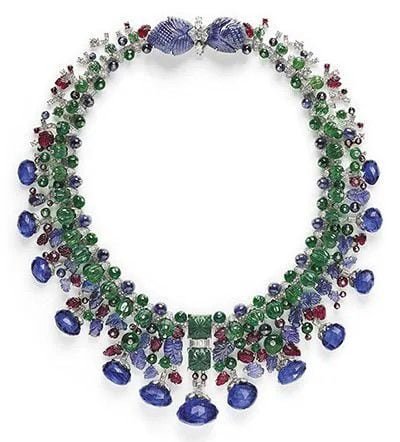
Tutti Frutti was a huge hit among Western trendsetters. Among them, one woman, deeply enamored with Indian style, helped make Tutti Frutti an unparalleled collection. She was Daisy Fellowes, heiress to the Singer sewing machine company and a fashion icon of her time. It is said that Daisy ordered a Tutti Frutti piece to ‘console herself’ after having to sell even her yacht due to the Great Depression that began with the 1929 Wall Street Crash. She reportedly used her own collection of carved sapphires, emeralds, and rubies. At the time, the fashion magazine ‘Vogue’ introduced Daisy’s Tutti Frutti piece across two pages under the title ‘The Splendor of the Orient and the Wild Character of Cartier’s Indian-style Jewelry.’ Perhaps, to European eyes, the uncut, primary-colored gemstones appeared raw and fresh.
This piece, then called the ‘Hindu Necklace,’ was inherited by Daisy’s daughter and, after her death, was auctioned in 1991, where Cartier repurchased it for $2.7 million. This was a record-breaking sum for Art Deco jewelry at auction at the time. Since then, the ‘Hindu Necklace’ has joined other masterpieces in the Cartier Collection, touring major museums worldwide.
In the 21st century, there is also someone deeply captivated by Indian jewelry: Hamad bin Abdullah Al Thani, a Qatari royal and entrepreneur. He became fascinated with India after visiting the ‘Maharaja: The Splendour of India’s Royal Courts’ exhibition at the Victoria and Albert Museum in London in 2009. This man, who had never even visited India before, amassed a collection of about 6,000 items related to India, including jewelry, in a short period, matching his passion with an investment strategy. It was a step forward from the last century’s concept of collecting, which was often dominated by sentimental ‘love story’ narratives.
However, around 400 pieces from Al Thani’s collection, boasting overwhelming quantity and museum-quality, were offered at Christie’s New York ‘Magnificent Jewels of the Maharajas and Mughals’ auction in 2019. Why did he suddenly put these masterpieces up for auction? Coincidentally, a traveling preview for this auction was being held in Hong Kong, so I immediately booked a flight ticket. Fortunately, at the preview venue, I was able to meet François Curiel, head of Christie’s jewelry department.
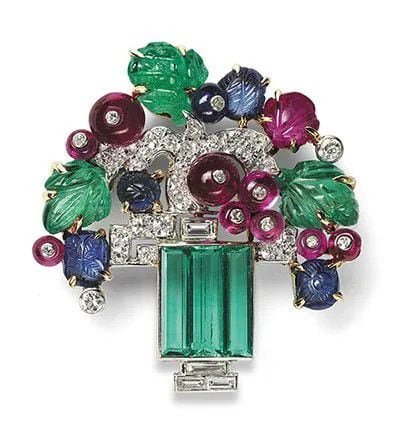
Despite being a preview exhibition for an auction, it encompassed four centuries of Indian decorative arts history, including jewelry, paintings, medieval manuscripts, and decorative objects. Impatient, I headed straight to the Art Deco jewelry section. The Tutti Frutti piece offered by Al Thani was a small brooch made in 1930. With its robust geometric design and a significantly higher proportion of diamonds, the present and past overlapped intriguingly. One could also see the Mughal Empire’s ‘Taj Mahal Emerald,’ a historic piece that Cartier had set in the ‘Berenice Necklace’ for the 1925 International Exhibition. Above all, while examining the dazzling jewelry of the Maharajas, one could vividly see how Indian and Western societies interacted and inspired each other. A few days later, the Al Thani collection, after a 12-hour marathon auction, earned $109 million (approximately 145.9 billion won), earning its place as the ‘Auction of the Century.’
A few years ago, at a gathering of Sotheby’s jewelry experts, we talked about our personal jewelry wish lists. Watching with curious eyes to see which pieces would be mentioned, everyone unanimously named Art Deco-era Tutti Frutti, causing a burst of laughter. The reason jewelry experts hold special affection for the Art Deco era is that it encapsulates the free-spirited art and design of the early 20th century, a rapidly changing social landscape, and the history of new science.
Born in Paris after World War I, Tutti Frutti perfectly captured the fiery passion that filled the ‘Roaring Twenties’ and the romance between East and West. A hundred years later, even today, Cartier does not remain within the bounds of retro style but reflects the spirit of the times like a mirror, presenting a 21st-century version of Tutti Frutti. This can be seen in the High Jewelry collections released annually.
Given my profession of researching and teaching gemstones and jewelry, time for meticulous observation of physical products is crucial. Especially for Tutti Frutti, as the size or proportion of gemstones used varies for each product, and the shapes of the carvings are diverse, careful examination is necessary. The bracelet is the most symbolic piece of Art Deco-era Tutti Frutti. However, at auctions, they appear as rarely as rain in a drought, and the often-seen pin brooches are frequently disappointing because the set gemstones are small. If you wish to encounter Tutti Frutti ‘masterpieces’ from the 21st and 20th centuries, I recommend the museum exhibitions occasionally held by Cartier.