Editor’s Note
This article provides a clear, technical definition of diamond, distinguishing between its natural and lab-grown forms. It serves as a foundational overview for understanding the material’s properties and classifications within both scientific and commercial contexts.
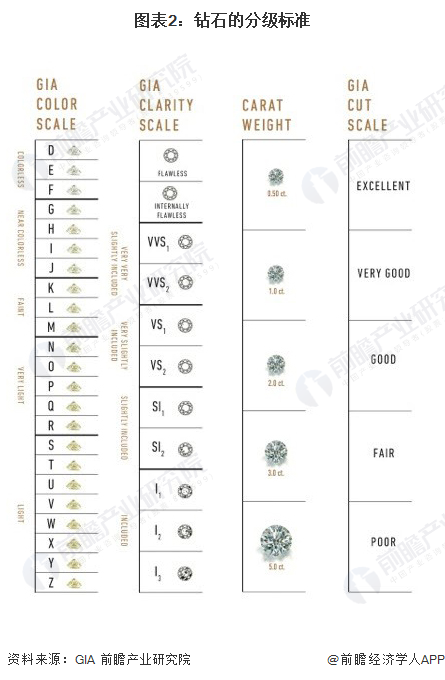
Diamond is a colorless crystal composed of carbon, currently the hardest known substance after moissanite. Diamond is one of the five precious gemstones and is referred to as “diamond” in chemistry and industrial fields. Based on the production method, diamonds can be divided into natural diamonds and lab-grown diamonds. Natural diamonds refer to diamonds mined from natural diamond mines; lab-grown diamonds refer to diamonds artificially cultivated in a laboratory by simulating the natural diamond growth environment using carbon powder. Unlike colored gemstones and jade, diamonds have a systematic grading standard (the 4C grading standard), and the price of polished diamonds can be determined based on this standard.
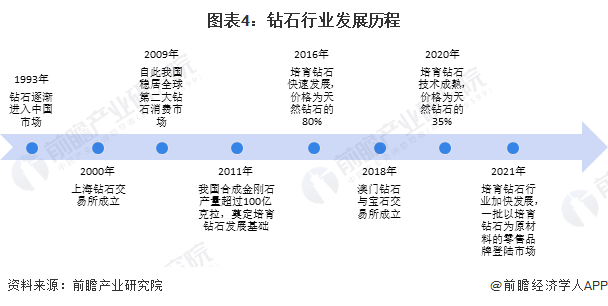
Since 1993, De Beers entered the Chinese market with the advertising slogan “A diamond is forever,” and diamonds began to be vigorously pursued by Chinese consumers. In 2000, to standardize industry trading models, the Shanghai Diamond Exchange was established. However, natural diamond prices are high and supply is relatively tight. To alleviate supply-demand tensions, China has continuously conducted research and development on lab-grown diamonds, constantly improving production technology and product quality. Since 2016, China’s lab-grown diamonds have entered a rapid development channel, priced at 80% of natural diamonds. By 2020, lab-grown diamond technology matured, and prices dropped to 35% of natural diamonds. From 2021 to the present, terminal retail for lab-grown diamonds has surged, with a large number of retail brands using lab-grown diamonds as raw materials appearing in the market, and consumer acceptance has been gradually and silently increasing.
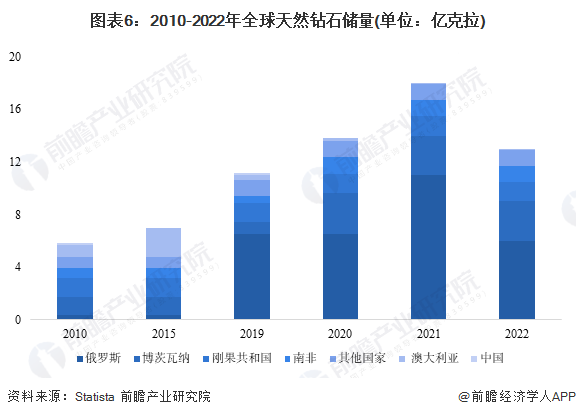
From the perspective of the upstream diamond mining segment of the diamond industry chain, Russia currently has the world’s largest natural diamond reserves. According to Statista data, Russia’s natural diamond reserves in 2022 were 600 million carats; global total natural diamond reserves were 1.301 billion carats, with Russia’s natural diamond reserves accounting for 46.12% of the world’s total. On the other hand, countries such as Botswana, Canada, South Africa, and Australia have maintained unchanged natural diamond reserves since 2021, and the tight supply situation for global natural diamonds may continue.
China’s diamond market demand is huge, being the world’s second-largest diamond consumer country, driving the rapid development of China’s lab-grown diamond industry. From the perspective of the upstream lab-grown diamond production segment of the diamond industry chain, according to Frost & Sullivan, China’s lab-grown diamond production capacity ranked first in the world in 2020, reaching 3 million carats. Next, India and the United States ranked as the world’s second and third largest lab-grown diamond producing countries, with production capacities of 1.5 million carats and 1 million carats respectively in 2020.
From the perspective of the midstream cutting and processing segment of the diamond industry chain, currently, the global diamond cutting and processing market share is mainly concentrated in India. In 2021, India’s diamond cutting and processing market share accounted for 96% of the global share, while China only had 2%. Furthermore, the market share of India’s diamond cutting and processing segment is still increasing year by year, from 80% in 2013, an increase of 16 percentage points over ten years.
From the perspective of the downstream retail consumption segment, China’s diamond market size has increased rapidly. In 2000, it was only $560 million, accounting for 1% of the global diamond market size. By 2021, China’s diamond market size had increased to $12.4 billion, more than 20 times that of 2000. In 2021, China’s diamond market size accounted for 14% of the global share.
From the perspective of diamond import conditions, because the diamond industry has strong consumption and luxury attributes, it is greatly affected by changes in residents’ income. Residents’ income was affected by the new coronavirus pandemic, declining significantly in 2020, so China’s diamond industry import volume and import value were greatly affected in 2020. In 2021, thanks to effective domestic prevention and control measures, the pandemic was controlled, the business environment recovered somewhat, driving a rebound in the diamond industry. In 2022, China’s diamond industry import value and volume shrank somewhat, with import volume and import value being 2045 kilograms and $8.477 billion respectively.
From the perspective of diamond consumption market space, diamond jewelry still has relatively large development space in the future. According to the Shanghai Diamond Exchange, in 2021, China’s jewelry market size reached $94.4 billion, and China’s diamond market size reached $12.4 billion. China’s diamond market size accounted for 13.14% of the jewelry market size. Compared to the United States’ diamond market size accounting for 56.05% of the jewelry market size and the global diamond market size accounting for 25.44% of the jewelry market size, China’s diamond market size share is expected to rise further. At the same time, consumer awareness and approval of diamonds can be further enhanced through training and publicity.
Note: The chart data is updated to 2021.
Chinese consumers are more willing to purchase diamond jewelry to reward themselves. According to Frost & Sullivan, in the structure of China’s diamond jewelry consumption scenarios, self-purchase and self-use is the largest part, reaching 46%.