Editor’s Note
A research team at Stanford University has achieved a significant breakthrough in laser technology, successfully fabricating a titanium-sapphire laser on a chip. As reported in *Nature*, this innovation reduces the device’s volume by a factor of 10,000 and cuts costs by a factor of 1,000 compared to existing models, marking a major step forward in miniaturization and affordability for advanced photonics.
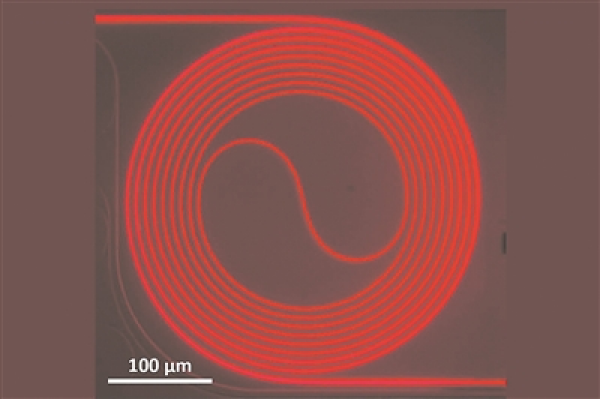
According to a report in the journal Nature on June 26, a team from Stanford University in the United States has successfully fabricated a titanium-sapphire laser on a chip. Compared to any other existing titanium-sapphire laser, this prototype’s volume has been reduced by four orders of magnitude (to one ten-thousandth of the original size), and its cost has been lowered by three orders of magnitude (to one thousandth of the original cost). This achievement represents a significant leap forward in both scale efficiency and affordability.
Titanium-sapphire lasers are indispensable in many cutting-edge fields such as quantum optics, spectroscopy, and neuroscience. However, their widespread application in the real world has been limited. This is because these lasers are typically bulky and expensive, costing hundreds of thousands of dollars per unit, and require other high-power equipment (costing around $30,000 each) to operate.
For this new device, the researchers first laid a large piece of titanium-sapphire on a silica platform. The titanium-sapphire was then ground, etched, and polished into an extremely thin layer, only a few hundred nanometers thick. Subsequently, a vortex composed of tiny ridges was designed onto this thin layer. These ridges function like fiber optic cables, guiding light to circulate continuously, gradually increasing its intensity. This configuration is known as a waveguide.
The remaining component is a micro-scale heater, which can heat the light passing through the waveguide. This allows researchers to alter the wavelength of the emitted light, tuning it across a range of 700 to 1000 nanometers—spanning from red light to infrared light.
In quantum physics, this new laser could significantly reduce the size of state-of-the-art quantum computers. In neuroscience, it could find applications in optogenetics, allowing scientists to control neurons by guiding light inside the brain through relatively large optical fibers. In ophthalmology, it might enable new applications in laser surgery when combined with chirped pulse amplification technology, or provide cheaper, more compact optical coherence tomography for assessing retinal health.
Currently, evolving technologies are enabling many laboratories to possess ultra-compact lasers on a single chip, rather than relying on a single large and expensive laser unit. Smaller lasers can actually enhance efficiency—mathematically, intensity equals power divided by area. Therefore, maintaining the same power as a large laser but concentrating it over a smaller area results in a substantial increase in intensity. More importantly, these compact yet powerful lasers can move out of the laboratory faster and serve many different critical applications.