Editor’s Note
This financing round for the high-end gold jewelry brand Bao Lan, backed by notable investors, signals strong confidence in its niche craftsmanship and growth strategy.
Recently, the high-end gold jewelry brand “Bao Lan,” which specializes in filigree inlay and ancient gold craftsmanship, announced the completion of a Series A financing round exceeding 100 million RMB. This round was led by Challenger Capital, with Kering Group and Shunwei Capital participating as co-investors. It is reported that the funds will focus on four core strategic directions: deepening brand value, deploying omni-channel distribution, upgrading supply chain resilience, and empowering core talent.
When discussing the investment rationale, Challenger Capital stated:
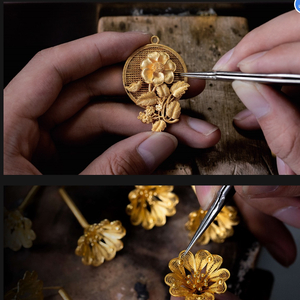
It is reported that Bao Lan originated from a family of gold jewelry artisans, possessing a profound gene of Eastern aesthetics and craftsmanship from its inception. The founder began learning traditional goldsmithing techniques in his teens and later moved north to Beijing to establish a gold workshop, laying the foundation for Bao Lan. During its development in Beijing, the workshop had the fortune to meet and absorb several master inheritors and their disciples of the national-level intangible cultural heritage skill “filigree inlay.” This 3,000-year-old imperial court technique has since been deeply imprinted in Bao Lan’s brand DNA. Bao Lan not only inherits ancient production techniques but also integrates the enduring essence of Eastern art spanning millennia into contemporary aesthetics.

Currently, the “gold” sector presents a competitive landscape differentiated from large-scale mainstream brands. Represented by Lao Pu Gold, which relies on its ultimate ancient gold craftsmanship and high-end positioning, it has achieved extremely high product premiums and per-store output value. In the first half of 2025, Lao Pu Gold’s revenue was 12.354 billion RMB, a year-on-year increase of 251%; its profit for the period was 2.268 billion RMB, a year-on-year increase of 285.8%.
Lao Pu Gold stated that although the company primarily focuses on offline channel sales, during the 2025 Tmall 618 shopping festival, its Tmall flagship store topped the sales performance chart in the gold category, with transaction volume exceeding 1 billion RMB, making it the first gold jewelry brand to achieve this result. During the reporting period, the company’s online channels achieved total sales performance of approximately 1.943 billion RMB; as of June 30, 2025, Lao Pu Gold’s loyal members reached approximately 480,000, an increase of 130,000 compared to December 31, 2024.
As of June 30, 2025, Lao Pu Gold had opened 41 self-operated stores in 16 cities, all located within 29 renowned commercial centers with strict entry requirements, including SKP-affiliated (6 stores) and MixC-affiliated (11 stores) malls.
Leading listed enterprises such as Chow Tai Fook also indicated in their latest financial reports that the drivers of their high growth have shifted from mere channel expansion to craftsmanship upgrades and product structure optimization led by ancient gold products like the “Heritage” series. According to Chow Tai Fook’s interim report for the 2025 fiscal year, its turnover in the first half increased by 19.2% year-on-year, with strong performance in the mainland market; Lao Feng Xiang’s Q3 2024 report also showed double-digit growth in both revenue and net profit.
Some industry analysts point out that the current Chinese gold jewelry market is gradually bifurcating: on one side are large-scale brands represented by Chow Tai Fook and Lao Feng Xiang, driving growth through extensive distribution networks and full-category coverage; on the other side are vertical boutique brands represented by Lao Pu Gold, whose core barriers lie in scarce intangible cultural heritage skills, unique cultural aesthetics, and the resulting loyalty of high-net-worth customer groups. Against the backdrop of an increasingly stable competitive landscape in the mainstream market, “Bao Lan” securing investment from top-tier institutions indicates that capital is actively seeking and betting on emerging brands that can establish unique moats in niche markets by leveraging hard-to-replicate cultural assets and top-tier craftsmanship. This also signals that China’s high-end consumer market is moving towards deeper value segmentation and maturity.