Editor’s Note
The recent policy shifts in Hainan are creating unique opportunities for gold purchases, as detailed in this report. The data indicates a significant surge in foreign investment following the island’s customs closure, suggesting a growing international interest in the region’s newly implemented economic measures.
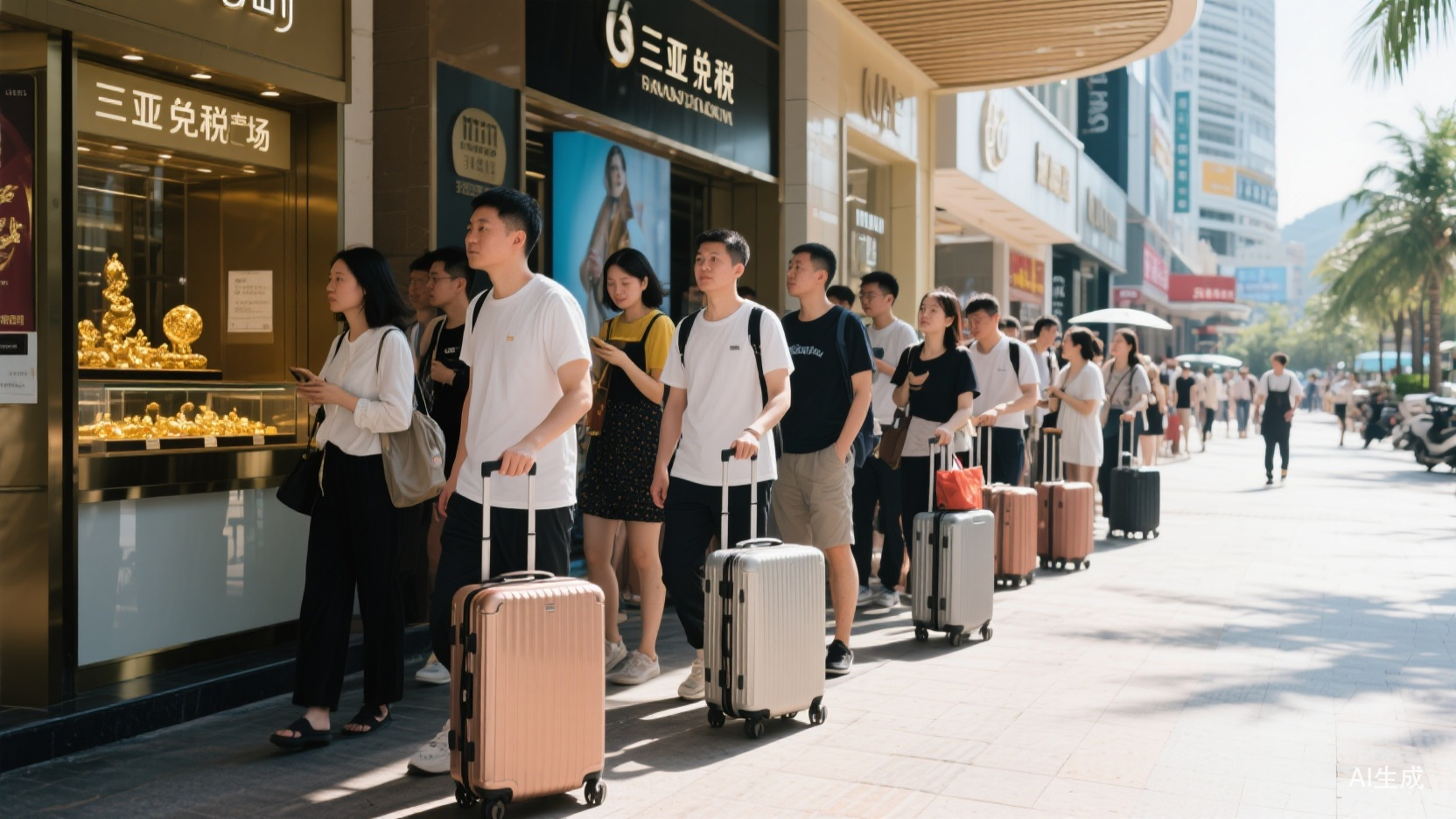
A long-distance gold rush is unfolding in Hainan. As of today, more than ten days have passed since the official launch of the island-wide customs closure operation in the Hainan Free Trade Port on December 18. Multiple related policies have seen their first batch of business implementations. Data from Haikou Customs shows that in the first week after the closure, Hainan saw 1,972 new foreign-invested registered enterprises, a year-on-year increase of 2.3 times.
After the closure, Hainan’s core policies focus on “zero tariffs, low tax rates, and a simplified tax system.” The policy indicates that the “zero tariff” policy mainly includes: comprehensive liberalization at the “first line” (the national border): Except for a very few exceptions (such as items endangering national security or the ecological environment), the vast majority of overseas goods entering the Hainan Free Trade Port are exempt from import tariffs, import value-added tax, and consumption tax.
Limited supervision at the “second line” (between Hainan and mainland China): The flow of goods between Hainan and the mainland is treated as “import” and requires tax payment according to regulations. However, goods produced by island-based enterprises with a processing value-added exceeding 30% (inclusive) are exempt from import tariffs when entering the mainland (already piloted in the Yangpu Bonded Port Area, to be extended island-wide after closure). The specific list for “zero tariffs” achieves full coverage.
A significant change is that the proportion of “zero tariff” commodity items has jumped sharply from about 21% before the closure to 74%. Production equipment imported for self-use by enterprises, transportation vehicles required for operations, and raw and auxiliary materials are basically all exempt from import tariffs, VAT, and consumption tax. The duty-free shopping quota for individuals has also been raised to 100,000 yuan per person per year.
For ordinary consumers, enjoying tax benefits still relies on the “duty-free shopping for off-island travelers” policy. According to statistics, in the six days following the closure, the sales of four duty-free shops in Sanya reached 630 million yuan, a year-on-year increase of 47.2%, with daily average sales exceeding 100 million yuan.
Before people had time to define the potential impact of this policy across various industries, a gold rush from the middle class quickly spread to Sanya and Haikou in Hainan.
Gold companies such as Zijin Mining, China Gold, and Lao Feng Xiang have also laid out plans in Hainan, establishing industrial parks or regional headquarters.
This gold rush began on December 19, the day after the closure. At that time, the price display board at Lao Miao Gold showed that the duty-free gold price for the day was 1,180 yuan/gram, while the tax-inclusive price was 1,356 yuan/gram, making the duty-free price 176 yuan/gram cheaper.
The key to the price advantage is that relevant taxes and fees originally levied on imported gold jewelry can be reduced or exempted at specific stages. Government subsidies and mall promotions can further lower the actual purchase price.
Standing at this historical juncture of record-high gold prices, for consumers, the tax benefits brought by Hainan’s customs closure indeed make buying gold jewelry cheaper, which can truly become a dividend for personal asset allocation. This explains why some people even come dragging suitcases.
In fact, even before Hainan’s customs closure, gold jewelry in Hainan’s duty-free shops already had duty-free status and government coupons. According to the China Gold News, the Hainan Free Trade Port had previously provided multiple policy supports for the gold and jewelry industry.
For example, the processing value-added duty exemption policy. Data from Hainan Customs shows that in the first half of 2025, Hainan enterprises utilized this policy to enjoy benefits on newly added goods worth 3.16 billion yuan, with tax reductions and exemptions amounting to 233 million yuan. Forty-eight enterprises across the province that have enjoyed benefits involve 10 industry categories and 44 product application scenarios. Among them, 7 jewelry manufacturing enterprises, as well as products like pearl jewelry and sapphire jewelry, were among the first to benefit.
The second key policy is the tax incentive policy. Hainan has explicitly included “precious stone processing and jewelry inlay manufacturing” in the encouraged industry catalog. Eligible enterprises can enjoy a preferential corporate income tax rate of 15%, lower than the mainland’s 25%. Simultaneously, the portion of actual tax burden exceeding 15% for high-end talents is exempted.
By the end of December, the gold rush in Hainan after the closure continues to heat up and intensify. Gold prices have already sustained an astonishing bull market this year. Reports such as “After Hainan’s customs closure, the middle class swarms in to grab gold, buying 40 grams of gold jewelry can save over 10,000 yuan” densely topped trending lists on major social media platforms for a time.
The frenzy of the middle class heading south for gold is just a microcosm. For the gold industry, Hainan’s customs closure will also bring deeper opportunities.
On one hand, it benefits the gold processing sector on the industrial side. Many investors and enterprises have turned their attention to links in the industrial chain such as gold processing, trading, and storage, making plans in Hainan to build industrial parks, regional headquarters, or creative centers.
Public data shows that Zijin Mining announced in December this year its investment in building an international business headquarters in Sanya, Hainan, and will timely engage in deep processing of gold. According to the National Enterprise Credit Information Publicity System, Zijin (Hainan) International Mining Operation and Management Co., Ltd. was established on December 9 with a registered capital of 100 million yuan. Its business scope includes non-coal mine mineral resource mining, metal and non-metal mineral resource geological exploration, mineral resource reserve estimation and report preparation services, etc.
Equity penetration shows that the company is wholly owned by Zijin Mining Group Co., Ltd.
China Gold announced in early December this year its plan to establish a wholly-owned subsidiary in Hainan Province—China Gold Jewelry International Co., Ltd., with a registered capital as high as 500 million yuan. Lao Feng Xiang has also established Lao Feng Xiang (Hainan) Jewelry Co., Ltd. and Lao Feng Xiang (Hainan) Gold Jewelry Fashion Creative Center Co., Ltd. in Hainan.
Many well-known jewelry brands including De Beers, Bulgari, and TSL have already established a presence in Hainan.
More and more gold industry players are contemplating how to leverage Hainan’s geographical advantages to transform the landscape, address shortcomings such as talent shortages and relatively backward supporting facilities, and explore more possibilities like gold entrepot trade.
Many people also fantasize about buying gold bars in Hainan and profiting from the price difference by reselling them on the mainland. However, arbitrage opportunities come with hidden risks.
Gold commodities have high unit prices and heavy taxes. Once the carried amount exceeds the duty-free quota, or the quantity exceeds the reasonable quantity for personal use stipulated by customs, tariffs, VAT, and consumption tax must be paid. Moreover, the认定 of duty-free goods for reasonable personal use is not solely based on amount but also on category and quantity.
If an individual carries goods exceeding the duty-free regulations from Hainan back to the mainland, the price advantage disappears after paying the taxes.
It is reported that the current duty-free shopping quota for off-island travelers is 100,000 yuan per person per year. However, many media reports have already highlighted the phenomenon of a large number of professional代购疯狂抢购 in duty-free shops. This has also triggered regulatory upgrades—Hainan has established a “Duty-Free Product Traceability System,” implementing yellow list warnings for frequent purchasers.
Gold jewelry itself is an industry that integrates value, raw materials, and design attributes. Therefore, Hainan’s current gold advantage is still mainly reflected in “processing value-added” and “duty-free consumption for off-island travelers.”
The real gold rush opportunity is destined not to depend on the price difference per gram, but on the industrial ecosystem effects released after the full island customs closure operation in Hainan.
Since entering 2024, influenced by multiple factors, international gold prices have repeatedly hit record highs, and domestic gold prices have also risen accordingly, with retail gold prices once soaring to over 600 yuan per gram. Market risks and volatility in gold prices always exist.
The current “gold rush” is largely also built on expectations of continued gold price increases.
For consumers, how long can the heat of buying gold in Hainan last? After the狂欢, this middle-class gold rush will ultimately return to rationality.