Editor’s Note
This article highlights the latest ESG rating performance for Hong Kong and A-share companies, revealing a trend of balanced performance among Hong Kong stocks and notable polarization in the A-share market. The findings underscore the growing importance of ESG considerations in investment decisions and corporate governance.
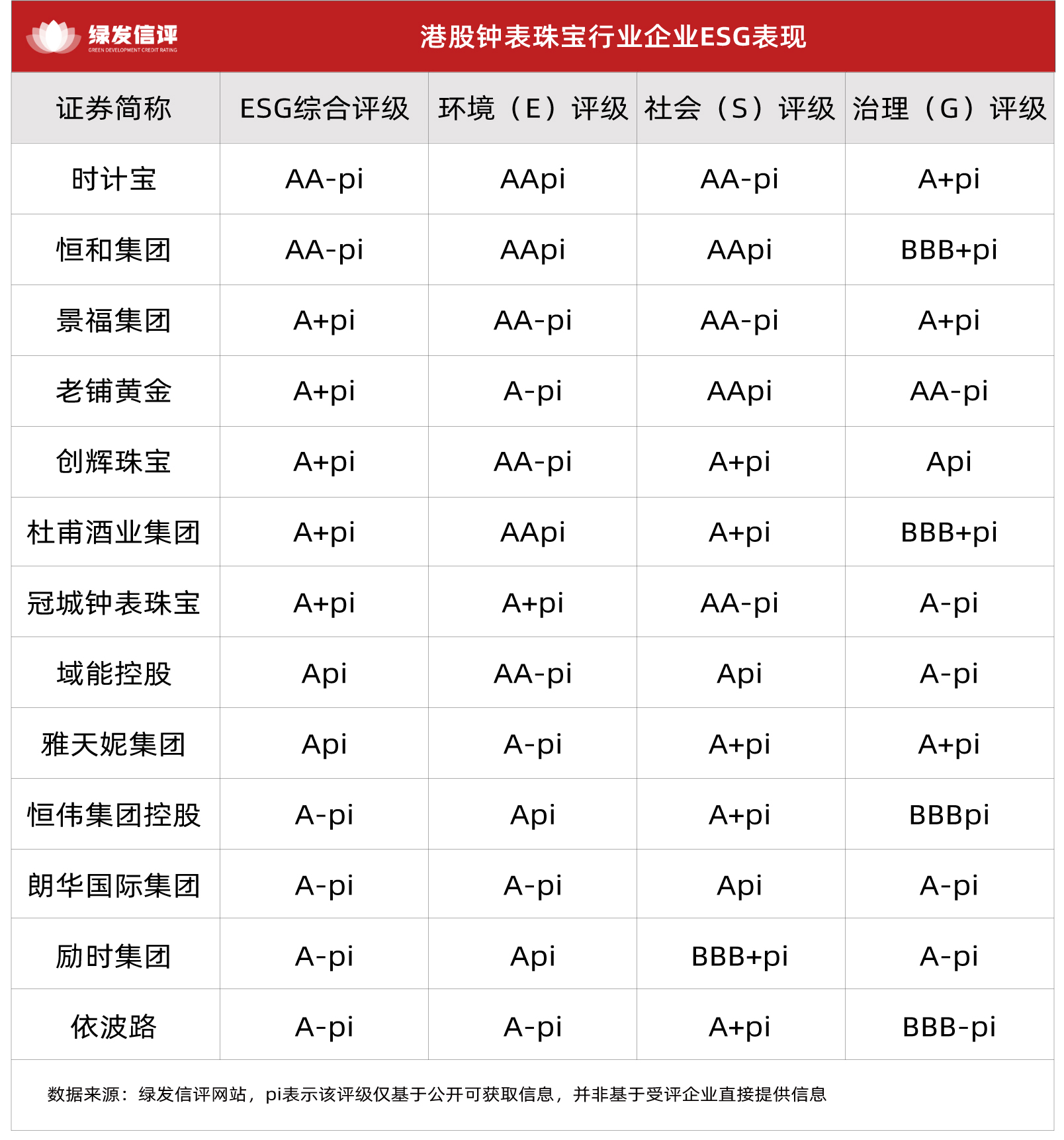
The active ESG rating results from Hainan Green Development Credit Rating Co., Ltd. (“Green Development Credit Rating”) show that Hong Kong-listed watch and jewelry companies generally achieve higher overall ESG ratings. Time Watch and Henghe Group lead the industry with AA-pi ratings, while King Fook Holdings, Lao Pu Gold, and three other companies received A+pi ratings. All other companies received ratings of A-pi or above, presenting an overall characteristic of “high rating concentration and low differentiation.”
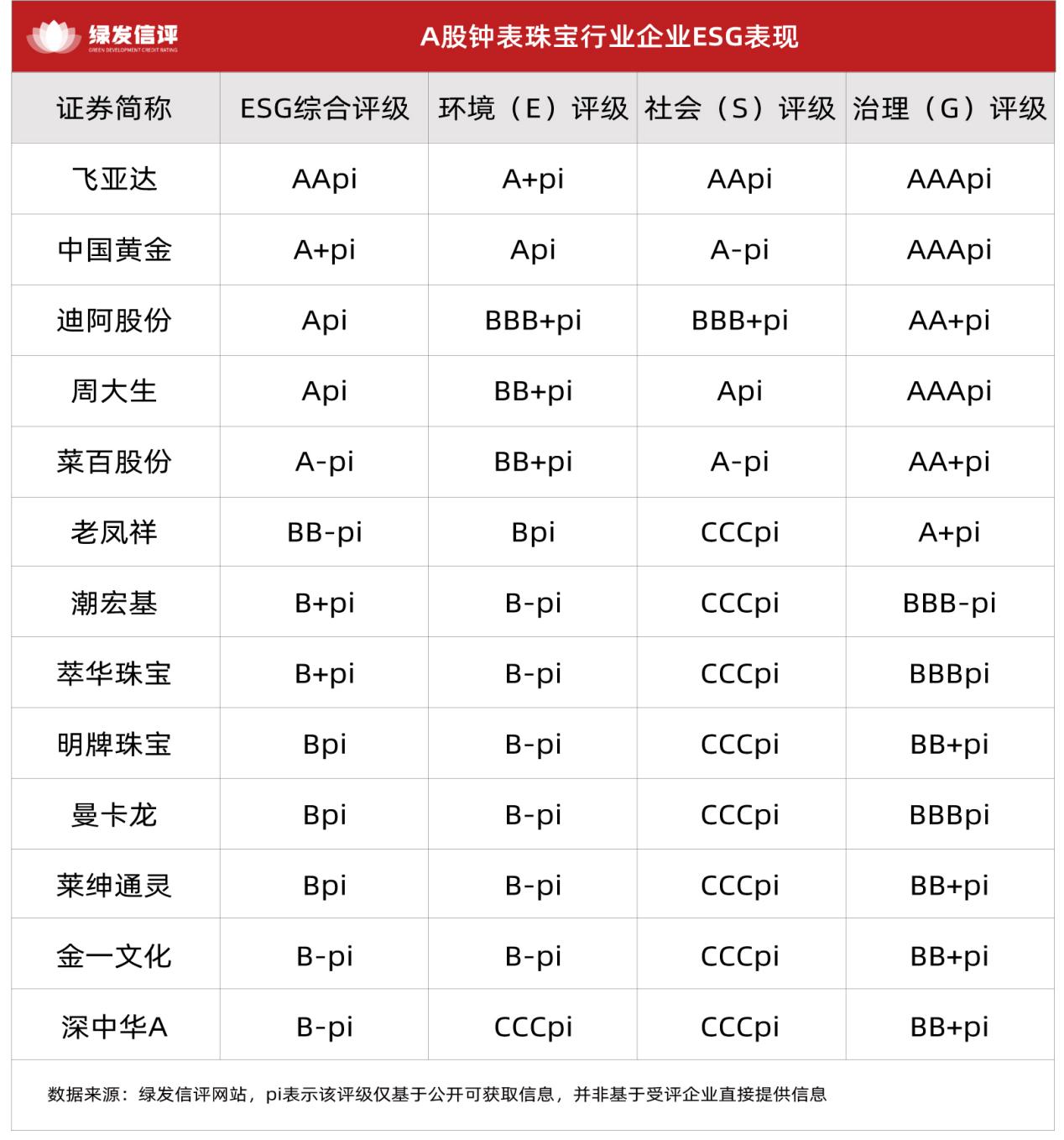
A-share company ratings show a tiered distribution of “leading outperformance with weaker tail performance.” Among the 13 companies, Fiyta obtained the highest rating of AApi, followed by China Gold with A+pi. DR and Chow Tai Seng received Api ratings, and Caibai obtained A-pi. However, eight companies, including Lao Feng Xiang, have ratings concentrated at BB-pi and below, with Jinyi Culture and Shen Zhong Hua A receiving the lowest rating of B-pi, indicating a significant rating gap within the industry.
In specific dimensions, Hong Kong-listed companies perform more prominently in environmental and social dimensions, with most maintaining ratings of A-pi or above, demonstrating more mature green production management and social responsibility fulfillment systems. A-share companies have certain advantages in the governance dimension, where leading companies generally achieve governance ratings of AA+pi or above, though there is still significant room for improvement in environment and social-related areas.
In the environmental dimension, green production and low-carbon transition are key. The raw material extraction and processing/manufacturing stages of the watch and jewelry industry involve environmental impacts such as mineral resource consumption and wastewater/air emissions. Key environmental issues focus on low-carbon production, resource recycling, and pollutant reduction. Companies need to increase investment in environmental technology R&D, promote clean production processes, and optimize energy structures to reduce their carbon footprint. Simultaneously, they should establish raw material traceability and sustainable procurement mechanisms to reduce waste of scarce resources, promote the recyclability of packaging materials, and fulfill ecological responsibilities through green management across the entire industry chain.
In the social dimension, responsible supply chains and value co-creation are crucial. The industry has a long supply chain involving many entities, so social responsibility should focus on three main directions: supply chain ethics, employee rights protection, and consumer value creation. On the supply chain side, it is necessary to establish a full-chain audit system covering mineral extraction, raw material processing, and finished product manufacturing to safeguard labor rights and production safety. In internal management, companies should improve employee training, career development, and welfare protection mechanisms, building an inclusive and diverse work environment. For consumers, companies must adhere to the bottom line of product quality and safety, strengthen after-sales service and rights protection channels, while also conveying brand social responsibility values through cultural dissemination and public welfare projects to enhance consumer trust.
Sound corporate governance is an important guarantee for sustainable ESG development, with core issues including governance structure optimization, ESG information disclosure, and internal control/compliance system building. Companies need to establish a clear governance structure with well-defined responsibilities, integrate ESG strategy into overall corporate development plans, and clarify the division of ESG responsibilities between the board of directors and management. They should strengthen the comprehensiveness and granularity of ESG information disclosure, proactively disclosing key data such as environmental emissions and social responsibility fulfillment to the market. Robust internal control and risk management mechanisms should be established to prevent potential issues like compliance risks and supply chain risks, laying a solid foundation for high-quality industry development through a standardized and transparent governance system.
In carbon reduction, Fiyta has set clear environmental performance targets. Its subsidiary, Technology Development Company, established a greenhouse gas management team responsible for formulating and implementing annual emission reduction targets. It also identifies potential climate change risks and opportunities for the business, developing and conducting drills for extreme weather contingency plans. Fiyta participated in formulating the “Technical Requirements for Carbon Footprint Assessment – Mechanical Watches,” released in October 2024, providing a reference for industry product carbon emission assessments. Three of its mechanical watch models obtained the Guangdong-Hong Kong-Macao Greater Bay Area Carbon Footprint Label certification, completing full lifecycle carbon footprint quantitative assessments.

In green production, Fiyta implements energy-saving measures across the entire chain, reducing energy consumption through lighting system upgrades and conducting energy-saving training to enhance employee environmental awareness. It also optimizes manufacturing base layouts and replaces equipment with energy-efficient alternatives to continuously improve energy efficiency. Time Watch promotes packaging lightweighting and reduction reforms, prioritizing the use of recyclable and biodegradable eco-friendly packaging materials to reduce resource waste at the source.
In green supply chain, Fiyta builds a green supply chain system, requiring partners to comply with quality, environmental, and occupational health and safety management system certifications. It conveys low-carbon and environmental concepts through supplier energy-saving and environmental protection training and firmly resists unethical business practices. China Gold prioritizes suppliers certified with environmental management systems and occupational health and safety systems, publishes a supplier whitelist, and promotes packaging lightweighting, reduction, and circularity reforms. In 2024, it used 300,000 jewelry boxes and 220,000 jewelry packaging bags made from eco-friendly materials, designing multi-functional reusable packaging to reduce resource waste.
In employee rights protection, Fiyta achieves a 100% labor contract signing rate and social security coverage rate. It conducted 213 employee training sessions throughout the year, totaling 33,523 hours, aiding career development. It established Spring Festival consolation funds and a caring fund for employees in difficulty, equipped nursing rooms, guaranteed paid maternity leave for female employees, and regularly organized health check-ups for active and retired employees. China Gold provides corporate annuities, supplementary medical insurance, and accident insurance for employees, and sets up welfare facilities such as nursing rooms, gyms, and barbershops. It has built a talent cultivation system including the “Golden Bud Plan,” “Golden Stone Plan,” and “Golden Elite Plan.”
In product quality and customer rights protection, Fiyta formulated the “Sales Service Team Rules and Regulations 3.0” and “Customer Service Behavior & Language Standards 3.0” to standardize service processes. It ensures consumer right to know through the “Product Identification and Traceability Control Procedure” and adheres to responsible marketing. Henghe Group follows ISO 9001 quality management standards, strictly controls the quality of jewelry and diamond products, and establishes a sound customer complaint handling mechanism to efficiently respond to consumer needs.
In social welfare, Fiyta promotes children’s literacy education with the “Dream Center” as its core, having donated a cumulative total of 35 Dream Centers benefiting 44,021 students, practically fulfilling social responsibility. Time Watch donates to the SEE Ecological Association (Alashan) and the Mangrove Conservation Foundation through its charity fund, actively supporting ecological conservation public welfare projects.
In the governance dimension, high-rated companies generally establish a complete governance system of “strategy guidance – structure support – system guarantee – compliance control – stakeholder collaboration,” solidifying the foundation for sustainable development with standardized and transparent management. Leading companies have established a three-tier ESG governance architecture led by the board of directors, coordinated by management, and implemented by the executive level. They have all formulated specialized systems covering the entire ESG field, including ESG management systems, compliance management measures, and anti-corruption policies, clarifying governance processes and control standards. Simultaneously, they integrate ESG responsibilities into the business decision-making system, requiring major projects to undergo social benefit or compliance assessments. They strengthen compliance and risk control, preventing risks such as corruption and bribery, intellectual property infringement, and information disclosure violations through internal audits, third-party verification, and compliance training. They establish whistleblowing mechanisms and accountability systems to ensure legal and compliant operations.
Currently, the jewelry and watch industry is at a critical intersection of consumption upgrade and industrial transformation. ESG has evolved from a policy compliance requirement to an important component of corporate core competitiveness, becoming a core engine driving high-quality industry development. The practices of leading companies show that ESG and business development are not opposing forces. Green production can reduce operational costs, compliant governance can avoid operational risks, and responsible practices can enhance brand credibility—all of which translate into long-term competitive advantages for companies.
In the future, ESG development in the jewelry and watch industry needs to focus on three major directions: First, deepen the green transition, promoting the spread of environmental dimension practices from leading companies to the entire industry. Companies should increase efforts in sustainable raw material procurement, improve full lifecycle carbon footprint management, and promote eco-friendly packaging and energy-saving production technologies. Leading companies need to drive collaborative carbon reduction across the supply chain through standard co-creation and technology transfer. Second, strengthen responsibility, addressing shortcomings in the social dimension. Establish and improve product traceability systems to protect consumer rights to know and choose; perfect employee rights protection and skills training systems to inherit traditional craftsmanship; promote systematic and regular public welfare practices, focusing on areas like craft heritage to achieve symbiosis of commercial and social value. Third, optimize governance systems to enhance sustainable development execution. More companies need to build professional ESG management structures, deeply integrate ESG goals with business strategy, and improve assessment and incentive mechanisms; enhance the quality of information disclosure, refine the granularity of core data, and increase transparency and credibility.
For industry companies, it is necessary to formulate practical and feasible ESG strategies based on their own development stage and business characteristics. Only by using ESG as a strategic pivot, safeguarding product quality with craftsmanship, and empowering industrial upgrading with green transformation can the jewelry and watch industry win long-term value in the wave of consumption upgrade, achieve a qualitative change from scale growth to value enhancement, and jointly propel the industry towards a new development stage characterized by greenness, transparency, and responsibility.