Editor’s Note
European equities are poised for a positive open, driven by a recovery in precious metals and the newly signed U.S.-India trade agreement. This follows a volatile session that saw sharp declines in gold and silver.
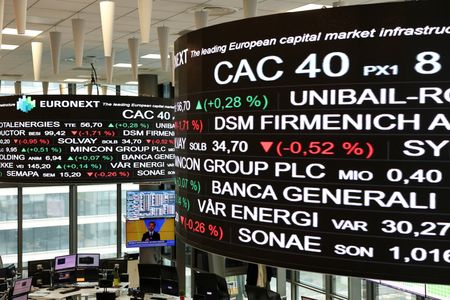
European stock markets are expected to open higher on Tuesday, buoyed by a rebound in precious metals and a trade deal signed between the United States and India.
Futures indicate a rise of 0.62% for the Parisian CAC 40, 0.66% for Frankfurt’s DAX, 0.11% for London’s FTSE, and 0.55% for the Stoxx 600.
The rout in gold and silver caused widespread shock on financial markets on Monday, although Europe and then Wall Street managed to finish in positive territory.
It all started with the appointment of Kevin Warsh as Chairman of the Federal Reserve (Fed) on Friday. The former central bank governor is seen as favoring a reduction in the Fed’s balance sheet, which would lead to higher bond yields, making sovereign debt more attractive than precious metals which generate no income.
The fall in gold and silver prices was so severe that it put pressure on leveraged investors, who had to liquidate their positions in other assets to cover their losses.
The rebound seen this Tuesday therefore eases tensions, especially as the news is favorable on the economic and geopolitical fronts.
The parade of corporate earnings releases continues, helping to support equity markets, while the scenario of a conflict between the United States and Iran recedes.
Donald Trump also announced on Monday that he had concluded a deal with India that lowers U.S. tariffs on Indian products from 50% to 18% in exchange for a reduction in trade barriers put in place by New Delhi and a halt to its purchases of Russian oil.
Spot gold gains 5% to $4,898 per ounce, after a 13.6% drop over the last two sessions.
Over the same period, silver fell by 32%. On Tuesday, it gains 8.5% to $86.13 per ounce.
The New York Stock Exchange ended higher on Monday, lifted by gains from chipmakers and other companies related to artificial intelligence (AI), while small-cap stocks also advanced strongly.
The Dow Jones index gained 1.05% to 49,407.66 points. The broader Standard & Poor’s 500 rose 0.54% to 6,976.44 points. The Nasdaq Composite advanced 0.56% to 23,592.107 points.
Futures on the three indices point to a higher opening on Tuesday.
The Tokyo Stock Exchange index gained 3.92% to 54,720.66 points to close at a record high, rebounding after falling 1.2% the previous day.
In China, the Shanghai Composite Index rose 1.29% and the CSI 300 large-cap index advanced 1.18%, with gains in rare earth and defense-related stocks offsetting the decline in tech stocks. The latter are penalized by speculation about a potential VAT increase for Chinese telecommunications groups.
The Hong Kong stock market is up 0.31%.
In India, the Nifty 50 and Sensex stock indices both gained nearly 3% following the trade deal announced between Washington and New Delhi.
The dollar is retreating slightly but largely retains the gains made after Kevin Warsh’s appointment to head the Fed and encouraging U.S. economic data on manufacturing activity, two factors that offset concerns related to the partial shutdown of U.S. federal agencies due to a lack of a congressional funding agreement. The situation could be resolved as early as Tuesday with an expected vote in the House of Representatives.
The greenback is down 0.22% against a basket of reference currencies.
The euro gains 0.22% to $1.1815, two days ahead of the European Central Bank’s (ECB) monetary policy decision.
The Reserve Bank of Australia (RBA) on Tuesday raised its key interest rate for the first time in two years, citing faster-than-expected economic growth and stating that inflation was likely to remain above target for some time.
The expected decision nevertheless pushed the Australian dollar higher (+1%).
The yield on the ten-year Treasury is unchanged at 4.2835% after rising more than three basis points the previous day.
In Europe, the yield on the German Bund of the same maturity, the main benchmark for the euro zone, advances by nearly two basis points to 2.8823%.
The relative easing of tensions between the United States and Iran and the strength of the dollar are weighing on oil prices.
A barrel of Brent crude is down 0.41% at $66.02 and U.S. light crude (WTI) is down 0.37% at $61.91.