Editor’s Note
This article explores how Henan province, traditionally known as agriculture, is leveraging its surprising status as a major diamond producer to boost tourism. The piece highlights innovative marketing strategies in China’s competitive cultural tourism sector.
Earlier this year, as cultural and tourism bureaus across China launched creative campaigns, many local “hidden specialties” captured public attention. Luoyang, Henan, made a particularly stunning move by generously giving away diamonds to tourists, with the largest being a full 1 carat, distributing 100 stones in a single day! This left netizens puzzled: Isn’t Henan a major agricultural province? When did diamonds become its specialty? In fact, Henan has not only excelled in growing crops but also in “growing diamonds” for some time. 80% of the world’s lab-grown diamonds come from Henan, with Zhecheng County in Shangqiu City being a major concentration area.
“A diamond is forever.” This iconic advertising slogan, considered one of the most successful of the 20th century, has tightly bound diamonds to love and marriage. Despite their high price, diamonds have remained in the spotlight due to their brilliance and symbolic value. What if diamonds could retain their sparkle while being significantly more affordable? This is where lab-grown diamonds enter the scene.
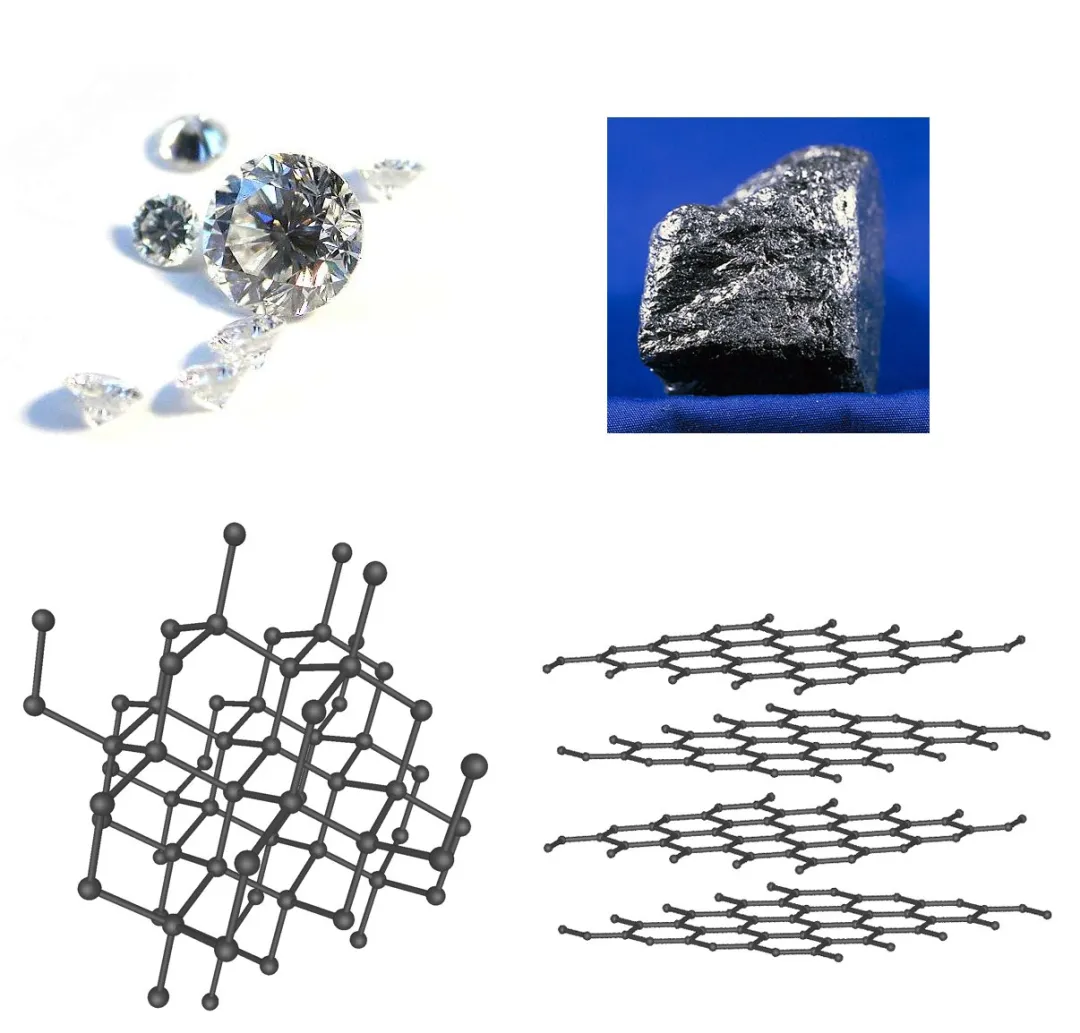
Lab-grown diamonds, as the name suggests, are diamonds cultivated in a laboratory. Are they real diamonds? Absolutely! Diamonds are gem-quality crystals of carbon, an allotrope of carbon like graphite. Within a diamond crystal, each carbon atom is tightly bonded to four others, forming a unique three-dimensional structure not found in other minerals, which gives diamond its status as the hardest natural substance.
Lab-grown diamonds are composed of pure carbon crystals, with essentially no difference in crystal structure, physical, chemical, or optical properties from natural diamonds. They can receive certification from the diamond industry’s three major grading laboratories, solidifying their official recognition as real diamonds. In 2018, the U.S. Federal Trade Commission revised its definition of diamond to include lab-grown diamonds.
Natural diamonds form deep within the Earth over billions of years under high temperature (900°C–1400°C) and high pressure (5–6 GPa) in an oxygen-free environment. In contrast, lab-grown diamonds can produce gem-quality stones in just weeks, or even days.
The two primary methods for growing diamonds are:
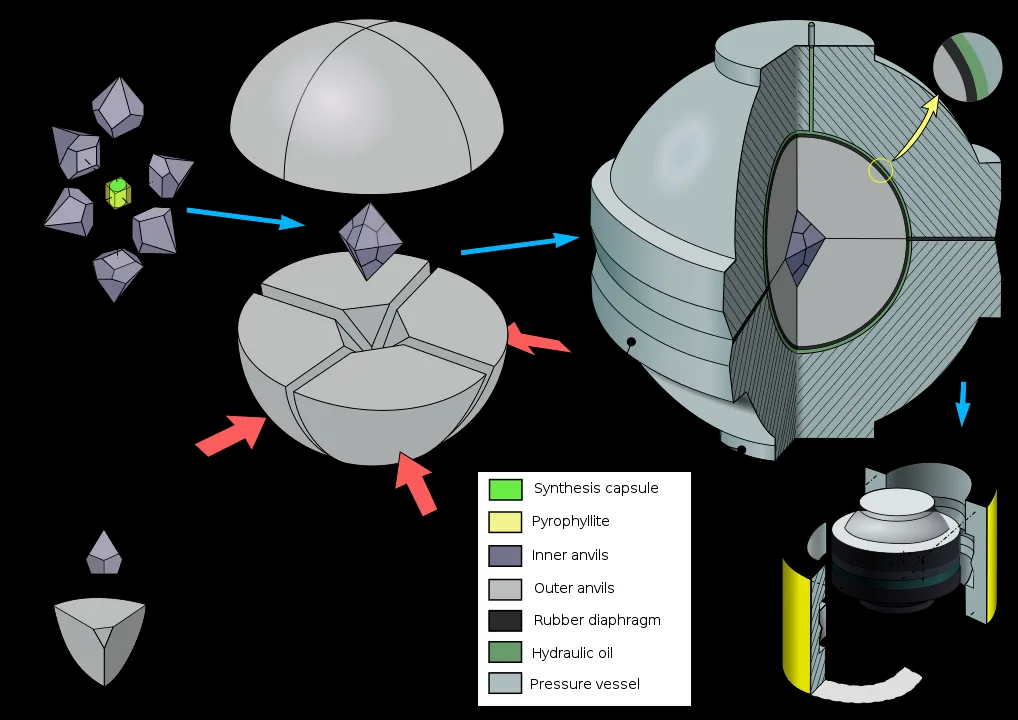
1. High Pressure High Temperature (HPHT): This is the mainstream technology in China, especially concentrated in Henan, using a cubic press as the main apparatus. Graphite powder, a diamond seed, and a metal catalyst are placed in a reaction chamber under extreme heat and pressure. The graphite crystallizes onto the seed, growing into a diamond in about a week.
2. Chemical Vapor Deposition (CVD): This method is primarily used in Europe and the U.S. It involves placing a diamond seed and a carbon-rich gas in a vacuum chamber under high temperature and low pressure. The gas breaks down, depositing carbon atoms layer by layer onto the seed, growing a diamond over about two weeks.
Currently, China, India, and the U.S. dominate the production, processing, and retail markets for lab-grown diamonds, respectively.
Initially, diamond’s primary use was not for adornment but for industrial machining. In the 1950s, Western countries successfully synthesized artificial diamonds. Around the same time, to develop its manufacturing sector, China began selecting sites for grinding wheel factories. The discovery of a large bauxite deposit in Gongyi, Henan, led to the establishment of China’s Second Grinding Wheel Factory in Zhengzhou. This factory and its affiliated Zhengzhou Research Institute for Abrasives & Grinding (ZRIA) became the “cradle” of China’s superhard materials industry.
The core material for abrasives is diamond, which China initially relied on imports for. To accelerate industrialization, China needed to develop its own synthetic diamond technology. In 1963, ZRIA succeeded in developing China’s first synthetic diamond, making it the fifth country globally to do so. By 1965, ZRIA, in collaboration with another institute, developed China’s first cubic press.
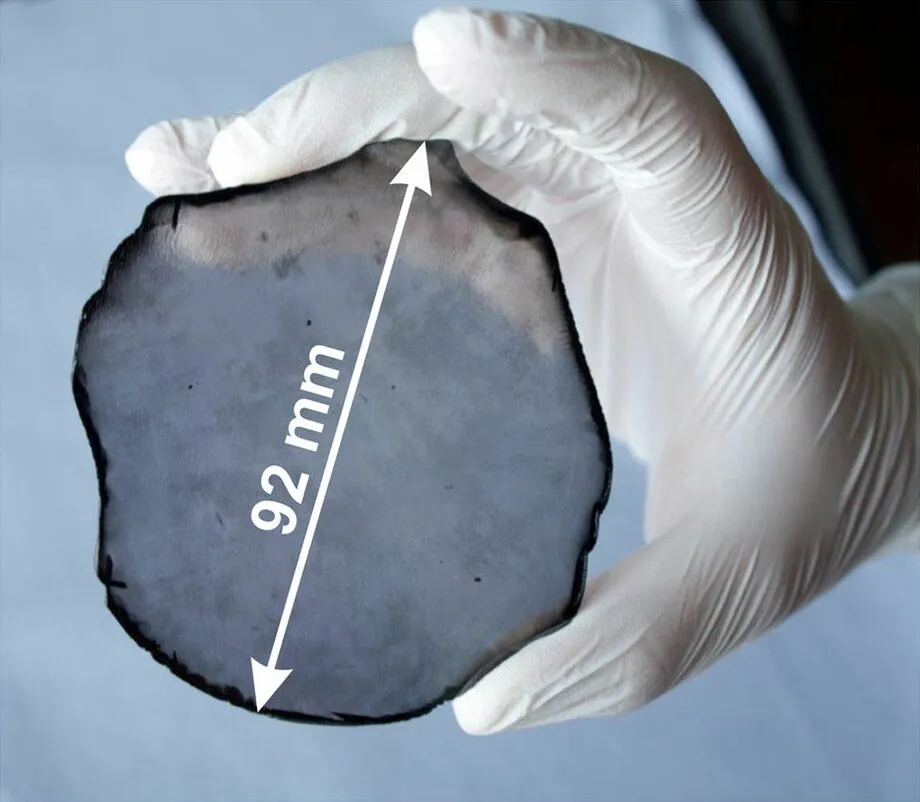
As technology improved, the purity of diamonds grown using cubic presses increased, easily meeting gem-quality standards. Today, Zhecheng County in Henan is known as China’s ‘Lab-Grown Diamond Capital’, home to many leading companies in the field.
The high price of natural diamonds is partly due to mining costs but is largely driven by resource monopoly, with about 70% of the world’s diamond resources controlled by five major producers. However, as lab-grown diamond technology advances, their quality now rivals that of natural diamonds, at a reported cost of only about 10%. This significant margin has attracted traditional jewelry giants like De Beers and Swarovski, as well as luxury brands like LVMH and Gucci, to enter the market.
While natural rarity is key for collectible diamonds, for everyday jewelry, lab-grown diamonds are gaining consumer acceptance due to their high cost-performance ratio.
Beyond gemstones, lab-grown diamonds have vast potential. Known as the “industrial teeth,” their extreme hardness makes them invaluable in applications from glass cutting and precision grinding to oil drilling and geological exploration. Furthermore, with stable chemical properties and high thermal conductivity, diamond is seen as a more efficient and environmentally friendly ultimate semiconductor material than silicon.
A crucial future application for lab-grown diamonds lies in optics, thermal management, and semiconductor research.