Editor’s Note
This article examines the unintended consequences of a recent tax policy change on Sri Lanka’s gem trade, highlighting how increased import duties led to a significant downturn in the sector.
From January 2024, gem imports were subjected to 18% VAT and 2.5% SSCL, calculated on the declared value of the imported gem parcels.
While the objective was to widen the tax base and enhance revenue, the outcome proved challenging for the gem trade. According to Dr. Chaminda, gem imports declined sharply during 2024 and 2025 compared to 2023, as the higher tax burden discouraged traders from importing raw stones. This decline was not confined to import volumes alone. Instead, it triggered a cascading effect across the entire gem and jewellery value chain, with serious economic, employment, and export consequences for Sri Lanka.
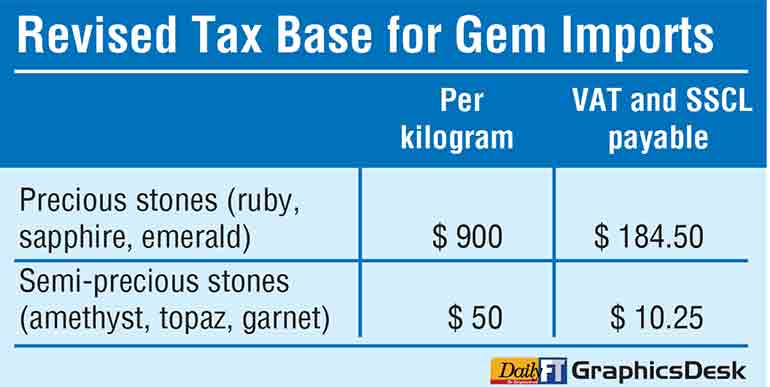
Sri Lanka’s globally renowned gem and jewellery industry has received a timely boost with the introduction of a revised tax calculation method for gem imports. The new framework for applying the Social Security Contribution Levy (SSCL) and Value Added Tax (VAT) is expected to ease the financial burden on importers, revive declining import volumes, and strengthen the country’s gem export performance.
The announcement was made by National Gem and Jewellery Authority (NGJA) Chairman and Chief Executive Officer, Dr. S.B. Chaminda, at a recent media briefing in Colombo. He explained that the earlier tax regime introduced from 1 January 2024, had unintentionally slowed down gem imports and negatively impacted the broader industry.
Since value addition is a core strength of Sri Lanka’s gem industry, any disruption in raw material supply directly weakens the country’s competitive advantage in global markets.
The reduction in re-exports meant fewer high-value shipments leaving the country, directly affecting national export performance.
Gem and jewellery exports are a key source of foreign currency inflows for Sri Lanka. When re-export volumes declined, so did foreign exchange earnings. This resulted in reduced export revenue, a lower contribution to the balance of payments, reduced availability of foreign currency for essential imports, and increased pressure on the exchange rate. At a time when Sri Lanka has been striving to strengthen its external sector, the slowdown in gem exports added further strain to the economy.
As gem processing is a labour-intensive industry, any contraction has a direct and immediate impact on employment, particularly in rural and semi-urban regions.
The gem industry supports thousands of livelihoods across gem cutting and polishing, jewellery manufacturing, certification and grading, trading and logistics, and retail and export operations.