Editor’s Note
This article explores how the jewellery industry’s present achievements are built upon the foundational work of past experts, echoing Sir Isaac Newton’s timeless insight about progress.

Without knowing where you came from, you’ll never get where you want to go. The jewellery industry wouldn’t be what it is today without the groundbreaking work of gemmologists.
Legendary mathematician, physicist, astronomer, and alchemist Sir Isaac Newton once famously wrote these words. As a key figure in the Scientific Revolution and the Enlightenment, Newton employed the metaphor to describe his work as building upon the foundation laid by others. It’s an acknowledgement that progress is often incremental and relies on the contributions of previous thinkers and researchers.
This sentiment is popular among the ‘unsung heroes’ of the jewellery industry, gemmologists. Behind the scenes, these researchers play a critical role in an industry that, at the surface level, is driven by beauty.
Over the past three years, *Jeweller* and the Gemological Association of Australia have published a series of articles dedicated to the giants responsible for constructing gemmology.
Despite common misconceptions, gemmology is far from a modern invention. Humans have adorned themselves with gemstones and used them as symbols of status since the dawn of civilisation. However, the scientific study of gemstones has its roots dating back at least to the 19th century.
Structured education in gemmology began to take shape in the early 20th century. Notably, the Gemmological Association of Great Britain was established in 1908, followed by the launch of the Gemmological Institute of America in 1931, offering the first formal courses in the field.
Since then, gemmological education has expanded globally, with institutions such as the Gemmological Association of Australia (est. 1945) contributing to the training of skilled professionals who form the backbone of the jewellery industry today.
Gemmologists are essential to upholding the integrity and authenticity of the gemstone and jewellery industry. Through extensive training and hands-on experience, they develop the expertise necessary to identify and evaluate gemstones accurately. This work provides the assurance jewellers need to sell — and consumers to buy — with confidence.
René-Just Haüy, well-known as the founding father of crystallography, was a French priest and mineralogist.
In one version of a famous tale, a critical moment behind the discovery of crystalline structure occurred when Haüy accidentally dropped a calcite crystal onto the floor, shattering it. Examining the fragments of calcite, he noted it “had a single fracture along one of the edges of the base.” Haüy discovered ‘cleavage’.
By continuing to break calcite into smaller pieces and observing the same step-like feature, he concluded it had the same internal structure regardless of its size.
Before Haüy’s research, understanding of crystal structure was limited to external morphology. An example of this is the crucial contribution Nicolas Steno made with his observation that for a particular mineral, the angles between corresponding faces of a crystal are constant.
Reading of his contributions to the field of crystallography, some may think Haüy’s work to be detached from gemmological practice today. However, as any good gemmologist would know, it is this understanding of a crystal’s internal structure that allows us to separate one gemstone from another.
Haüy’s ground-breaking study opened the door for researchers to recognise cleavage and planes of weakness, to predict in which directions a gemstone may appear different colours (pleochroism), or to understand how light may interact with a gemstone, to name a few of the properties dependent on crystal structure.
George Frederick Kunz was a renowned American mineralogist. His humble upbringing led to his education in public schools. Kunz did not graduate with a degree and instead channelled his hunger for knowledge and passion for minerals into self-teaching.
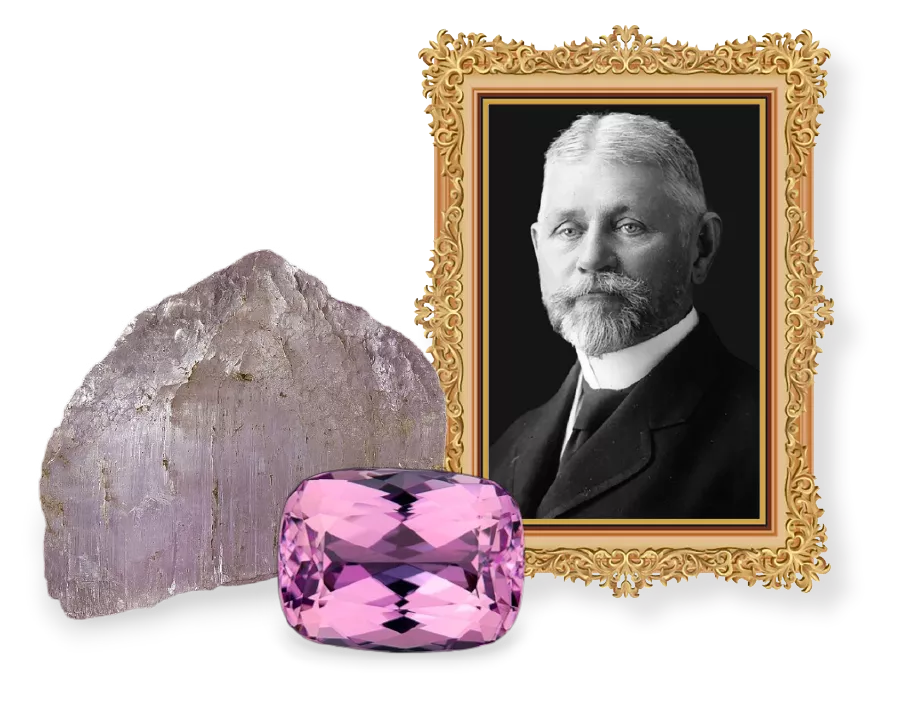
Through his ventures exploring the geology of nearby regions and exchanging specimens with overseas dealers, Kunz had amassed a collection of more than 4,000 mineral specimens by the time he was still a teenager.
At the age of 23, Kunz secured a position at Tiffany and Company as a gemstone expert before advancing to vice president. This was the first example of a jewellery retailer having a gemmologist on staff.