Editor’s Note
This article highlights a critical discrepancy in Sri Lanka’s gem and jewelry sector, where official export figures represent only a fraction of the value estimated to be moving through a vast, unregulated shadow market. The scale of this informal economy, as revealed in Parliament, poses significant questions for economic governance and revenue collection.
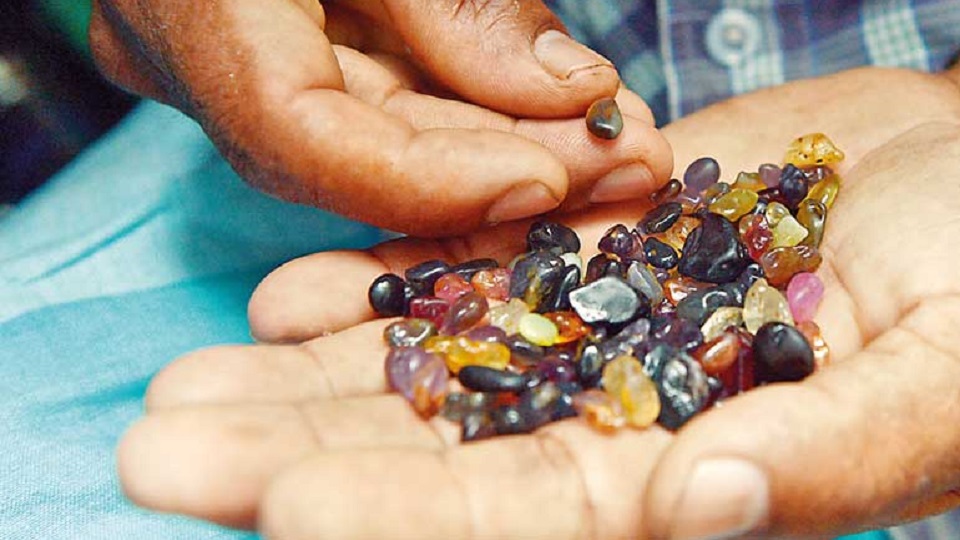
As revealed in Parliament on October 24, Sri Lanka’s gem and jewelry industry is characterized by an underground market composed of unaccounted exports and clandestine trafficking exceeding 300 billion rupees (over one billion US dollars). However, according to data from the Central Bank of Sri Lanka (CBSL), declared precious stone exports in 2024 were less than $382 million (approximately 115.895 billion rupees). This figure is even more significant considering that during this period, the US dollar continued to trade below 300 rupees and experienced a further decline against the rupee in 2025.
Precious stones introduced irregularly into popular foreign markets like Hong Kong, Thailand, and Dubai and sold at “exorbitant prices” indicate an outflow from the country without customs declaration, with the multi-million dollar revenues not being reinvested domestically. Furthermore, although sector operators have exerted intense pressure, sometimes even involving politicians, to obtain huge tax advantages and various incentives, the sector has recorded unaccounted exports for decades.
Scholars believe that to remedy the problem, “all exports of gems and jewelry must be conducted within an appropriate legal framework.” Meanwhile, the Sri Lanka Gem and Jewelry Association has proposed the duty-free import of both worked and unworked precious stones, including the duty-free import of “gold and other precious metals” by banks, selected retailers, and large producers. This option was proposed considering the relatively low value of the island’s monthly and annual gem and jewelry export revenues.
Although the export of raw gems—geuda, a variety of corundum found in Sri Lanka—is not permitted, they are sent abroad irregularly. Sector experts Thushari Mendis and Ajantha Tennakoon, based in Western Australia, explain to AsiaNews that the island “is one of the leading producing countries”; it also boasts “the highest gem density and is a global destination for the supply of over 75 varieties of precious and semi-precious stones, including rubies, sapphires, topazes, and tourmalines.”
The sale of precious stones, including Ceylon sapphires and jewelry set with precious stones, generates hundreds of thousands of dollars in foreign markets, especially at auctions. Two pieces of jewelry with Ceylon sapphires sold separately by the world’s leading auction house, Sotheby’s, generated around 344 million rupees. According to the institution’s records, 19 of the most expensive sapphire jewelry pieces (most of them with Sri Lankan sapphires) sold for $12 million since 2024, approximately 169% more than the maximum estimate of $4.5 million, as stated by Sotheby’s itself.
According to precious stone traders Ratnapura Akalanka Gomes, Ramesh Satharasinghe, and Ramzi Shihabdeen, “the industry supplies 75 types of precious stones, among which are rubies, padparadscha, and moonstones, in addition to the high-priced, blue-toned, velvety-textured Ceylon sapphires. In a sector where small precious stones are traded for millions of dollars, gem, diamond, and jewelry exports in 2024 recorded a modest figure of $381.9 million. The value, according to sector operators, has decreased by over 23% compared to the $500 million in 2023. In December 2023, the US dollar was trading at 323.92 rupees, and by March the exchange rate had fallen to about 295 rupees. These figures distorted the real value of precious stone exports at that time.”
According to academics Nishan Galappathi and Samanthika Gamage, “this year [in September], for the first time, authorities have authorized the export of raw precious stones (natural, uncut, and unworked stones) from Sri Lanka. Most companies were interested in selling raw stones abroad, as some of them operate globally. This decree will allow them to export raw stones and then sell them in other countries.”