Editor’s Note
As synthetic diamonds reshape the luxury market, heritage brands like Messika are doubling down on the allure and ethical narrative of natural stones. This glimpse inside Namibia’s high-security diamond hub underscores the tangible human and economic value tied to the traditional diamond trade—a value proposition increasingly central to the industry’s future.
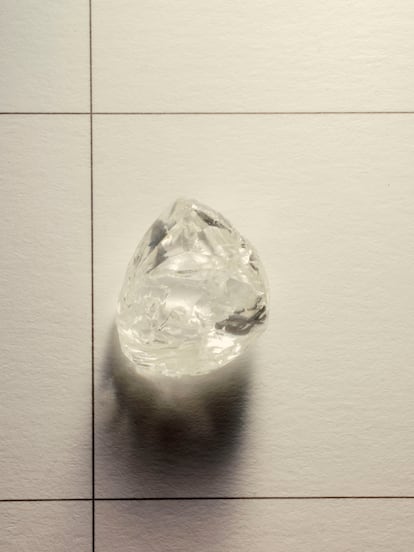
Facing the rise of synthetic diamonds, the firm Messika seeks the natural while being a source of employment and future.
No chewing gum, no shirts with pockets, no shoes with ridged soles. And, of course, no mobile phones. As an exception, we are allowed to enter with a camera and recorder. To access the high-security zone of the Namibia Diamond Trading Company (NDTC) headquarters in Windhoek, there are strict rules. Also three double doors that only open with accreditation, scanners, and cameras at every turn. Here, two million carats per year are processed, sorted, and prepared for sale.
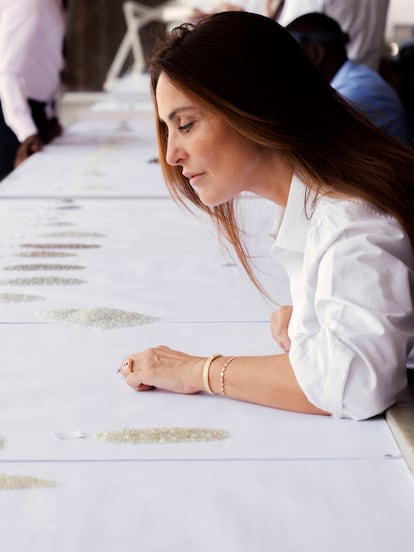
All diamonds mined in Namibia pass through these offices, inaugurated in 2007. It is the strategic bottleneck of the value chain: the moment when the diamond passes from the mine to the market. There are only 10 buyers with access to its production — sightholders, in mining jargon. Among them is André Messika LTD, the eponymous company founded by a Tunisian diamond dealer in the seventies and of which his children, Ilan and Ben, are CEO and strategic director, respectively. Although on the street the surname is better known for the firm that his daughter Valérie (Paris, 49 years old) created in 2005 and which, with 600 stores and an irreverent approach, plays in the league of the big names. Accustomed to making diamonds dance, she cannot (nor wants to) moderate her surprise. “Incroyable,” she repeats. It is not her first time in Namibia, but it is the first time she crosses the doors of NDTC and finds herself in front of piles of stones lined up on a very long table, sorted by size, color, and shape.
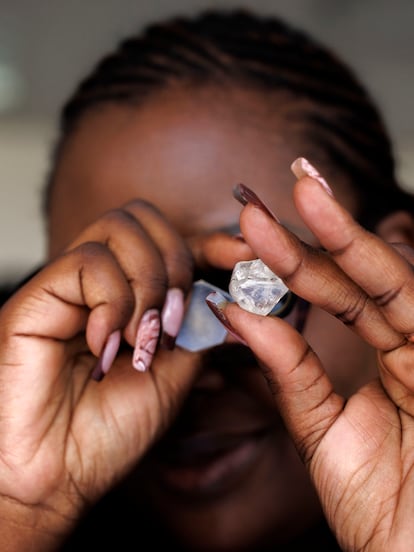
NDTC is the axis of a system that broke the colonial pattern, in force until Namibia’s independence in 1990. The country, which was for eight decades a producer without sovereignty over its most valuable resource, today does not limit itself to collecting taxes for letting others exploit its resources: it is co-owner of the mines, the marketing system, and the final profit. For every dollar generated by diamonds, 80 cents go to the public coffers. NDTC’s sightholders must process their gems in the country: it is the crux of a value chain of which Messika, specialized in stones between 1 and 20 carats, is a key link. 95% of the workers are Namibian and 50% are disabled. Local employees own 25% of the shares. Everyone wins. Namibia captures value, industry, employment, and sovereignty. Messika gets stable access to one of the most valuable origins in the world, control of the process from the source, and accredited traceability. Which, defends Ilan (Paris, 32 years old), for them is not an option but an imperative: “Without an invoice, there is no deal.” They only buy from accredited sources and that requirement, adds Ben (Paris, 25 years old), underpins their clients’ trust.
Namibia is one of the few producing countries that has managed to control the diamond’s journey from the origin. The idea of certifying its provenance began to take shape in the nineties, when “blood diamonds” entered the lexicon of the first world. The first was KP in 2003. RJC, in 2005. Fairmined, in 2014.
But why settle for a piece of paper? Messika’s manufacturing facility in Namibia was the first in the world to implement a traceability system not based solely on administrative documentation. Since 2020, each diamond goes through digital scans that record its anatomy and generate a unique and unalterable profile. It all starts in a room they call The Galaxy. The stone is placed in a machine — basically, an MRI — and in 20 seconds it reveals its anatomy in a 3D image: weight, clarity, color, fluorescence, inclusions. A kind of map that serves to plan the cutting and is linked to a certificate, associated with the GIA number engraved on the girdle with a QR code that shows the stone’s journey in a video.
Today, conflict diamonds represent, according to the Kimberley Process — the only international certification system backed by the UN — less than 1% of world trade. The needle of the debate has shifted to synthetic gems.
If in 2020 the proportion of natural and lab-grown diamonds sold in North American jewelry stores was 90-10 in favor of naturals, today it is 54-46. Cheaper than their natural counterpart, the appeal of lab-grown stones is economic. Also their weak point. The average price of an engagement ring, per carat, has fallen from $3,240 to $1,400.