Editor’s Note
This article highlights a recent New York auction that solidified the legacy of French designer Suzanne Belperron, whose exceptional jewelry continues to captivate collectors.
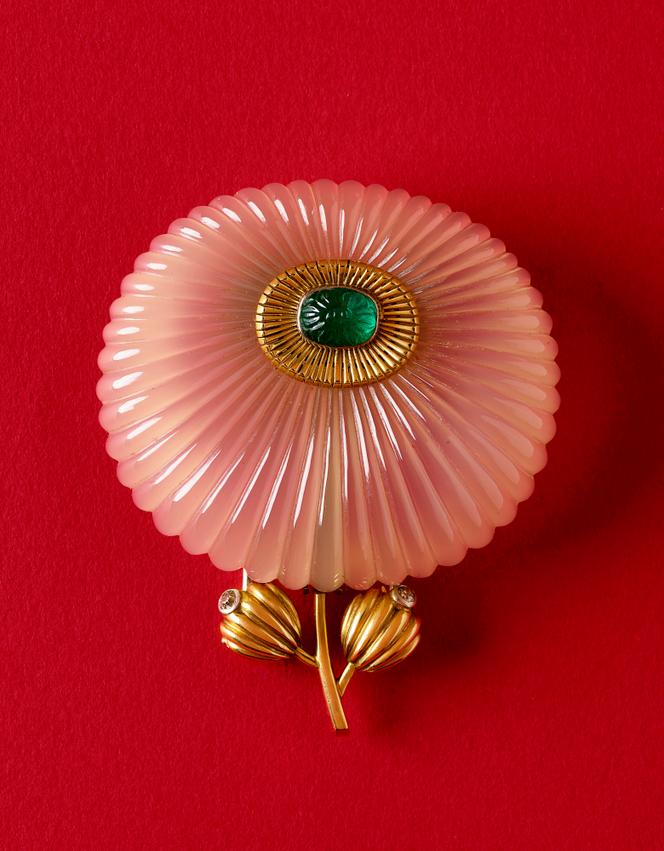
A chalcedony, emerald, and diamond brooch by Suzanne Belperron, sold by Christie’s.
ANNA BUKLOVSKA/CHRISTIE’S IMAGES LTD
Anticipated for weeks, the auction held on the evening of December 8th in New York at the Breuer Building—the former Whitney Museum recently inaugurated as Sotheby’s new headquarters—did not fail to attract connoisseurs. And, unsurprisingly, it consecrated Suzanne Belperron. The highly-rated French jewelry designer (1900-1983) shone alongside JAR (Joël Arthur Rosenthal), Cartier, Van Cleef & Arpels, and Boucheron. The dazzling selection belonged to an anonymous owner with impeccable taste.
Among the 24 scattered pieces signed Belperron—including two for René Boivin, where she worked between 1919 and 1932 before starting her own business—
approves Olivier Baroin. Since 2008, this independent expert has been working with the archive—once thought to be burned—which helps date and authenticate the work of this jeweler with a novel-like biography.
A precocious talent, Madeleine Suzanne Vuillerme, her real name, was a friend of high society, mingled with renowned clients (Gabrielle Chanel, Elsa Schiaparelli), allegedly concealed the Jewish identity of buyers from authorities during the war, and ended her life at 82, ravaged by arthritis and drowned in her bathtub.
At Sotheby’s, the total low estimates for her work amounted to $1.32 million (€1.13 million); the high estimates, to $1.94 million. Their cumulative total ultimately soared under the hammer beyond $3.5 million, or €3 million.
Among the appreciated lots: a pink and blue plastron of topazes, morganites, and aquamarines; “papillote” cuff bracelets with gold striations; or a necklace composed of sapphire pebbles.
animates Catharine Becket.
Among bidders, decades pass and the attraction for Belperron remains. It first blossomed in April 1987, during the sale of the Duchess of Windsor’s jewelry casket at Sotheby’s in Geneva, Switzerland: several pieces, including a famous chalcedony bead parure, launched the phenomenon, never denied since.
notes Violaine d’Astorg, head of the jewelry department at Christie’s in Paris, which is offering, notably from December 5th to 17th, three lots from the Jurassienne, including a 1967 ring set with two sapphires and a stunning 1940s flower brooch in gadrooned (fluted) chalcedony and engraved emerald.
The appetite is such that ten years ago, anticipating a Sotheby’s sale in Geneva, a certain Mrs. L. was left stunned by Olivier Baroin’s estimates:
Fearing soaring fees and taxes, this octogenarian, who arrived with beautiful specimens in an ordinary plastic bag, ultimately preferred to keep a few pieces for herself,
recalls the expert.
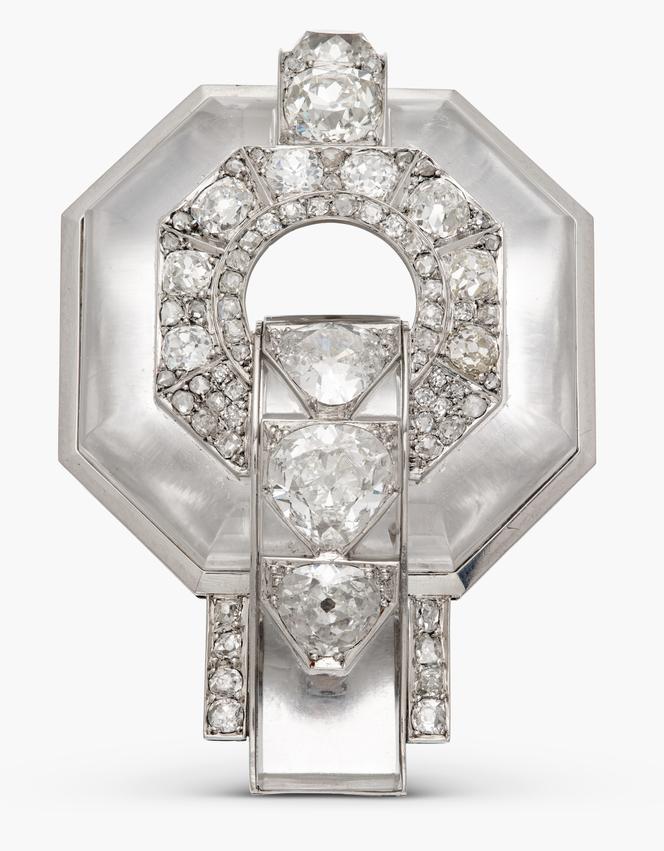
A rock crystal and old-cut diamond brooch by Suzanne Belperron for René Boivin, sold by Sotheby’s.
SOTHEBY’S
A chalcedony and amethyst cuff bracelet, sold by Sotheby’s.
SOTHEBY’S
Acquiring a Belperron piece is first and foremost seizing a rare luxury, as her production exists in reasonable quantity.
summarizes Valérie Goyer, Jewelry Director at Artcurial. Her style, however,
recalls Olivier Baroin. A plasticity that today suits auction houses: if the prices are not within everyone’s reach, visually, there is something to seduce diverse profiles.
Some common traits remain: geometry, cabochon stones, bold volumes and shapes. But, more than anything, insiders say, a charm, a je-ne-sais-quoi of daring.
declared Suzanne Belperron to justify why she never signed her rings, necklaces, bracelets, or brooches.
analyzes Violaine d’Astorg at Christie’s,
To better adopt it.