Editor’s Note
This article highlights the robust growth trajectory of the global 3D printed accessories market, projected to expand at a CAGR of 14.77% through 2032. Key drivers include technological advancements in rapid prototyping and manufacturing, enabling diverse consumer products from jewelry to home decor. North America currently dominates the market, holding nearly half of the global share.
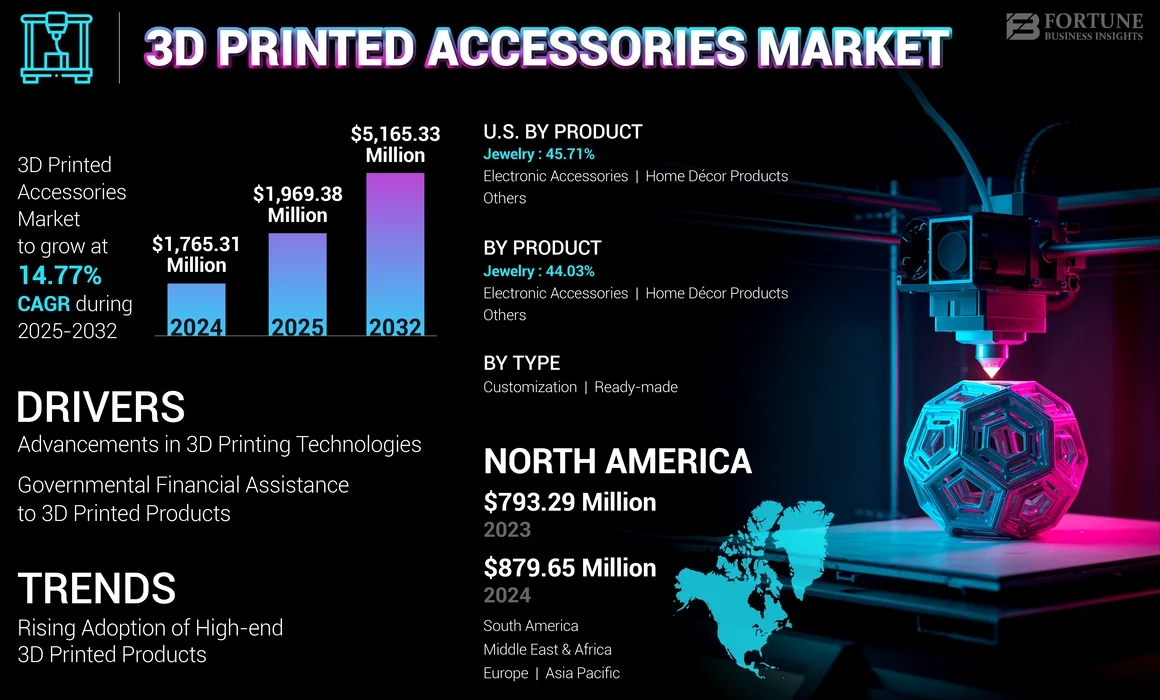
The global 3D printed accessories market was valued at USD 1,765.31 million in 2024. The market is projected to grow from USD 1,969.38 million in 2025 to USD 5,165.33 million by 2032, exhibiting a CAGR of 14.77% during the forecast period. North America held a market share of 49.86% in 2024.
Advancements in rapid prototyping technology and manufacturing practices for consumer products enable manufacturers to produce 3D printed items, including jewelry, home decor items, phone cases, and 3D toys. Increasing consumer demand for 3D printed accessories in various shapes, sizes, colors, and textures is accelerating global market growth.
Drivers: Advancements in 3D printing technology and government financial assistance for 3D printed products are key growth drivers. For instance, in August 2023, Godrej Consumer Products Limited (GCPL) partnered with the Tamil Nadu government in India to invest USD 590,000 in establishing a 3D printing manufacturing facility.
Restraints: Limited availability of raw materials for producing 3D printed products and the high initial investment required for industrial-grade 3D printers pose challenges to market growth.
Opportunities: Increased utilization of sustainable materials in 3D product production and the rising adoption of premium/luxury 3D printed products create new growth avenues. The growing trend of responsible raw material sourcing and implementing recycling/reuse measures in manufacturing also supports market expansion.
Challenges: Increasing incidents of product design plagiarism and modification present challenges related to trademarks and copyrights. High competition from local manufacturers offering products at competitive prices also poses a challenge for global players.
By Product: The jewelry segment is expected to hold the largest market share, driven by significant international demand for 3D printed gemstone jewelry. The electronics accessories segment is driven by traveler preference for modular 3D printed phone cases. The home decor products segment is growing due to increasing home renovation trends and the popularity of 3D printed photo frames.
By Type: The ready-made segment held a significant market share in 2024, fueled by the growing popularity of 3D printed murals/wall art and easy consumer access to affordable products in supermarkets and malls. The custom segment is expected to grow at the fastest rate during 2025-2032, driven by increasing consumer demand for personalized products and the proliferation of e-commerce portals.
North America: Dominated the market in 2024 (49.86% share), driven by widespread adoption of additive manufacturing for jewelry and home decor, along with increased government and corporate investment in 3D printing technology in the US and Canada.
Europe: Projected to be the second fastest-growing region (2025-2032). Germany, the UK, and France are key markets, with growth driven by R&D investments and rising consumer demand for personalized 3D printed products.
Asia Pacific: Projected to be the fastest-growing region (2025-2032). Japan and China lead the region, supported by substantial government investments in 3D printing technology and manufacturing facilities. Growing demand for premium 3D decor items and electronic accessories in India, Australia, and Southeast Asia also drives growth.
South America: Market growth is driven by increasing demand for modern housing facilities, boosting demand for 3D printed wall art and home decor items, alongside growing consumer accessibility to 3D printed phone cases and other electronic accessories in Brazil and Colombia.
Middle East & Africa: High consumer demand for 3D printed luxury gold and gemstone-based jewelry in Saudi Arabia and the UAE generates significant product revenue. Increasing availability of 3D printed travel accessories and home decor items also contributes to growth.
Leading manufacturers in the market include Boltenstern, Nervous System, Inc., Greger Group S.P.A., Additive X, and Rapid Prototyping Services. These companies are focused on expanding their 3D printing technology capabilities and product portfolios.
Key players are concentrating on portfolio expansion and forming partnerships with 3D printing solution providers to develop innovative products. For instance, in March 2023, Greger Group S.P.A. collaborated with HP, Inc. to develop metal 3D printed jewelry and fashion accessories. The top 5 participants held approximately 10% to 20% of the global market share in 2024.
Key Industry Developments:
• Dec 2024: Demcon acquired Dutch 3D printing startup Bond3D.
• Apr 2024: Greger Group Spa launched a 3D metal jet printing service for precious metal powders.
• Dec 2022: Inter IKEA Systems B.V. launched 3D art-inspired home decor products.
• Aug 2022: XACT Metal partnered with Tecnologías Computarizadas Para Manufactura S.A. de C.V (TCM).
• Feb 2021: Satori collaborated with 3D printing fashion designer Ganit Goldstein.