Editor’s Note
This article highlights the intersection of traditional luxury assets and modern technology, featuring insights from David Go, CEO of Gemblock. It explores the growth trajectory of the global gemstone market and the emerging role of blockchain in transforming asset trading and verification.
David Go, CEO of Gemblock, a Blockchain-Based Gem Trading Platform
[CEONEWS=Reporter Oh Young-joo] Is there anyone who dislikes diamonds and colored gemstones? The global diamond market was valued at $87.01 billion in 2018, and according to a Grand View Research report, it is projected to grow at an average annual rate of 3.0% from 2019 to 2030. The value of raw materials poised to become the next Tesla is also comparable to that of gemstones. Particularly, with the COVID-19 pandemic highlighting eco-friendly electric vehicles as the future of mobility, interest has surged in key raw materials like nickel, used in electric vehicle batteries. On the 23rd (local time), the economic news channel CNBC, citing a recent report from the US investment bank Goldman Sachs, reported that increasing demand for electric vehicle batteries will cause a sharp rise in raw material prices.
The crucial point is that individuals, unlike corporations, have limited access to premier overseas mines in countries like Brazil, where all these resources (various gemstones and raw materials) are buried. The current gemstone and raw material market, controlled by large distribution companies, has a very complex supply chain structure. Consequently, the price of gemstones that reach consumers after going through these processes is inevitably high. Furthermore, the high barriers to entry for mine investment inevitably raise issues of fairness.
Gemblock confidently presents its ‘blockchain’ system as a solution to this situation. It claims that not only can one purchase gemstones at prices stripped of speculative bubbles, but individual investors can also own rights to raw material mines. We met with David Go, CEO of Gemblock, a blockchain-based gem trading platform, to hear the details.
1. To understand the gemstone and raw material market, one must know about mines well. Do you have extensive experience?
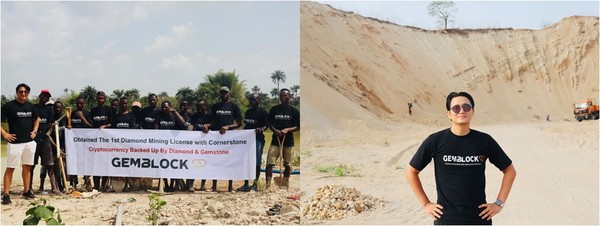
“Brazilian mines are not only rich in raw materials not found in our country but are also counted among the world’s leading diamond producers. Notably, it is also the country with the world’s third-largest nickel reserves (17% of global reserves according to USGS), whose value has skyrocketed recently due to electric vehicles. I immigrated to Brazil in my teens and, over 20 years of engaging in various businesses, experienced Brazil’s blessed resources more vividly than anyone. Also, having lived there for a long time, I can confidently say I am an expert who knows the local situation well. Currently, I have secured licenses for 6,000 hectares of diamond mines and am advancing into the global market by establishing partnerships with mine owners, focusing on Brazil, a world-class mining country.”
2. Could you explain Gemblock’s strengths from the perspective of a gemstone buyer?
“Consumers who want to buy gemstones are inevitably dissatisfied with the high prices formed in the market and the complex distribution process. They would also be concerned about the forgery, alteration, and authenticity of certificates. Gemblock first secured a price advantage by partnering with local mines to reduce intermediate distribution stages. This is the 5D system (1. Dig: Mine operation, 2. Design: Raw stone processing and jewelry manufacturing, 3. Direct selling, 4. Divide: Reasonable distribution system with users, 5. Deposit: Linking with physical gemstones) that handles everything from trade to mine operation in one stop. By directly connecting the distribution channel like this, one can encounter gemstones at reasonable prices, and we also provide international standard diamond appraisal and professional appraiser services.”
3. Could you explain Gemblock’s strengths from the perspective of an investor?
“It is a well-known fact that gemstones and raw materials have high investment value. Particularly, gemstones are increasingly being valued higher for investment compared to gold. According to China Daily, Chinese millennial consumers born between 1982 and 2000 prefer diamonds over gold, and the market share of gold-related jewelry products in China decreased from 28.1% in 2011 to 18.4%. The important point is that the current market has high investment barriers for individual investors to access. Therefore, Gemblock introduced blockchain and issued its own token, the GEM Token, to make investment in expensive gemstones possible even with small amounts. When gemstones secured locally at prices stripped of bubbles are registered on the Gemstore, consumers can purchase them at lower prices than fiat currency through the GEM Token. The GEM Token is linked to gemstones, guaranteeing value equivalent to the gemstones, and we plan to facilitate mutual circulation between the GEM Token and gemstones by using 40% of GEM Token sales revenue for gemstone purchases. Verified gemstone holdings and assets can also be accurately checked on the website at any time.”
4. What are your future plans and vision for Gemblock?
“As the Gemblock Foundation’s holdings increase, we are planning a cost-effective jewelry rental business at 1% of the sales price to maximize profits beyond sales. I believe the era has shifted from ownership to sharing, an era of enjoying together, not just borrowing. Furthermore, we are preparing to allow the purchase of ownership rights in raw material mines with tokens. Brazil is rich in raw materials: it ranks first in graphene reserves (called the oil of the future), has 98% of the world’s niobium reserves, and 17% of the world’s nickel reserves. In the future, there will come a time when individuals can purchase ownership of such Brazilian mines with tokens, and we are thoroughly preparing for this. Finally, compared to Bitcoin mining, which has recently been criticized as a major culprit of environmental pollution, I believe Gemblock will gain attention as an alternative and emerging investment vehicle. Bitcoin mining consumes enormous fossil energy for mining, leading to significant carbon emissions, but Gemblock links coins with gemstones and raw materials actually mined from physical mines without such processes. Therefore, I am confident it will grow into the investment vehicle most suitable for the globally trending topic of eco-friendliness.”