Editor’s Note
This analysis highlights how iconic jewelry pieces serve as leading indicators for the luxury market’s shifting dynamics. As the sector enters a complex adjustment phase, these items reflect deeper changes in heritage, design, and consumer values beyond mere seasonal trends.
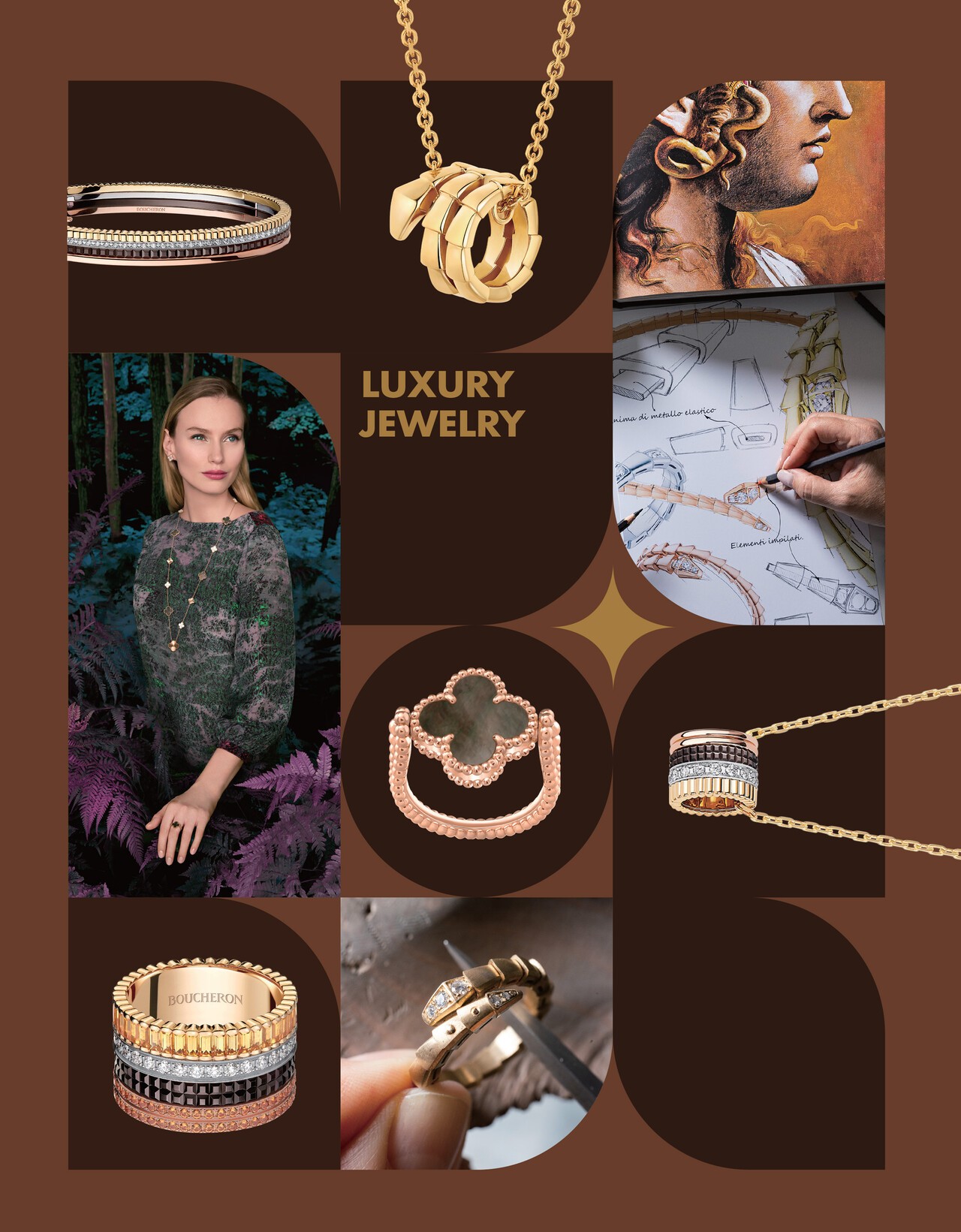
The fastest way to capture the changes in the 2026 luxury market is to examine the icons of brands. Iconic jewelry is the point where heritage, design language, and changing consumer values are first reflected, and it is the most intuitive signal heralding market trends for the new year.
The global luxury jewelry market has now entered a stage that is difficult to explain by simple design changes or shifts in trends. As the rapid post-pandemic consumption recovery enters a period of stabilization, the market is moving towards a phase of adjustment and realignment. The current changes show not just a slowdown in consumption, but a redefinition of the core values of the luxury market.
According to Bain & Company and Altagamma’s analysis of the global luxury market, the luxury industry has entered a phase where competitiveness between brands is becoming more distinct than quantitative growth. While riding the wave of overall market growth was effective in the past, the environment is now changing to one where the core assets and identity each brand possesses determine actual performance. In this process, the elements a brand centers its strategy on become the criteria for evaluation in the market.
Amid these environmental changes, the jewelry category is once again gaining strategic importance. Compared to fashion or leather goods, jewelry has higher durability and symbolism, and consumer choices are based on long-term value judgments rather than short-term trends. Its structure, which is relatively less affected by price increases and economic fluctuations, is also cited as a strength of jewelry. As market volatility increases, jewelry acts as the area that most directly reveals a brand’s identity because consumption remains relatively stable. Therefore, jewelry more easily becomes a benchmark for brand strategy than other luxury categories and is used as an important indicator to gauge a house’s direction.
Changes in consumer values also reinforce this trend. Today, luxury consumption is moving towards valuing meaning, purpose, attitude, and identity over ostentation and ownership. The preference for products that can be owned for a long time and used repeatedly over short-lived trendy items is becoming more pronounced. Jewelry is perceived as an expression of personal taste and life attitude, and the tendency to choose based on frequency of wear and utility is strengthening. The spread of daily fine jewelry and genderless designs starkly illustrates this change. Jewelry is now established as a category premised on daily wear, not just decoration for special occasions.
At the center of brand strategy in this trend lies iconic jewelry. An icon is not just a bestseller; it is the result of a brand’s accumulated history, aesthetics, technical choices, and value judgments condensed into a single form. The way an icon is maintained or varied shows exactly what identity a brand is preserving and how far it aims to expand. If new collections explain the direction of trends, icons explain a brand’s long-term direction and judgment criteria. This is why brands are paying renewed attention to icons as the market enters an adjustment phase.
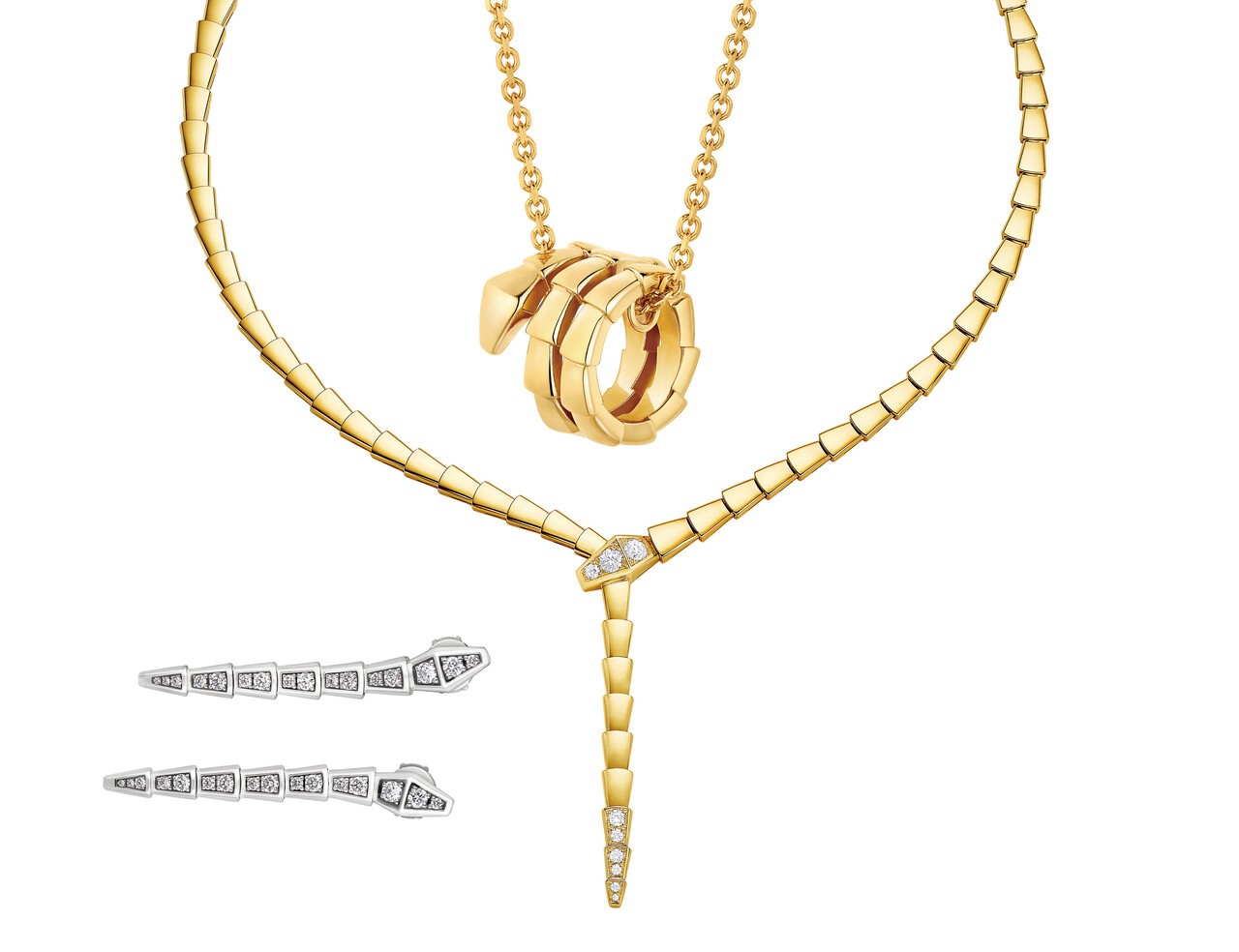
Therefore, to understand the 2026 jewelry market, one should look at which icon each house is centering on, rather than chasing the popularity of individual products. Bvlgari’s Serpenti, Boucheron’s Quatre, and Van Cleef & Arpels’ Alhambra are developed with different aesthetics and methods, but they share the commonality of being strategic assets that most compactly show brand identity. These icons are not mere collections of designs but benchmarks showing what a brand maintains and how it expands. What is revealed through icons is not the product itself, but the way the brand relates to the market. Ultimately, looking at 2026 jewelry is akin to reading the structure and direction of the luxury market through its icons.
Founded in Rome in 1884, Bvlgari is a high jewelry maison that has reinterpreted the heritage of ancient Rome and Italy’s unique sculptural sensibility in a modern way. The use of intense colored gemstones, bold volume, and a design approach that crosses the boundaries between jewelry and watches have become representative of Bvlgari’s identity. This brand aesthetic is revealed in a form condensed through a single motif, with the Serpenti collection at its center.
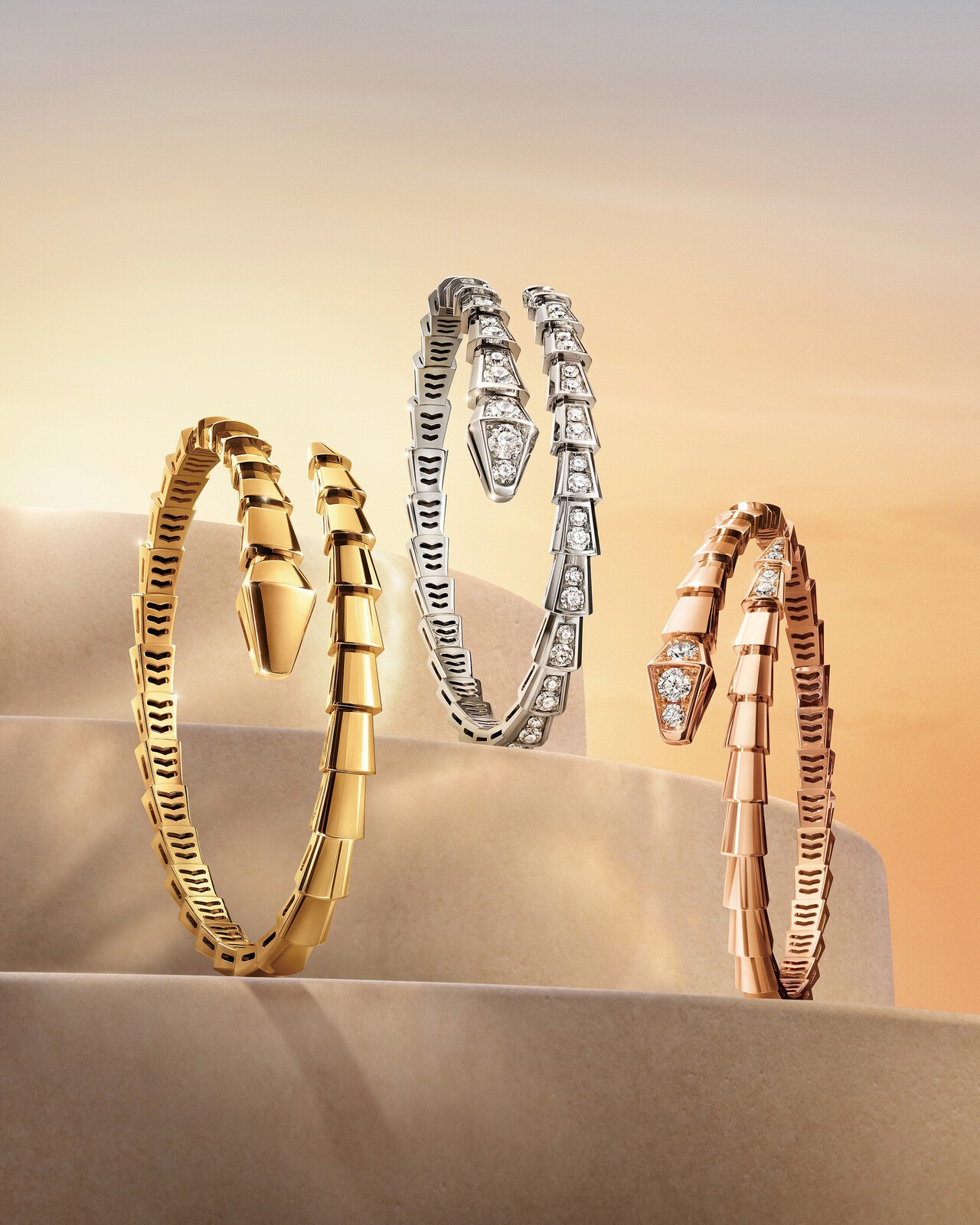
Serpenti means ‘snake’ in Italian, an image symbolizing transformation, rebirth, and vitality since ancient times. Bvlgari noted this symbolism and began the history of Serpenti in the late 1940s by introducing a bracelet watch inspired by the snake’s flexible movement. The design, which applied the Tubogas technique, implemented a structure where individual parts are organically connected to naturally wrap around the wrist, forming the key element of Serpenti’s unique silhouette and wearability.
Subsequently, Serpenti gradually expanded as an icon encompassing jewelry and watches. In the 1950s and 60s, more sculptural designs combining enamel, gemstones, and gold emerged, establishing it as a symbol of Bvlgari’s aesthetics. The structural idea of hiding the watch dial in the snake’s head, in particular, demonstrated both technical perfection and visual tension. Through this accumulation, Serpenti established itself as a brand asset that can be reinterpreted across eras, beyond a single product.
Serpenti has three core codes. First, the symbolism of transformation and rebirth. The image of a snake shedding its skin and being reborn is consistently reflected throughout Serpenti, forming the basis for the collection to be interpreted in line with changing times. Second, flexible structure and sculptural silhouette. Bvlgari’s unique manufacturing methods, including Tubogas, enable forms that flow along the wearer’s body, elevating the wearing experience itself as an important element of the design. Third, sculptural quality and color sense. The combination of gold, gemstones, and enamel reveals Bvlgari’s unique Roman aesthetic.
Strategically, Serpenti is important because this collection has functioned as a representative icon connecting Bvlgari’s past and present. Serpenti has expanded into various forms such as bracelets, rings, and necklaces, maintaining a consistent design language across jewelry and watches. It has also continuously attempted variations like Tubogas, Seduttori, and Viper, adjusting the wearing style, volume, and proportion to the times while maintaining the basic structure. This method of expansion shows Bvlgari’s strategy of managing and reinterpreting icons from a long-term perspective and connects with the value-centered consumption trend becoming important in the 2026 jewelry market. Serpenti is a collection that shows the process of Bvlgari interpreting its accumulated heritage in a contemporary language and expanding it to the next stage.
Founded by Frédéric Boucheron at Place Vendôme in Paris in 1858, Boucheron is a maison that has built an identity transcending eras based on architectural aesthetics, bold design, and craftsmanship.
Over four generations of history, Boucheron has combined traditional goldsmithing techniques with modern sensibilities to build a free and independent brand identity. It is currently part of the global luxury group Kering and operates over 85 boutiques worldwide.
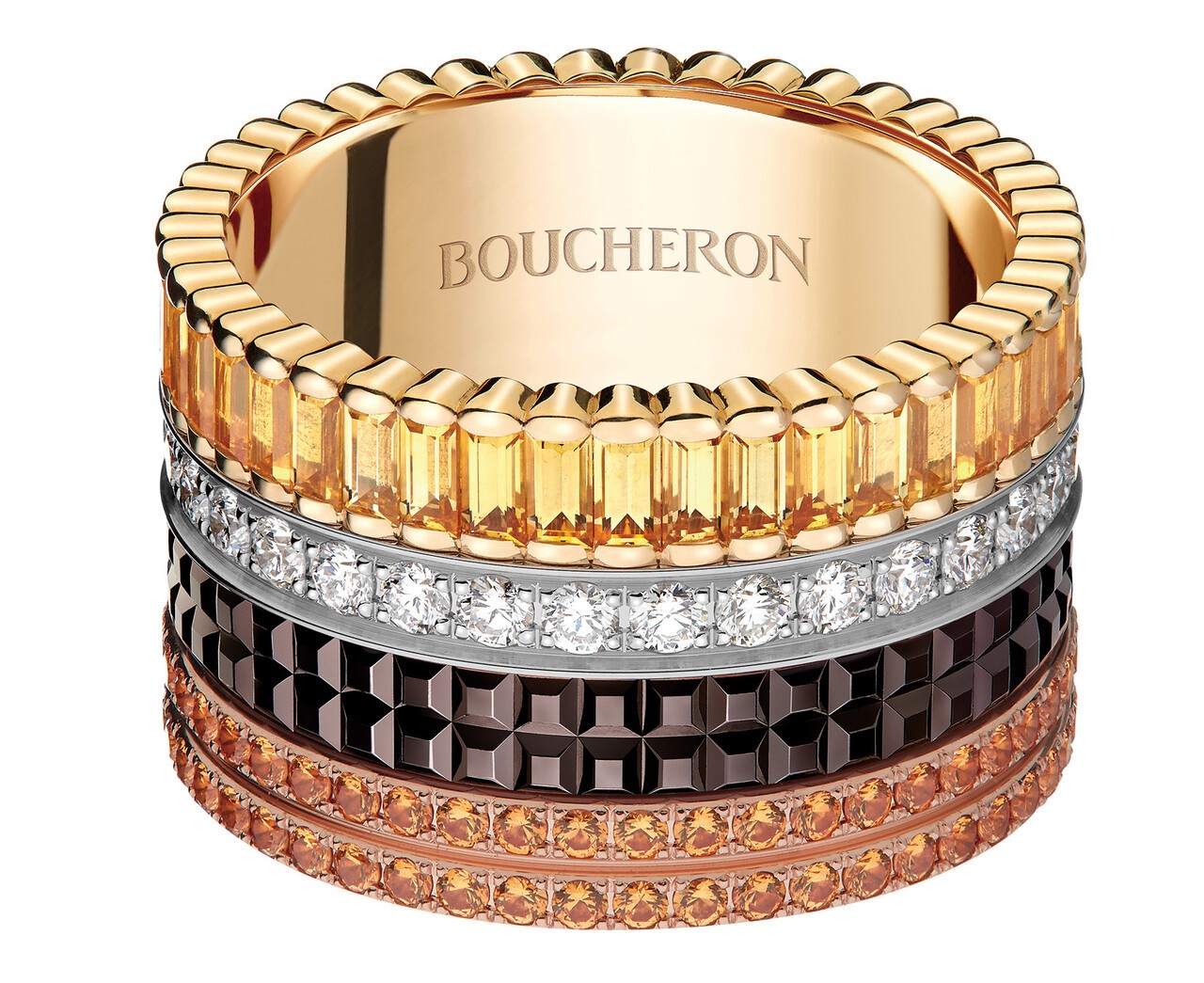
Boucheron’s representative icon, the Quatre collection, has established itself as a signature symbolizing the brand for 20 years since its birth in 2004. Quatre is a design that combines four symbolic codes selected from the Boucheron archives into a single ring structure, proposing a new concept of urban jewelry encompassing both women and men.
Boucheron CEO Hélène Poulit-Duquesne emphasized the iconic value of Quatre.
The four core codes constituting Quatre are: Double Godron, inspired by architectural columns and symbolizing the union of two beings and eternal bonds; Clou de Paris, a facet texture reminiscent of the cobblestone streets of Place Vendôme, visually revealing its Parisian origin; Diamond Line, continuing since 1892, which emphasizes the brilliance and eternity of stones through mirror setting, symbolizing technical prowess as a high jeweler; and finally, Grosgrain, a texture inspired by ribbons, reflecting couture sensibility and delicate craftsmanship.
Strategically, the importance of Quatre is clear. By condensing the brand’s history, origin, technology, and aesthetics into four codes, it completed a structure that explains Boucheron’s identity through a single icon. Furthermore, its design, which breaks down the boundaries of gender and style, precisely aligns with the core trends of the 2026 luxury market: genderless and daily wear. The manufacturing method combining traditional craftsmanship with digital processes, and the application of innovative materials like High Ceram® and PVD, are also key elements that make Quatre ‘a heritage of the past and a future strategy’.
Founded in Paris in 1906, Van Cleef & Arpels is a high jewelry maison that has grown around a poetic worldview inspired by love, luck, and nature. The brand, which began with the marriage of Alfred Van Cleef and Estelle Arpels, established a boutique at 22 Place Vendôme, setting meticulous standards for craftsmanship and the finest gemstones. Traditions like identifying gemstones under natural light and original techniques represented by Mystery Setting have positioned Van Cleef & Arpels as one of the world’s top high jewelry maisons.
The most symbolic icon at Van Cleef & Arpels is the Alhambra collection, born in 1968. Centered on the four-leaf clover motif symbolizing luck, this collection takes its name from the Alhambra Palace in Granada, Spain. Its simple yet balanced silhouette, gold frames finished with bead setting, and combination of natural stones like mother-of-pearl, onyx, and carnelian have made Alhambra a timeless design.