Editor’s Note
This article explores the growing market for synthetic diamonds, which are chemically and optically identical to their mined counterparts but created in laboratories. As these stones gain certification and consumer acceptance, they present a significant shift in the traditional jewelry industry.
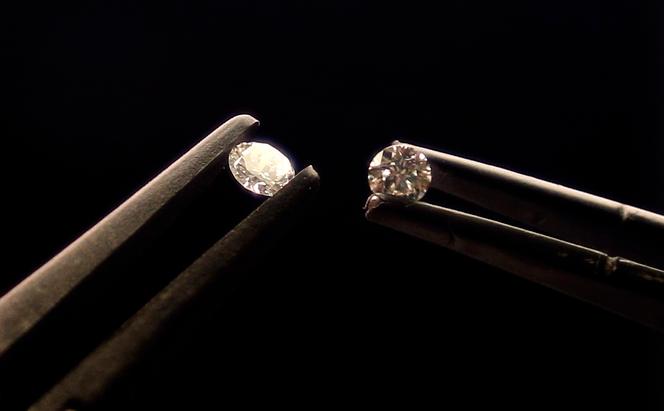
Diamonds are a girl’s best friend, sang Marilyn Monroe. Are their synthetic versions too? These perfect reproductions of the world’s most precious stone are shaking up the jewelry market. Their physical, chemical, and optical characteristics are identical. They are not fakes, but real diamonds, with the sole detail that they do not come from the depths of the Earth but from a laboratory. They can even come with a certificate attesting to their synthetic origin.
These two diamonds are each 0.41 carats: to the naked eye, one cannot distinguish the natural stone (left) from the artificial one.
While they are primarily intended for industry, they have also been feeding the jewelry market for about a decade. However, it is impossible to quantify this proportion. Estimates range from a few thousand to nearly 3 billion carats.
says Rob Bates, director of the professional online magazine JCK Online.
According to one of the few official estimates, established by the Gem & Jewellery Export Promotion Council, the annual production of synthetic diamonds would be around 350,000 carats per year (compared to about 150 million carats for natural rough), which would represent, in value, between 45 million and 135 million dollars (between 39.4 million and 118 million euros).
clarifies Rob Bates.
states Olivier Segura, director of the French Gemmology Laboratory (LFG) in Paris.
confirms Eddy Vleeschdrager, expert and founder of the Gemmology Institute of the Hoge Raad voor Diamant school and training institute in Antwerp.