Editor’s Note
The rise of lab-grown diamonds is reshaping the global gem industry, challenging traditional notions of value and luxury. This report from Surat, India’s historic diamond hub, explores the economic and cultural divide between the established mining sector and this burgeoning synthetic market.
A new kind of diamond is gaining traction in Surat, India’s oldest diamond city. And it is set to change the entire game.
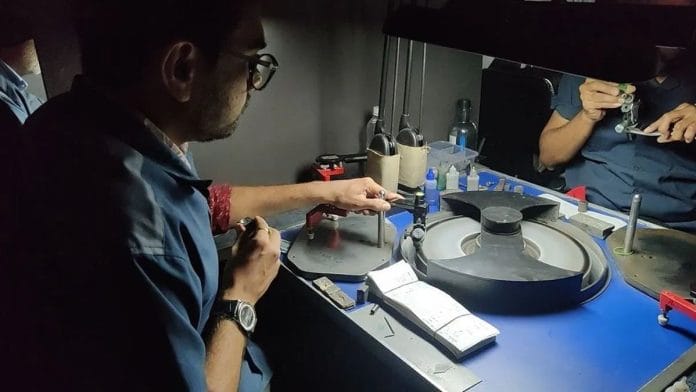
Lab-grown diamonds require the same hours of design and cutting labor, but cost a fraction—just one-tenth—of mined diamonds. The industry is divided between the old and the new, between what is proven to be precious and what is yet to have its value established.
India is fully prepared for the global excitement and demand surrounding lab-grown diamonds. It is a major market leader, exporting to the United States, the United Arab Emirates, and China. The industry began growing in 2018 and has since expanded sevenfold. Due to the economic slowdown caused by the COVID-19 pandemic, India exported $1.3 billion worth of lab-grown diamonds in 2021-22, a 106.46 percent increase compared to the $636.44 million trade in 2020-21.
While the pop culture notion of a diamond being “a girl’s best friend” still dominates, the ‘extreme rarity’ of mined diamonds may now be a thing of the past. Similar to the rise of lab-grown meat in the West, ethical consumer behavior is also a key driver boosting lab-grown diamonds in the market.
For specially designed diamonds, the marketing hook lines will be *different from before*. Instead of the old romantic lines like ‘forever’—think ‘I know I can make an impact’ and ‘diamond made, not mined’.
However, one solid issue divides diamond companies regarding this diamond. A division that is not limited to any particular region but touches every area where diamonds exist. This is how the diamond was born. In Surat, the global hub of diamond manufacturing, a ballpark of companies—5 large and 20 small—are in the business of making synthetic diamonds, most of which are exported abroad.
Since their common birth in the 1950s, lab-grown diamonds have begun to be adopted by major watch and jewelry companies. This includes De Beers, the prestigious jewelry brand long known for coining the popular slogan, ‘Diamonds Are Forever’. In 2018, the company entered the growing space through its lab-grown diamond label, Lightbox. The figures emerging from India are also evidence of this rapid growth. According to the Gem & Jewellery Export Promotion Council (GJEPC)—the industry’s government-supported apex body monitoring jewelry exports—India exported $216.07 million worth of lab-grown diamonds in the financial year 2017-18. The latest figure (between April 2022 and February 2023) was $1.5 billion, showing a sevenfold increase over the past six years.
It has been *scientifically proven* that the difference between mined and lab-grown diamonds is negligible, but the price of a lab diamond is about one-tenth compared to the original ‘super beautiful’ and ‘hard-to-find’ diamond. However, producers say this is just the initial stage for these gems and its lower price is its strength.
Last year, the company created a 27.27-carat marquise step-cut diamond, claimed to be the world’s largest lab-grown polished diamond. Greenlab was one of the first movers in this field, coming from its five-decade experience in the mined diamond business. Patel says they decided to move towards lab-made stones because they believed consumers would be drawn to it.
It started buying lab-grown diamonds in 2016 and began growing and cultivating them through its own reactors in early 2018.
Closer to home, the picture is a bit different. Patel says the share of cultivated diamonds in the Indian market is “very, very, very small” compared to traditional diamonds.