Editor’s Note
This overview outlines the essential structure and evolving capabilities of modern fire trucks, highlighting their specialized design for firefighting, rescue, and disaster response.
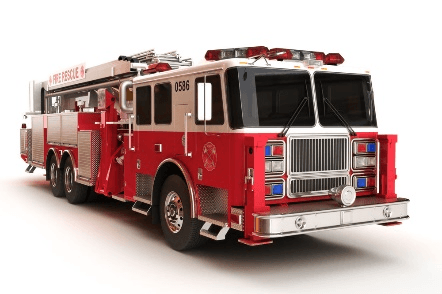
Fire trucks are specialized vehicles designed to perform complex tasks such as firefighting, rescue, and support at fire and disaster scenes. Their basic structure consists of a multifunctional module built on a chassis, including a pump unit, water supply and firefighting equipment, power generation devices, communication equipment, warning lights, and storage for rescue tools.
In particular, modern fire trucks are equipped with chemical agent tanks, high-pressure mist nozzles, and automatic fire suppression systems for oxygen-enriched environments, requiring advanced flexibility to respond to diverse disaster types such as urban fires, wildfires, and chemical fires. Furthermore, integration with digital devices, including vehicle-mounted communications and drone coordination systems, is progressing. Fire trucks are evolving from mere firefighting equipment into mobile platforms that serve as the “core function for on-site command and response.”
Structurally, they possess high safety, durability, and environmental resistance, and are also designed to minimize environmental impact at disaster sites. In response to the demands of a decarbonized society, the shift towards electrification and hybridization is beginning in various countries.
Fire trucks are primarily procured by the public sector, but their manufacturing and operation require a supply chain and technological integration spanning multiple industries such as automotive, machinery, chemicals, electronics, communications, and construction. In other words, the evolution of fire trucks is enabled by the implementation of cutting-edge technologies from various fields, making it a result of cross-industry innovation.
Particularly, the increasing prominence of social challenges such as urban densification, aging populations, and climate change has further heightened the importance of disaster prevention and mitigation. As capabilities to respond to floods, large-scale fires, earthquakes, and chemical accidents are tested, the functional expansion and equipment sophistication of fire trucks have become urgent priorities.
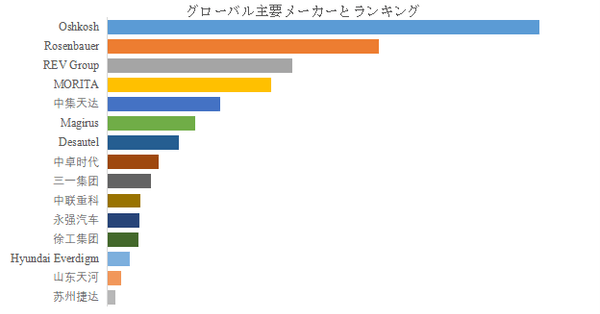
According to LP Information’s Top Companies Research Center, global leading manufacturers of fire trucks include Oshkosh, Rosenbauer, REV Group, MORITA, CIMC Tianda, Magirus, Desautel, Zhongzhuo Shidai, Sany Group, and Zoomlion. In 2024, the world’s top five companies held approximately 49.0% of the market share in terms of revenue.