Editor’s Note
This article discusses the EU’s latest sanctions deliberations, highlighting a shift toward targeting evasion and transit routes. The focus appears to be moving beyond earlier speculation about specific sectors.

On Friday, the European Commission held a closed-door briefing on a new round of sanctions against Russia, inviting EU ambassadors to participate in the discussion. Prior to the official release of the new sanctions package, there were numerous market rumors suggesting the EU would target Russia’s diamond and nuclear energy sectors. However, according to the latest report from Russian news agency TASS, the new 11th package of anti-Russian sanctions may prohibit the transit of certain goods through Russian territory, such as a range of high-tech products and certain vehicles. Additionally, approximately thirty Russian entities and institutions will be added to the sanctions list, but Rosatom, Russia’s key nuclear energy corporation, is not expected to be sanctioned. This aligns with European Commission President Ursula von der Leyen’s statement last month that the new sanctions plan would focus on combating the circumvention of existing sanctions and restricting Russia’s supply of spare parts and equipment for the battlefield.
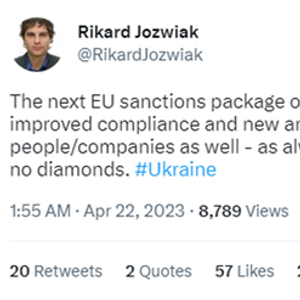
Furthermore, Radio Free Europe journalist Rikard Jozwiak posted on Twitter that the next EU anti-Russia sanctions package will focus on improving the effectiveness of sanctions and adding sanctions against some individuals and entities, but as expected, it will not include nuclear energy or diamonds. According to comprehensive foreign media reports, Belgium, home to the world’s largest diamond trading center, successfully dissuaded the EU from banning diamond imports from Russia. Meanwhile, France and Hungary strongly opposed plans to ban imports of Russian nuclear fuel and services. Supporters of a nuclear ban include Germany and the Baltic states. As of now, the EU has not disclosed the formal 11th package of anti-Russian sanctions.
According to an informal document proposed by the four countries (Germany and the three Baltic states) advocating for a ban on Russian nuclear fuel, Russia currently supplies 20% of the materials needed for the operation of EU nuclear reactors. The strongest opposition to a Russian nuclear ban likely comes from Eastern Europe. The Czech Republic, Slovakia, Finland, and Bulgaria operate Russian-made nuclear reactors, which would struggle to continue functioning without Russian nuclear fuel. Hungary, after sanctioning Russian fossil fuels, has strengthened its ties with Russian nuclear energy and has repeatedly demanded that the EU exempt the normal flow of Russian nuclear energy within EU countries. France, as a traditional nuclear power, also has frequent commercial dealings with Russia’s nuclear sector, making it difficult to find alternative partners in the short term.
Additionally, Russia is one of the world’s largest diamond suppliers and a crucial source for Belgium. One-quarter of the rough diamonds imported annually by Antwerp’s diamond industry come from Russia’s Alrosa mines.
This has led a growing number of EU officials to privately admit that in the new sanctions package, the EU may have few options left that can strongly impact Russia and gain unanimous approval from EU member states. This point was publicly acknowledged by EU chief diplomat Josep Borrell, who stated that the EU has almost exhausted its punitive measures against Russia, and the EU’s attention needs to shift to financial and military support for Ukraine.