Editor’s Note
This article highlights the expanding reach of global conflict mineral regulations, as major U.S. tech firms begin due diligence on their supply chains ahead of new U.S. rules. It underscores how international frameworks are translating into concrete corporate actions with direct implications for suppliers worldwide.

Earlier this year, 25 major U.S. companies including Apple, IBM, Dell, and HP requested information from Korean companies supplying core components regarding their use of conflict minerals. This marks the start of preliminary investigations ahead of the implementation of the ‘U.S. Conflict Minerals Regulation’ next year.
Conflict minerals refer to resources from countries like the Democratic Republic of the Congo in Africa, where ongoing internal conflicts are funded by selling resources abroad. The proceeds are used to purchase weapons, hire soldiers, and commit atrocities against civilians. To prevent this, international organizations like the United Nations (UN) and the Organisation for Economic Co-operation and Development (OECD), along with non-governmental organizations (NGOs), are imposing sanctions. Similar to regulations on ‘blood diamonds’—diamonds produced in conflict zones used to fund wars or terrorism—restrictions are being introduced by Western developed nations.
The United States is undoubtedly the fastest-acting country. Under the Dodd-Frank Wall Street Reform and Consumer Protection Act, which included a conflict minerals provision (Section 1502) enacted in July 2010, the U.S. Securities and Exchange Commission (SEC) announced its final rule on August 22, 2012. According to the rule, SEC-listed companies become directly obligated to disclose for the first time by May 2014 whether their products contain conflict minerals. Korean export companies supplying raw materials, parts, materials, and semi-finished goods to the global production and sales bases of these SEC-listed companies are also indirectly obligated to report, having received verification requests regarding conflict mineral use since 2012.
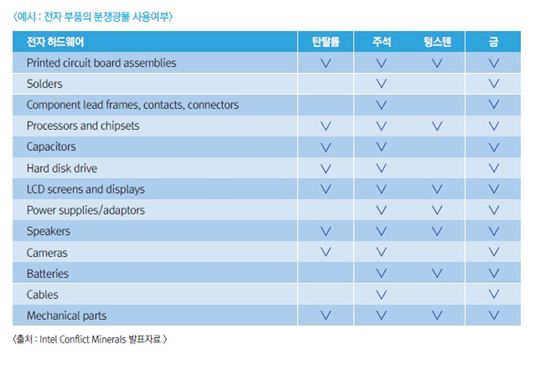
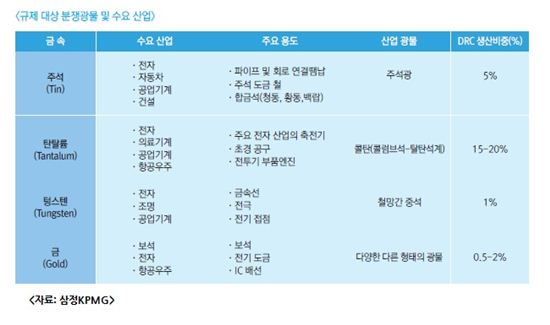
The regulated minerals are tin, tungsten, tantalum, and gold produced in the Democratic Republic of the Congo and nine neighboring countries. Companies must file a Specified Disclosure Report with the SEC annually by May 31st, stating whether their products were manufactured using conflict minerals. Korean exporters must align with the reporting schedule of SEC-listed companies, leading to earlier due diligence requests—hence the actions by the 25 U.S. companies earlier this year.

The conflict minerals regulation affects numerous industries, including mobile phones, home appliances, and automotive parts. It impacts not only U.S. listed companies with direct disclosure obligations but also their suppliers and subcontractors through verification requests.
For Korea, the top 15 export items to the U.S. in 2011 accounted for 72.5% of total exports to the U.S. Most of these items, with few exceptions, are expected to be affected by the conflict minerals regulation.
Therefore, Korean manufacturers of semiconductors, LCDs, batteries, electronic components, and automotive parts supplying to U.S. electronics, automotive, aerospace, and defense industries must disclose the origin of minerals used and prove whether minerals from conflict regions were used.
If unable to prove non-use of conflict minerals, companies may face pressure from U.S. listed companies to change suppliers. If products are found to contain conflict minerals despite guarantees to the contrary, companies could face damage claims due to reputational harm.
Samjung KPMG explained that to prove whether minerals from conflict regions were used, companies need to establish internal organizations for compliance, map their supply chains (e.g., tracing minerals used in circuit boards back to the smelter), identify the origin of purchased raw materials and parts, and develop and implement compliance policies.
As guidance, the U.S. conflict minerals regulation allows the use of the OECD’s Due Diligence Guidance. According to this guidance, companies should establish internal policies related to conflict minerals, obtain necessary compliance information through their supply chains, establish internal control structures to achieve reasonable assurance regarding the received information, and, if necessary, conduct third-party audits to gain reasonable confidence in the collected information.
Furthermore, Samjung KPMG added that industries with complex supply chains or global exporters should not only seek cooperation from primary partners through existing procurement portals but also devise efficient methods to collect information from secondary and tertiary partners by utilizing public IT infrastructure and human resources (training, implementation, supervision) from government and industry associations for more thorough responses.
The conflict minerals regulation reflects a shift in U.S. corporate regulation patterns toward disclosure-centric obligations. It does not impose a mandatory ban on conflict minerals but rather mandates corporate self-disclosure of conflict mineral use and reduction efforts, allowing consumers to make informed decisions.
Moreover, beyond the U.S., the European Union (EU), Canada, and Australia are also moving to legislate conflict minerals regulations, indicating a trend toward global regulation. This respects declarations by the UN and OECD that companies worldwide must act as global citizens, not just adhere to regional morality for U.S. companies.