Editor’s Note
**Editor’s Note:** This article explores the innovative French brand Deux Brins, which uses patented technology to transform DNA into a tangible piece of jewelry, offering a deeply personal way to preserve the memory of loved ones.
Thanks to patented technology, DNA becomes an intimate and tangible object of memory.
Thanks to patented technology, DNA becomes an intimate and tangible object of memory.
In Aigues-Mortes, Gard, a start-up is transforming the intimate into a precious object. Deux Brins offers to preserve a DNA sample in a piece of jewelry. An old idea, born in the mind of a geneticist, now realized thanks to patented technology and French know-how.
Sylvain, a doctor in genetics and former expert for the gendarmerie, imagined twenty years ago an object capable of maintaining a physical link with his loved ones while he was on missions abroad. In 2023, he founded Signature ADN with two associates, marketing its creations under the Deux Brins brand. The three co-founders call themselves “bijoulogists,” a deliberate crossover between molecular biology and artisanal jewelry.
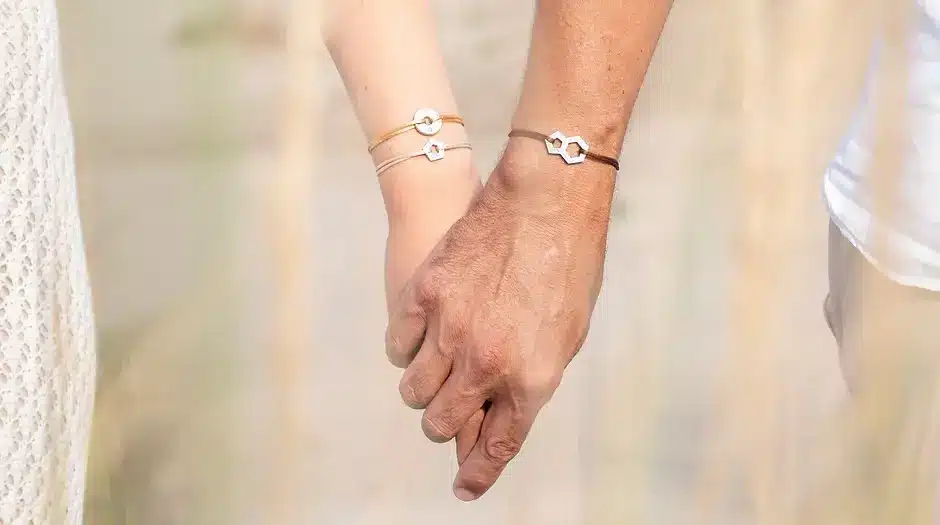
The process begins with a saliva sample, taken at home using a kit. The DNA is then extracted, purified, and deposited on a one-millimeter diameter disc, encapsulated in a compartment sealed by a transparent sapphire glass. No sequencing, no analysis: the DNA is simply preserved, visible, and fixed. The whole is integrated into bracelets or pendants designed and manufactured in France – assembly in Gard, medals crafted in Morteau.
The customer journey follows a well-oiled mechanism. Choice of jewelry online, receipt of the kit, return of the sample, validation of the collection, then manufacturing. Four to six weeks of waiting. Each piece of jewelry is delivered in a textured white case, marked with a golden polygon, with a certificate of authenticity.
Three models are offered: Nobel (from 378 euros), Louisa (343 euros), and Rosalind (203 euros). Each piece can incorporate up to four “eternity shards,” i.e., as many DNA samples. Positioning: between high-end commemorative jewelry (up to 1500 euros) and entry-level souvenir jewelry (around 20 euros). The materials used – medical-grade titanium, Polymiroir technology – and the lifetime guarantee reinforce the qualitative positioning.
Deux Brins rides a double trend: personalization and emotional attachment. In 2023, the global personalized jewelry market was worth nearly $28 billion, growing rapidly. In France, the jewelry and goldsmithing sector represented 5.38 billion euros in revenue, up 17% year-on-year. The niche of jewelry containing hair, breast milk, or ashes appeals to a clientele seeking meaning. Deux Brins goes further: it does not preserve a visible trace, but the genetic information itself. A fundamental difference.
Legally, the company navigates between the lines. French law strictly regulates DNA tests. But here, there is no analysis. The company insists: it merely preserves a fragment of DNA, without scientifically exploiting it. A detailed FAQ on the site explains the process. The method is more akin to preserving a lock of hair.
To broaden its audience, Deux Brins relies on ambassadors: Sophie Davant, Camille Lacourt, Frank Leboeuf, and Jeanfi Janssens. All symbolize values of family, transmission, or authenticity. A strategy of embodiment to humanize a complex product.
The brand claims three pillars: ethics, emotion, and excellence. Unused samples are destroyed. Manufacturing is local. The vocabulary used – “bijoulogist,” “eternity shard” – creates a universe that blends scientific rigor and marketing poetry. The goal: to create a tangible link with those who matter, living or deceased.
But innovation is not everything. The young company still has to overcome several obstacles. The concept may raise reluctance. Wearing a loved one’s DNA around one’s neck is not self-evident. The artisanal model limits production capacity. And competition could emerge. Another company, Orygen Experiences, is already exploring the same territory.
Deux Brins currently targets a premium clientele, attached to exclusivity and technology. In the long term, the brand could expand its offering to more accessible segments. It also envisions international development, particularly in Asia, subject to a compatible legal framework. Another avenue: the integration of blockchain or connected technologies to enrich the experience.
The start-up is part of a broader transformation of the sector. 3D printing, digital modeling, traceability: jewelry is entering the 4.0 era, where innovation does not replace the gesture but extends it. Deux Brins ticks all the boxes of this convergence between craftsmanship and science.