Editor’s Note
This article revisits the 2019 Sotheby’s Hong Kong auction of an exceptionally rare 88.22-carat oval diamond, exploring its historic significance and the market forces behind its record-breaking sale.
A Rare Diamond That Drew Attention at Sotheby’s Hong Kong in April 2019
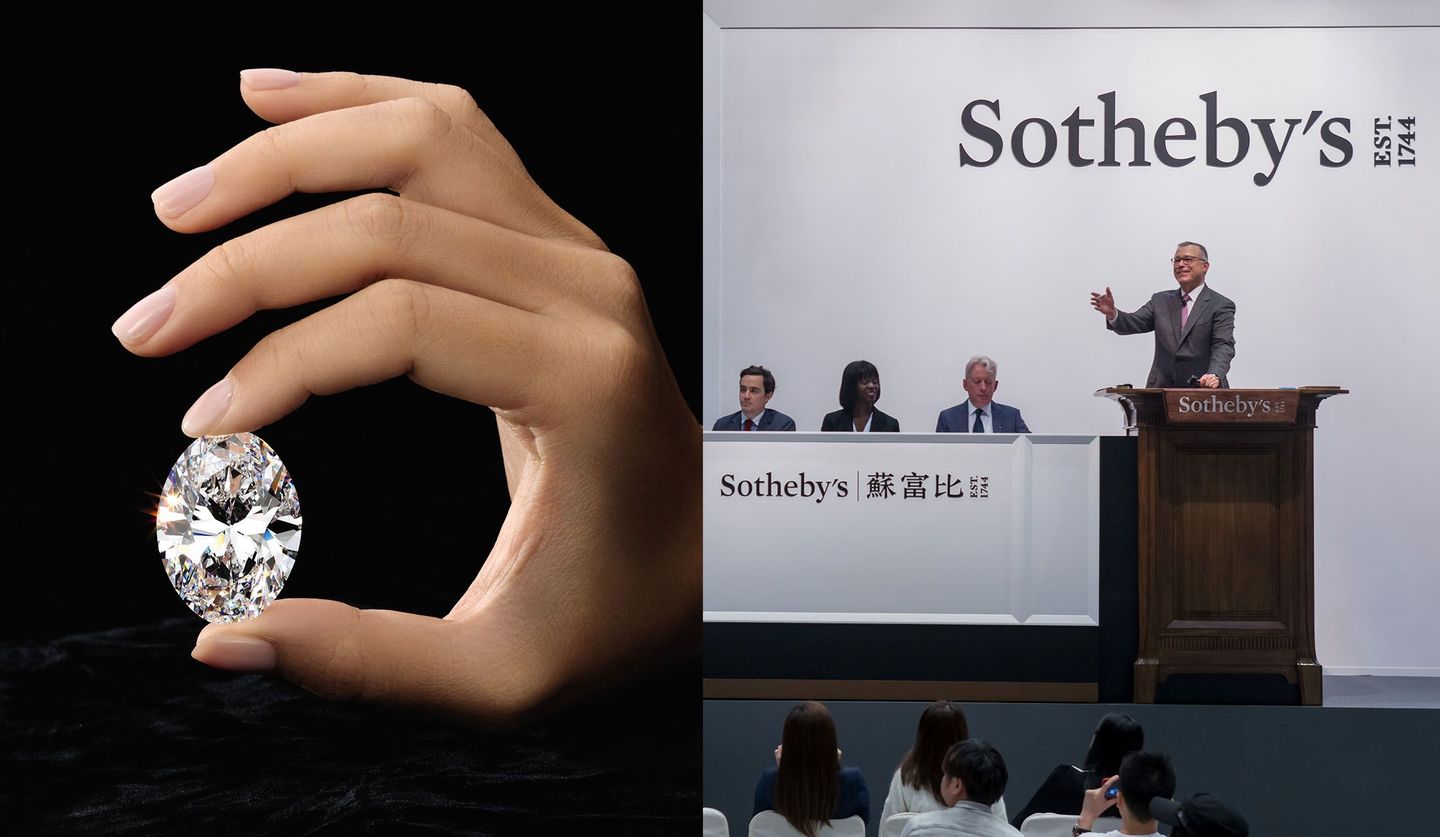
The 88.22-carat diamond that drew attention at Sotheby’s Hong Kong in April 2019 was a rare piece, being only the third oval diamond over 50 carats to appear in auction history. Amidst a bidding war among three Asian individuals, a Japanese collector ultimately won it for 1.53 billion yen.
We spoke with Patti Wong, Chairman of Sotheby’s Asia, and Akiko Uemura, Client Services Manager of Sotheby’s Jewelry Department, about the diamond’s value, the scene on the day, and the future of Sotheby’s Hong Kong.
Why was this miraculous diamond offered in Hong Kong? The world’s largest diamond, fetching 1.53 billion yen
Q. Please tell us specifically how rare and valuable this diamond is.
“This diamond has achieved the highest rank in all four Cs—Color, Clarity, Carat, and Cut—the evaluation criteria. The color is completely colorless, a ‘D Color,’ the highest grade for white diamonds. The clarity is ‘Flawless,’ meaning there are no inclusions or blemishes internally or externally even under 10x magnification. The cut, polish, and symmetry are all ‘Excellent’ and perfect. Furthermore, it is a Type IIa oval-cut diamond, the same type used in the British Crown Jewels. It belongs to the rare category comprising less than 2% of all diamonds, made of pure carbon without nitrogen impurities. Essentially, it is characterized by extremely high transparency.”
Q. Please tell us why such a precious diamond was offered at Sotheby’s Hong Kong among all places in the world.
“We see a characteristic among clients in the Asian region of ‘seeking the highest quality.’ Compared to other auction locations, there is a particular tendency for high-quality items like this diamond to be in demand here. Moreover, this diamond is 88.22 carats. In Chinese and other Asian cultures, the number 8 symbolizes ‘perfection, prosperity, and eternity’ and is considered lucky. Having double eights like 88 is said to bring abundant happiness, which is why it was decided to offer it in Hong Kong this time.”
Three Asians competed, and it was sold for a price exceeding the estimate
Q. The winning bidder seems to have decided to bid after the preview. What aspects of this diamond captivated them?
“The client who won the bid first saw this diamond at a Sotheby’s preview held in Tokyo on March 19, 2019, where a selection of the jewelry and watches to be offered can be viewed. They were reportedly impressed by the extraordinary transparency and imposing size, something that can only be felt when seeing the actual piece. Also, this being only the third time an oval diamond over 50 carats has appeared in auction history likely contributed to their decision to bid due to its rarity.”
Q. Please tell us about the atmosphere in the venue and how the bidding unfolded.
“This diamond was contested by three Asian bidders. While there are various bidding methods—in-person bidding by raising a paddle at the venue, telephone bidding, or online bidding via the web—all three bidders this time used telephone bidding. For such rare diamonds, we require pre-registration for bidding. Once the auction started, the three agents took turns raising their bids. Given the high value, the auctioneer proceeded cautiously and slowly. A somewhat tense mood filled the venue, with everyone present watching the outcome. The bid increased by about 2 million Hong Kong dollars (approximately 28 million yen) each time. The estimate was 1.2 to 1.4 billion yen, but after about 7 minutes, it rose to 1.53 billion yen (including fees) and was finally won by a Japanese collector.”
Sotheby’s Hong Kong market expands across Asia
Q. Let’s talk about Sotheby’s Hong Kong. Compared to Geneva, New York, and London, what are its unique characteristics?
“Sotheby’s Hong Kong started in 1973. A jewelry auction specializing in jadeite began in 1989, and by 1995, it included jewelry beyond jadeite. Compared to other cities, a characteristic here is the higher proportion of individual wealthy clients versus professional dealers. Initially, the jewelry auction market in Hong Kong centered on clients from Hong Kong, Taiwan, and Singapore, but it has rapidly expanded to include Japan, China, Indonesia, Thailand, Malaysia, and others.”
Q. If there have been changes since the startup phase, please tell us.
“One notable change is the increase in online transactions. In May 2019, we held our first online-only jewelry auction in Hong Kong. The feature is that one can bid by viewing our website without visiting the venue, and many items are in price ranges that are easy to try. This is growing, particularly among younger demographics. In 2018, the company’s total online sales reached approximately 24 billion yen (including all fields beyond jewelry), accounting for 37% of the total number of sales.”
This transaction, where a Japanese buyer won the 88.22-carat diamond for over 1.5 billion yen, proves the high demand for top-quality diamonds in Asia and marks another new record for Sotheby’s worldwide.