Editor’s Note
This dispatch from Afghanistan’s Panjshir Valley reveals the perilous reality behind the global gem trade, where former professionals like Mohammad Israr Muradi brave extreme conditions in a desperate daily search for emeralds. The scene underscores the profound human cost and economic fragility in regions rich in resources yet plagued by instability.
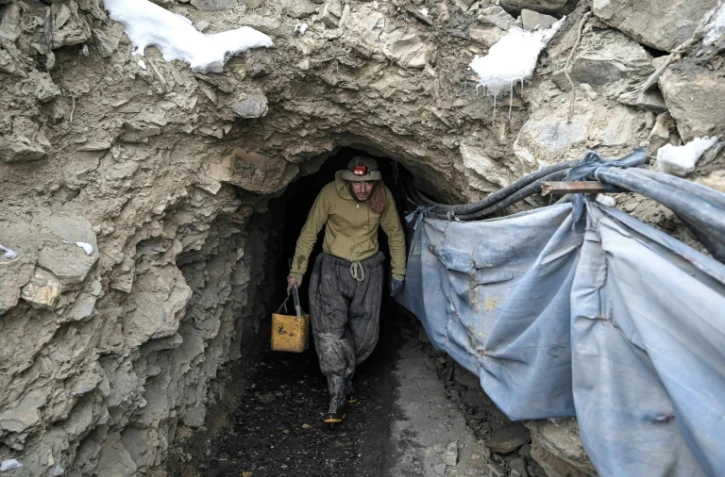
In biting cold at over 3,000 meters altitude, Mohammad Israr Muradi scrapes the earth with a little water and an improvised sieve. If he is lucky, the former policeman will find a few crumbs of emerald that he will resell for a handful of afghanis. (Photo: AFP)
Like him, dozens rush forward whenever a trolley filled with rocks emerges from one of the countless shafts plunging into this mountain in the Mikeni valley, in Panjshir, about 130 kilometers northeast of Kabul.
Like many former police and military personnel, he suddenly found himself without work when the Taliban came to power in mid-August, following the fall of the former US-backed government.
Mohammad Israr Muradi then invested a few thousand afghanis and tried his luck as a street vendor of second-hand clothes in Kabul.
But “it didn’t work,” and without money, he was “forced” to join the mine where, like all newcomers, he is content with the most thankless and lowest-paid work.
While the presence of emeralds in Panjshir has been known for millennia, serious exploitation only dates back to the 1970s and remains largely artisanal, even though its quality and purity are often compared to Colombian emerald, the most sought-after in the world.
In Mikeni, as in the other mines in the region, each shaft is co-owned by several dozen partners and operated by a team of about ten miners.
The shafts, which sometimes go down more than 500 meters, are dug with explosives. To reach the site from the bottom of the valley, one must climb via a track traced in the snow, crisscrossed by horses and donkeys bringing necessities, from food to generator engines.
It is, among other things, this difficulty of access that convinced Gulabuddin Mohammadi to work in Mikeni. Of the Afghan army, where he served for seven years, he remembers it was “a very good job” paying 35,000 afghanis (295 euros at the current rate) per month.
At the mine, in comparison, “we are treated like cattle,” sighs the 27-year-old man, before listing: “We don’t have a real place to live, we are under tents. We have no water, no fire, no clinic if we get sick.”
But Gulabuddin Mohammadi had no choice: “I have the responsibility to feed the 25 members of my family.” According to him, many other former soldiers or police officers have come to work there, not knowing very well what the attitude of the country’s new masters would be towards them.
Upon their return to power, the latter had decreed a general amnesty, but several NGOs have since reported the execution or disappearance of former security force members.
The Taliban did go up to the mine once. It was shortly after they came to power, recalls Mohammad Riyah Nizami, a senior Kabul police officer who worked in Mikeni.
A steep and hard-to-access valley, Panjshir is a historic bastion of resistance against the Taliban and the last region to fall under the total control of the Islamists at the end of September.
Mohammad Riyah Nizami also remembers the anxious journey from Kabul to Panjshir, the “fear of a misunderstanding” at the numerous checkpoints where travelers’ phones were inspected.
He was lucky: his job, found by a friend, consisted of pushing the cart. A little more stability, 400 afghanis per day, and a small bonus if they found a vein.
But as soon as he could, recalled to Kabul by the Taliban who needed his computer skills, he returned. What Mohammad Israr Muradi is also ready to do, as the Taliban have said they want to rebuild the Afghan army and police. For years, his job was to pursue the Taliban, but today, he confides, “if they call me back to work, I’ll go.”